MEET THE DUO BEHIND THE CREATIVE DESIGN STUDIO ACIL & PIERRE
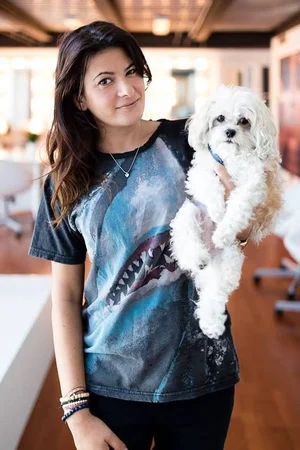
Pierre
Acil Benamara and Pierre Mallart met at Penninghen, Paris, in their first year of art direction. They have been collaborating ever since. In 2019, after years of working together on school projects, the studio was the obvious next step. In 2021 they settled in the Marais — Paris's art district. They work in the cultural field, especially the art world, and in luxury and fashion with houses including Chanel and Hermès.
Born and raised in Algiers, Algeria. At 17, moved to Paris to study at Penninghen. Grew up in a family of scientists: rationality, good measures, and perfect balance have always been necessary in terms of design. Did her thesis under the supervision of Etienne Robial, who passed on his passion for "three fundamentals: shapes, colors, and alphabet." He also familiarized her with the great Swiss designers and the precepts of concrete art.
Grew up in the Paris area. Son of an illustrator father — immersed in the world of graphic design and the importance of image at a very young age. Always loved drawing. But it was in his older brother's record sleeves that his passion for graphic design truly grew. The record sleeve: a perfect fusion of music, image, and typography in the smallest possible format.
Tell us about your creative process.
We bring a conceptual approach. Our proposal for each topic should be radical and meaningful. The design must be reduced to the cleanest and most functional expression while containing essential elements of balance, harmony, and accuracy of proportions. Nothing should be superfluous. We use a smooth and elementary graphic language. The objective is to achieve a minimal aesthetic, with constant consideration of accuracy, care for detail, and visual efficiency.
We work around graphic systems that are usually quite rigid. It is the constraint that paradoxically opens the door for creative freedom. In addition, experimentation is a crucial aspect of our creative work. The interest lies in the visual surprise it can cause. We believe that playing fuels our conceptual thinking.
"It is the constraint that paradoxically opens the door for creative freedom."
What is your medium of choice?
We really like typography. Letters are, above all, a means of telling stories. Characters carry and distribute our thoughts. We do not define ourselves as typographers but rather as "typo-graphic designers." The letters we draw are shapes, modules, and rhythms before forming a word.
We design a lot of modular typefaces. They are composed of limited basic shapes held in a regulated layout. The principle of modularity allows the deconstruction of letters and multiplies the possibilities to play with the type. The importance of balance between shape and readability of the letter underlines what is seen and what is read.
Along with typography, we reflect and think with animation. Animation is an activation of elements. It allows us to reveal details and capture attention with an image. The rhythm and movement offered by animated images open possibilities to play and tell a story. Animation should not be anecdotal; it should serve a purpose.
The desire to use design as a tool for improving everyday life. The idea of functional design. The simplicity of shapes and colors. Designers of the Bauhaus inspire us to always go back to the basics, underlining the need for simplicity and practicality in artistic invention.
The radicality and sense of efficiency. The use of fundamentals is the best way to strive for timelessness. Grid, precision, the belief that function and form are not opposites but two aspects of the same act.
His work around form and colour constitutes a great graphic richness. His visual compositions provoke an impression of movement and characteristic optical vibrations between pleasure and displeasure. It is fascinating.
Galerie Kreo gave Acil & Pierre complete liberty to create. They chose three objects made exclusively for Kreo and gave them a graphic reinterpretation using lively colours and clean geometrical shapes, brought to life with motion — showing different perspectives, dynamic compositions with dancing shapes, and works related to illusions and psychedelic patterns.
The Italian luminary design selected as one of the inspiration objects. The historical weight of a mid-century design object translated into animated geometric form.
The Snake Mirror, made for Kreo exclusively. Reflective surface, organic form, and the graphic possibilities of a shape that moves even when static.
The P9. by Virgil Abloh, also made for Kreo exclusively. The kinetic energy of Abloh's industrial aesthetic meeting Acil & Pierre's modular language.
"Learn to see and to feel life; that is, cultivate imagination, because there are still marvels in the world, because life is a mystery and always will be. But be aware of it."
An independent platform dedicated to artists, musicians, photographers, designers, and thinkers at every stage, from emerging voices to established masters. Every interview is selected for depth, not reach.
✦ EXPLORE ALL INTERVIEWS →"We need to support alternative films, art, any artistic form that challenges mainstream."
More personal essays and cultural commentary from Leila Antakly, on art, politics, wellness, and the complicated business of paying attention.
READ ON SUBSTACK ↗