Cristóbal Schmal Illustration
Cristóbal
Schmal
He grew up in Arica, a dusty city in the Atacama Desert — one of the driest places on earth. He now lives in the countryside near Frankfurt. Along the way: Valparaíso, seven years in Barcelona, Berlin and its Bauhaus heritage. His work carries all of it: Latin American folklore, pre-Columbian symbolism, German modernism, collage, gouache, hand-painted paper.
"Chilean communist graphics from the 70s, engravings, posters, travels, old typography. German Modernism, films, literature and music."
Tell us about your creative process.
I mix natural elements — animals, plants — with urban scapes: cities, buildings, structures. To create analogies and contrasts between these two, and create new things. I'm always drawing in my sketch pad and I take some of those ideas to inspire my projects.
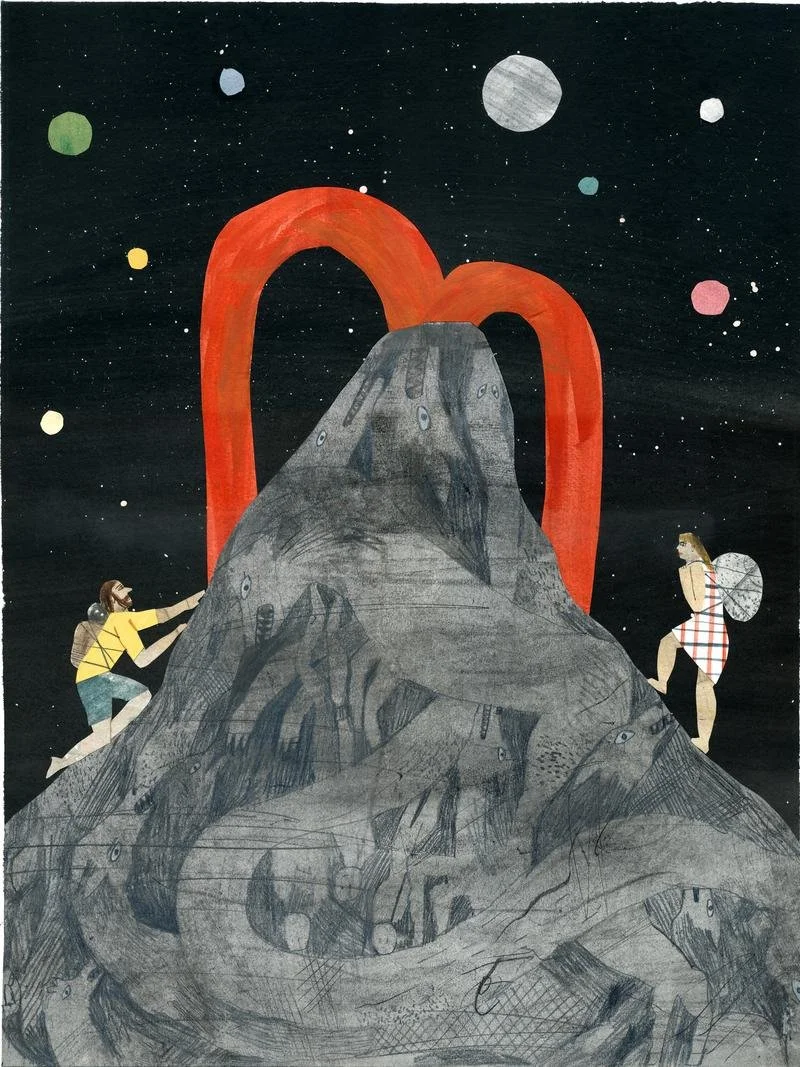
My work merges analogue and digital processes, often incorporating hand-painted papers, watercolour, gouache, and cut-paper collage to build textured, geometric imagery. The visual language draws from Latin American folklore, pre-Columbian symbolism, and personal mythologies. Through simplified forms, bold colour palettes, and intricate patterns, I construct poetic visual narratives that invite contemplative reading.
How is design in Latin America different from the US and Europe?
There is a difference in styles and shapes management, but the biggest difference in my opinion is the perception of colour. Latin American people like contrast palettes of colours — this is partly about the quality of light. In the equatorial regions and the desert north where I grew up, the light is intense and constant. It trains the eye differently than European seasons do.
Why has Berlin become such a creative hub in Europe?
Because of its history, its spaces, the low prices, and its strategic location in Europe.
What do you like most about living in Berlin?
I enjoy Berlin for its quality of life — people are relaxed. There is also a great tradition in terms of graphic design and illustration. And it's still cheap!
"There is a great tradition in terms of Graphic Design and Illustration concerns. And its still cheap!"
What would be a dream project for you?
I would really like to make a film, or some animation project. The work always moves — in my head the illustrations are already moving. The fixed image has always been, for me, a still from something longer.
The posters of Allende's Chile — bold, flat, urgent. A graphic tradition that fused political necessity with genuine visual invention, using limited means to produce maximum impact. Still one of the richest bodies of poster work in the world.
The Bauhaus tradition — the belief that design could improve life, that beauty and function were not opposites. The reason he made posters for Bauhaus Archive exhibitions and Bauhaus city tours in Berlin. The influence runs deep enough to become a project.
The accumulated visual knowledge of moving. Atacama to Valparaíso to Barcelona to Berlin to Frankfurt. Each place leaves its mark, not as tourism but as a shift in how the eye calibrates. Old type and engravings as evidence of every place that existed before the places he has lived.
A poster commission for one of the most important archives of the Bauhaus movement, made by an artist whose deepest influences include both the Bauhaus and the radical poster tradition of Latin America. The collision of those two lineages in a single image.
A walking tour of the Bauhaus legacy in Berlin, given a poster by an artist from Arica, Chile. Design as a genuinely international language, absorbed in different cities and returned in new forms.
Illustrations of Russian poets who lived in Baku, for a magazine in that city. Three geographies in a single commission: the poet's Russia, the city's Azerbaijan, and the illustrator's eye formed in Chile and sharpened in Berlin.
Since October 2022, Cristóbal Schmal has been teaching an online drawing course called Drawing Workout — a space for reflection, work, and experimentation around creative processes. The course is available at artnomono.com.
It is a practice, not a product. A weekly commitment to looking, to making marks, to understanding what drawing is for before understanding how to do it well.
He left Berlin for the countryside near Frankfurt in 2022, where he lives and works with his family. The trajectory — Atacama Desert, Valparaíso, Barcelona, Berlin, rural Germany — is not a story about restlessness. It is a story about what a practice needs at each stage: the city for formation, the other city for sharpening, the countryside for the long, slow attention that complex work requires.
What the Atacama teaches you about colour that Barcelona cannot
Cristóbal Schmal grew up in one of the driest places on earth. The Atacama Desert has a specific quality of light — fierce, shadowless in parts, ancient — that no European education can fully transmit. It sits in the visual cortex before language arrives and it shows up, quietly, in the palette choices and the formal decisions of everything he makes.
The Chilean communist poster tradition he cites is not an academic influence. It is a political and visual inheritance from a country whose graphic design had to be urgent, had to work, had to move people to act. That sense of visual necessity runs through his practice even when the commission is a magazine illustration for a publication in Baku about Russian poets.
He is now in the countryside near Frankfurt, teaching Drawing Workout to students around the world and working on whatever comes next. Follow his practice at artnomono.com.
An independent platform dedicated to artists, musicians, photographers, designers, and thinkers at every stage, from emerging voices to established masters. Every interview is selected for depth, not reach.
✦ Explore all our interviews →"We need to support alternative films, art, any artistic form that challenges mainstream."
More personal essays and cultural commentary from Leila Antakly, on art, politics, wellness, and the complicated business of paying attention.
Read on Substack ↗