The Art of
Fashion
Illustration
Once confined to the pages of glossy magazines and couture houses, fashion illustration now unfolds in real time across Instagram feeds, stories, and live sketches. What was once slow and rare has become immediate, visible, and constant.
The challenge is no longer simply to capture fashion. It is to be seen while capturing it. From the ateliers of Paris to the feeds of a new generation, these are the artists drawing the world as it moves.
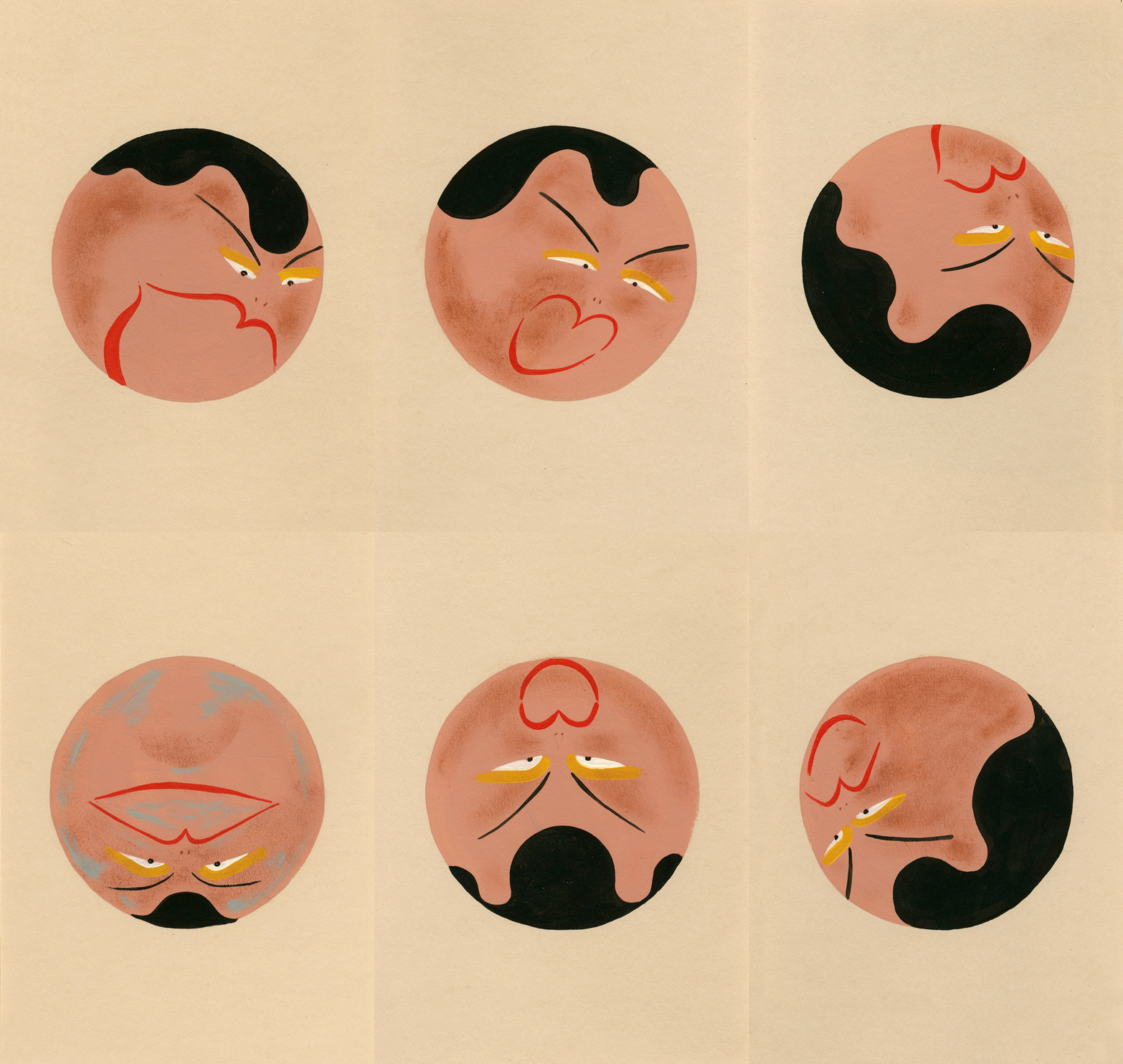
Scroll through and you will find conversations with Caroline Tomlinson, Naja Conrad-Hansen, Ana Jaren, Benjamin Lacombe, Marina Benito and many more. Let one interview lead you to another.
Illustrators like David Downton defined an era where mastery was measured in restraint. His elegant, minimal lines distilled fashion to its essence — an economy of gesture that mirrored the exclusivity of the industry itself.
Megan Hess built a global following through a refined, aspirational aesthetic that translated seamlessly into publishing, branding, and luxury collaborations. These were illustrators who operated within a system of scarcity. Access was limited, publication was selective, and visibility was mediated by institutions, magazines, maisons, and galleries.
Artists like Hayden Williams have built vast audiences by merging fashion illustration with celebrity culture, transforming red carpet appearances into instantly shareable digital sketches. Others lean into elongation and movement, creating figures that feel animated, designed to hold attention in a fast-moving feed.
What unites the best of this generation is not a shared style, but a shared instinct. Their work is instantly identifiable, designed to be consumed quickly yet remembered. People who understand not only how to draw, but how to distribute. The future will belong to those who understand the discipline of the atelier and the demands of the algorithm.
Tomlinson
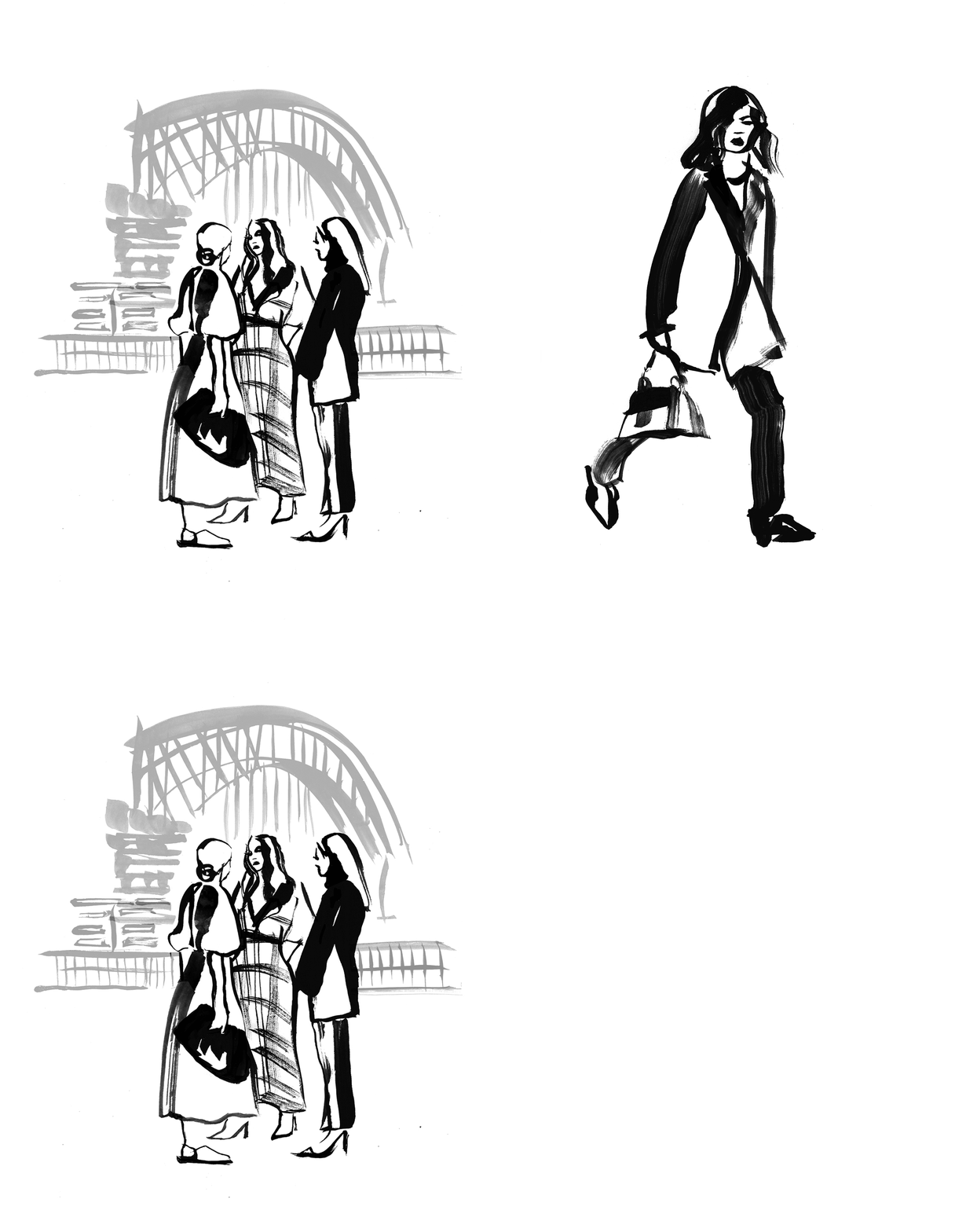
Fifteen years as a designer and art director before making the shift. A committed believer in happy accidents, working with ink, brush, and the spontaneous mark. Clients include Dior, Christian Louboutin, Marc Jacobs, Rankin, Vogue Arabia.
"I have a slight obsession with mark making and lines that have varying flow. The greats like Picasso and Matisse really understood how lines worked. I look at them constantly."
Read interview →Silk-screens, Max Mara, Louis Vuitton, and her own brand Meannorth. Selected four times for Lurzers Archive 200 Best Illustrators Worldwide.
Read interview →Girls with coffee, croissants, flowers. Daily life as a cosy world. Born in Seville, trained in Madrid fashion communication.
Read interview →Romanian folklore, psychedelic 70s, abstract expressionism, layered into something unmistakably hers.
Read interview →Founder of Hey Ladies fanzine. Vogue, Calvin Klein, The Barbican, Channel 4, Goldfrapp.
Read interview →Artist, textile designer, creative director. V&A print collection. Exhibited in London, Seattle, Rome, LA.
Read interview →Identity, body, and the personal as political, with colour as the primary emotional instrument.
Read interview →Some illustrators work at the very heart of the luxury fashion world, collaborating with the great houses themselves. Their work appears in the campaigns of Louis Vuitton, Cartier, and the couture ateliers, with a softer and more romantic sensibility that bridges fine art and commercial fashion.
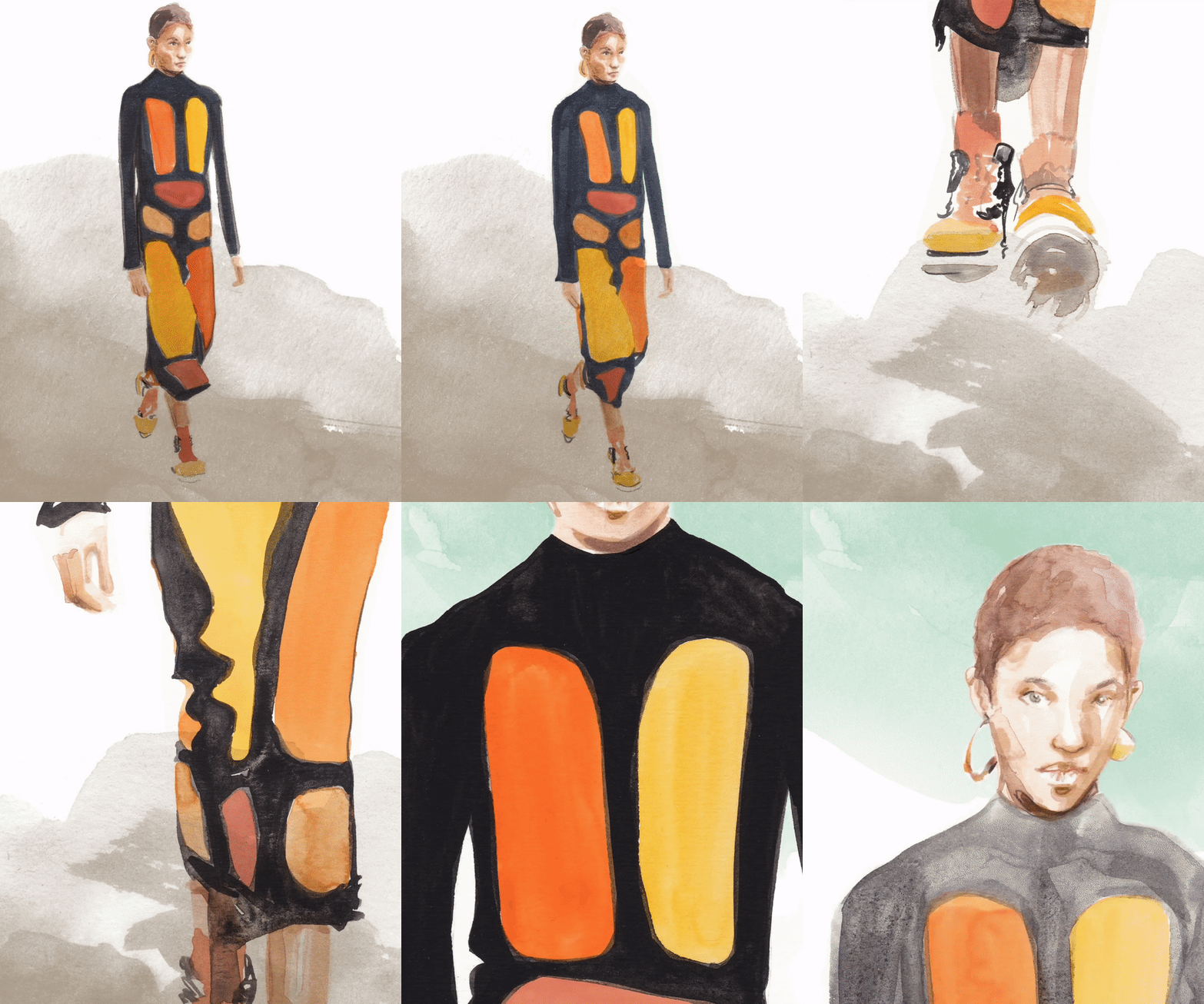
Featured by Vogue for interpreting couture collections through illustration. A tender, hand-drawn sensibility that finds the emotion in every cut and drape.
Follow → Featured by VogueKnown for bold silhouettes and expressive runway interpretations. Her line carries real authority, capturing the weight and movement of fashion with confident, decisive strokes.
Follow →Graphic designer and illustrator working in Paris, bringing a refined French sensibility to illustration.
Read →Bold, graphic illustration with a strong sense of character and a highly distinctive visual voice.
Read →Illustration with architectural precision and emotional warmth, balancing structure and feeling.
Read →Tender, colour-saturated figures exploring femininity and emotion. One of the most affecting illustrators in the archive.
Read →Gothic storybook illustration and painting with an otherworldly, deeply literary sensibility.
Read →Pop art and collage in constant, irreverent conversation. The image as raw material to be subverted.
Read →Hyper-stylized elongated figures with movement that plays beautifully on Instagram. He understands how the algorithm sees illustration.
Follow →Turned live sketching at fashion week into real-time content. Collaborations with luxury brands. This is where illustration is going.
Follow →Raw, childlike, immediately recognizable. Distinctiveness beats technical perfection in the age of the infinite scroll.
Follow →Chaotic, surreal, blending fashion with art direction and commentary. Where illustration becomes cultural critique.
Follow →Fashion illustration is not a trend. It is a practice with deep roots and a genuinely open future, and the artists doing it most interestingly are rarely the most visible. These conversations exist because they deserve to be heard.

The Evolution
of Typography
Typography is a map of where we are headed. If you look closely, every letter, typeface, and innovation tells the same story: the future of typography is the future of human expression.
Typography has evolved from ancient, handwritten scripts to digital, highly adaptable forms, driven by the need for efficiency and visual impact. The story begins not in Gutenberg's workshop in Mainz, but in 11th-century China, where Bi Sheng created the first system of movable ceramic type around 1040 AD — four centuries before Europe arrived at the same idea using metal. That gap matters. It tells us that the drive to systematise, reproduce, and disseminate written language is a universal human impulse, not a Western invention.
When Johannes Gutenberg developed his metal movable type system in the 1440s, he changed Europe's relationship to the written word permanently. Books moved from the scriptoria of monasteries into the workshops of commercial printers. Knowledge became reproducible. Ideas moved faster than armies. The typeface Gutenberg used — a form of blackletter, dense and vertical and unmistakably medieval — was itself a statement about legitimacy: it looked like what handwritten manuscripts looked like, and that look was authority.
The shift from blackletter to Roman fonts during the Renaissance was not merely aesthetic — it was ideological. The humanists of 15th-century Italy looked to classical antiquity for their models of thought, politics, and visual form. They commissioned typefaces that evoked ancient Roman inscriptions: upright, proportioned, seriffed, and built on geometric principles. The Venetian printers of the 1470s — Aldus Manutius above all — gave us the foundational vocabulary of Western typography that we are still using today. Every serif typeface in use descends from decisions made in Venice five hundred years ago.
"Typography is the craft of endowing human language with a durable visual form, and thus with an independent existence."
The Industrial Revolution disrupted everything, including type. The 19th century needed typefaces that could shout — that could stop a passer-by on the street, sell a product, announce a train departure. The elegant proportions of the Renaissance letterform were not built for a poster to be read from thirty feet away at speed. What emerged in response was the sans-serif: stripped of serifs, built for display, unapologetically bold. The first sans-serif typefaces were called "grotesques" by their contemporaries — a word that tells you exactly how strange they seemed at the time.
The 20th century prioritised minimalism. The Bauhaus school, founded in Dessau in 1919, treated typography as a form of design thinking — not decoration but communication, not ornament but function. Paul Renner's Futura, released by the Bauersche Giesserei in Frankfurt in 1927, was the definitive expression of this thinking: a geometric sans-serif built almost entirely from circles, triangles, and straight lines. Its specimen — reproduced here — announced it as Die Schrift unserer Zeit: the typeface of our time. It was not wrong.
In 1957, Helvetica arrived from Switzerland, designed by Max Miedinger with Eduard Hoffmann. Where Futura was ideological — a manifesto in letterform — Helvetica was neutral. It had no personality, or rather, its personality was the deliberate absence of personality. It aimed to get out of the way of the content. Governments used it. Airlines used it. The New York Metropolitan Transit Authority used it for the entire subway system. Neutrality, it turned out, was its own kind of power.
The designers working in this era also understood typography as a visual art form. Josef Müller-Brockmann created minimalist, grid-based posters that used typography as the primary visual element — clarity and order as aesthetic choices. Paula Scher's bold, oversized, vibrant text for the Public Theater in New York went in the opposite direction, using type expressively rather than neutrally. Both approaches were right. Typography holds both possibilities simultaneously.

Touki Grotesk · Udi Foundry · Weight progression across variable axes
Typography's transition from physical metal to digital pixels happened in stages. Photo-typesetting in the 1960s and 70s allowed type to be produced photographically rather than mechanically cast. Then the desktop publishing revolution of the 1980s put type design tools in the hands of designers rather than specialist foundries. PostScript, TrueType, OpenType — the formats changed, and with each change the relationship between type designer and type user shifted.
One of the most consequential milestones in web typography was the introduction of CSS — Cascading Style Sheets — in the late 1990s. CSS enabled designers to define fonts, sizes, weights, and styles with precision, offering control over the presentation of web content that had not previously existed. This shift significantly impacted how websites were designed and which typefaces were used. It also created new constraints that produced new creativity — the limitations of web-safe fonts in the early internet era pushed designers toward creative workarounds that shaped an entire visual era.
The variable font, introduced by Apple, Google, Microsoft, and Adobe in 2016, represents perhaps the most significant formal innovation since movable type. A single variable font file contains the full range of a typeface's design space — weight, width, optical size, slant — and allows the user to specify any point along those axes. What you see in Udi Foundry's Touki Grotesk is exactly this: the letterforms changing weight from ultrablack to hairline within a single continuous design. The serif becomes a thread. The thick stroke becomes an idea.
"The question has shifted from how do we read? to how do we experience text?"
While digital typography is prevalent in contemporary design, there has been a strong resurgence of interest in hand lettering and the slow art of calligraphy. Designers and artists are exploring the organic and personal qualities of hand-drawn letterforms, qualities that no algorithmic system can fully replicate because they emerge from the particular pressure of a particular hand on a particular surface at a particular moment. This trend brings a sense of authenticity that functional typography often cannot provide.
Typography, as an art form, is a dynamic and integral part of design and communication. Typographers and artists create works that are not only functional but a form of art. As technology advances into new technologies, into spaces where text can move, respond and adapt, typography faces a challenge: to remain an art as much as it is a science. Every letter is still an intentional decision and every typeface is a symbol of how language should look.
Try Udi Foundry's Touki Grotesk and explore more typeface foundry editorials at type-01.com.
An independent platform dedicated to artists, musicians, photographers, designers, and thinkers at every stage, from emerging voices to established masters. Every interview is selected for depth, not reach.
✦ Explore all our interviews →"We need to support alternative films, art, any artistic form that challenges mainstream."
More personal essays and cultural commentary from Leila Antakly, on art, politics, wellness, and the complicated business of paying attention.
Read on Substack ↗