KarlaHiraldoVoleau
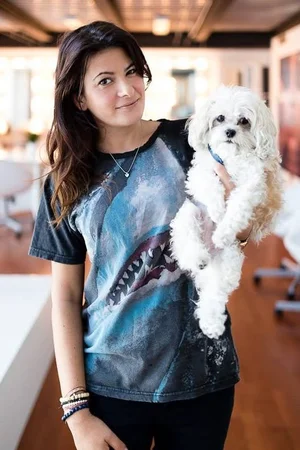
A French-Dominican artist who uses photography, writing and performance to turn love stories, her own and other people’s, into art.
“Why does anyone do anything?”
Who is Karla Hiraldo Voleau?
Karla Hiraldo Voleau (born 1992, Santo Domingo) is a French-Dominican artist who grew up in France and has been based in Switzerland for about ten years. She calls her practice performative and participatory photography: she often plays the main character, and her work deals with love, intimacy, gender, the body, women’s rights and the female gaze. Her best-known projects are Hola Mi Amol (2018), about love tourism and stereotypes of Dominican men, and Another Love Story (2022), in which she re-staged a relationship after discovering her partner’s double life. She has been represented by Christophe Guye Galerie in Zurich since 2024.
- Born
- 1992, Santo Domingo · grew up in France
- Based
- Switzerland (Lausanne) and Paris
- Trained
- MA Photography, ECAL Lausanne (2018) · BA Design, option Photography, École de Condé, Paris (2016)
- Books
- Hola Mi Amol (Self Publish Be Happy, 2019) · Another Love Story (Mörel Books, 2023) · You Can Have It All (In return for everything) (Artphilein, 2026)
- Gallery
- Christophe Guye Galerie, Zurich, since 2024
- Online
- khiraldovoleau.com · @karla.voleau
In conversation with
Karla Hiraldo Voleau
Who are you, and what is your work about?
I am a French Dominican artist. I was born in Santo Domingo, but I grew up mostly in France, and now I have been based in Switzerland for about ten years. At the same time, I travel a lot for work, residencies, and long-term projects, so I do not feel completely fixed in one place.
My work is rooted in what I call performative and participatory photography. I am interested in intimacy, gender, the body, and questions around women’s rights, and my projects often begin from something very personal, something that I have experienced or struggled with myself. From there, the work expands outward, from the “I” to the “we,” and becomes a way of addressing something more collective or societal.
What drew you into photography in the first place?
It was a series of coincidences that made me end up studying photography. Originally I had no clue about what medium to choose. I just knew I wanted to tell stories, mine and the ones that surrounded me. Eventually, I studied art history and discovered the ’70s conceptual art and then contemporary art, where artists were mixing different mediums and layers, breaking the fourth wall, etc. And during my MA, I found a tone that I liked and still use, in between photography, writing, and performance.

Why love stories?
To put it simply, these are the themes that interested me. I’ve always been someone who wanted to talk about love stories, my love stories, other people’s love stories; this is what I like to consume in terms of books and films and art shows. I’ve always been obsessed with love stories, family stories, what drives an artist and the behind the scenes of everything.
There are infinite themes, but in the end what drives me to explore certain stories is a deep curiosity for people’s minds. Why does anyone do anything? I’m interested in the psychology behind certain actions and the stories that build entire lives.
Where did it begin?
Her answer here begins with Hola Mi Amol, set in the Dominican Republic, about relationships between foreign women and local Dominican men.
Already there, it talked about gender and stereotypes attached to them, about performativity within romantic relationships, it talked about love, it talked about the female gaze, women looking at men and its implications, etc.
“Why does anyone do anything?”Karla Hiraldo Voleau
Where do you find inspiration?
Art exhibitions for sure, especially the ones that are not photography or even contemporary art.
What is your favourite song at the moment?
“A Song for You” by Donny Hathaway, on replay every day. Super hard to sing but I can’t help it, so my neighbours must be really tired.
Five projects, one question
Hola Mi Amol
Her ECAL diploma project and first book. She grew up hearing one warning, never to date a Dominican man, and went back to the tourist coast of the Dominican Republic (Punta Cana and the north coast) to make an autofiction about love tourism, the hyper-masculine stereotype of Dominican and Latino men, and what happens when women do the looking.


A Man in Public Space
A performative series whose first images were made in Lausanne. It marks her shift from deconstructing stereotypes of Dominican men to gender and how it is represented visually, with performance taking a bigger role.
Another Love Story
A year with a man she calls X ended when a phone call revealed his double life. She re-staged more than 300 of the couple’s snapshots with a look-alike actor, at the original locations, and showed them alongside the transcript of the call. Heartbreak becomes evidence, and photography is revealed as both proof and fiction.
Doble Moral
A long-term project about abortion in the Dominican Republic, where it remains banned in all circumstances, and the most explicitly political turn in her work.
You Can Have It All
Begun with a letter to her future self on a solo trip to the Mediterranean in 2019, a self-portrait project about body dysmorphia that places her in the line of Francesca Woodman, Jo Spence and Ana Mendieta.
From the I to the we
Most photographers who work with autobiography use the camera as a diary. Hiraldo Voleau uses it more like a stage. She writes the script, casts herself, sometimes hires an actor, and then lets the photographs claim to be evidence. That is what makes her work uncomfortable in a productive way: you can never fully trust what you are looking at, and neither, she suggests, can anyone in a relationship.
The line from Hola Mi Amol to Another Love Story is not a change of subject but a change of position. In the first, she looked at Dominican men and at the women who desire them. In the second, she became the one being deceived, and turned that into the work. In Doble Moral and You Can Have It All, the personal becomes explicitly political: abortion law, body image, who gets to control a woman’s story.
Her phrase for it, moving “from the ‘I’ to the ‘we’,” is the best summary of her practice. She starts from something that happened to her, and ends somewhere that is about all of us.
Timeline
- 1992
Born in Santo Domingo to a Dominican father and a French mother; grows up in France.
- 2016
BA in Design, option Photography, École de Condé, Paris.
- 2018
MA in Photography, ECAL Lausanne, with Hola Mi Amol as her diploma project.
- 2019
Hola Mi Amol published by Self Publish Be Happy. Laureate of the VFG Swiss Young Talents for Photography; shortlisted for the Paris Photo–Aperture First PhotoBook Award.
- 2020
Foam Talent; Olympus Recommended Fellowship. Shown at the Biennale de l’Image Possible, Liège.
- 2021
Photo London.
- 2022
A Man in Public Space at Art Basel as a Swiss Design Awards finalist. First solo exhibition, Another Love Story, at the Maison Européenne de la Photographie, Paris. Begins a residency at the Cité internationale des arts, Paris (2022–23).
- 2023
Another Love Story tours to Biel/Bienne, Bolzano and the International Center of Photography, New York. The book is published by Mörel Books. First preview of Doble Moral at the Locarno Film Festival.
- 2024
Represented by Christophe Guye Galerie, Zurich. Shown alongside Marcel Duchamp, Jenny Holzer and Barbara Kruger in How Language Invents the World at the Bündner Kunstmuseum, Chur (24 February – 28 July). First solo show with the gallery, Without Men (6 June – 24 August). Doble Moral at Paris Photo. Winner of the Bourse du Talent.
- 2025
Love, Maybe, Alexander Tutsek-Stiftung, Munich. Doble Moral enters the collection of the Bibliothèque nationale de France.
- 2026
Another Love Story at La Nombreuse, Brussels, during PhotoBrussels Festival (January – February). You Can Have It All at Fotofestival Lenzburg and EXPOSED, Turin, with a catalogue from Artphilein Books. Swiss Design Awards finalist; Art Basel.
Frequently asked
Who is Karla Hiraldo Voleau?
A French-Dominican artist, born in 1992 and based in Switzerland, who combines photography, writing and performance to explore love, gender and the female gaze.
What is Another Love Story?
Her re-staging of a year-long relationship that ended when she discovered her partner’s double life: more than 300 snapshots recreated with a look-alike, shown with the transcript of the phone call. It premiered at the MEP in Paris in 2022.
What is Hola Mi Amol?
Her 2018 ECAL diploma project and 2019 debut book: an autofiction on love tourism and Dominican masculinity, set on the Dominican Republic’s tourist coast.
Which gallery represents her?
Christophe Guye Galerie in Zurich, since 2024.
Links
Sources
- Christophe Guye Galerie, Karla Hiraldo Voleau: biography.
- Christophe Guye Galerie, Without Men press release (2024).
- Bündner Kunstmuseum Chur, How Language Invents the World (2024).
- Metal Magazine, Karla Hiraldo Voleau: Heartbreak rewritten.
- Picter, Meet Visual Artist and Photographer Karla Hiraldo Voleau.
- PhotoBrussels Festival, Another Love Story at La Nombreuse (2026).
- Pellicola Magazine, On Karla Hiraldo Voleau’s transformative rituals (2026).
- L’Œil de la Photographie, Fotofestival Lenzburg: You Can Have It All (2026).
Antakly, Leila. “Karla Hiraldo Voleau: Love, Performance and the Female Gaze.” Antakly Projects, 4 March 2024, updated 8 November 2026. https://www.ninunina.com/interviews/2024/3/4/karla-hiraldo-voleau-at-christophe-guye-galerie
More photographers from the archive
Curious about their work, not the moment.
Leila Antakly founded Antakly Projects in New York in 2003, as Ninu Nina. For more than twenty years it has published conversations with artists, musicians, photographers, designers and thinkers across art, music, fashion, film and contemporary culture.
Interviews are chosen through curiosity and research, not celebrity, trend or algorithm, with particular attention to artists who deserve a deeper conversation than the usual press cycle allows. The archive asks how people think, what shapes their work and where their ideas sit in a wider cultural conversation, not simply what they are promoting.