Jerry
McLaughlin

Jerry McLaughlin is a full-time artist based in San Miguel de Allende, Mexico. A former pediatric critical care physician, he makes paintings in oil, cold wax medium and wood ash, as well as objects and installations. He co-wrote Cold Wax Medium: Techniques, Concepts & Conversations with Rebecca Crowell, and his work is held in private and institutional collections in the United States and abroad.
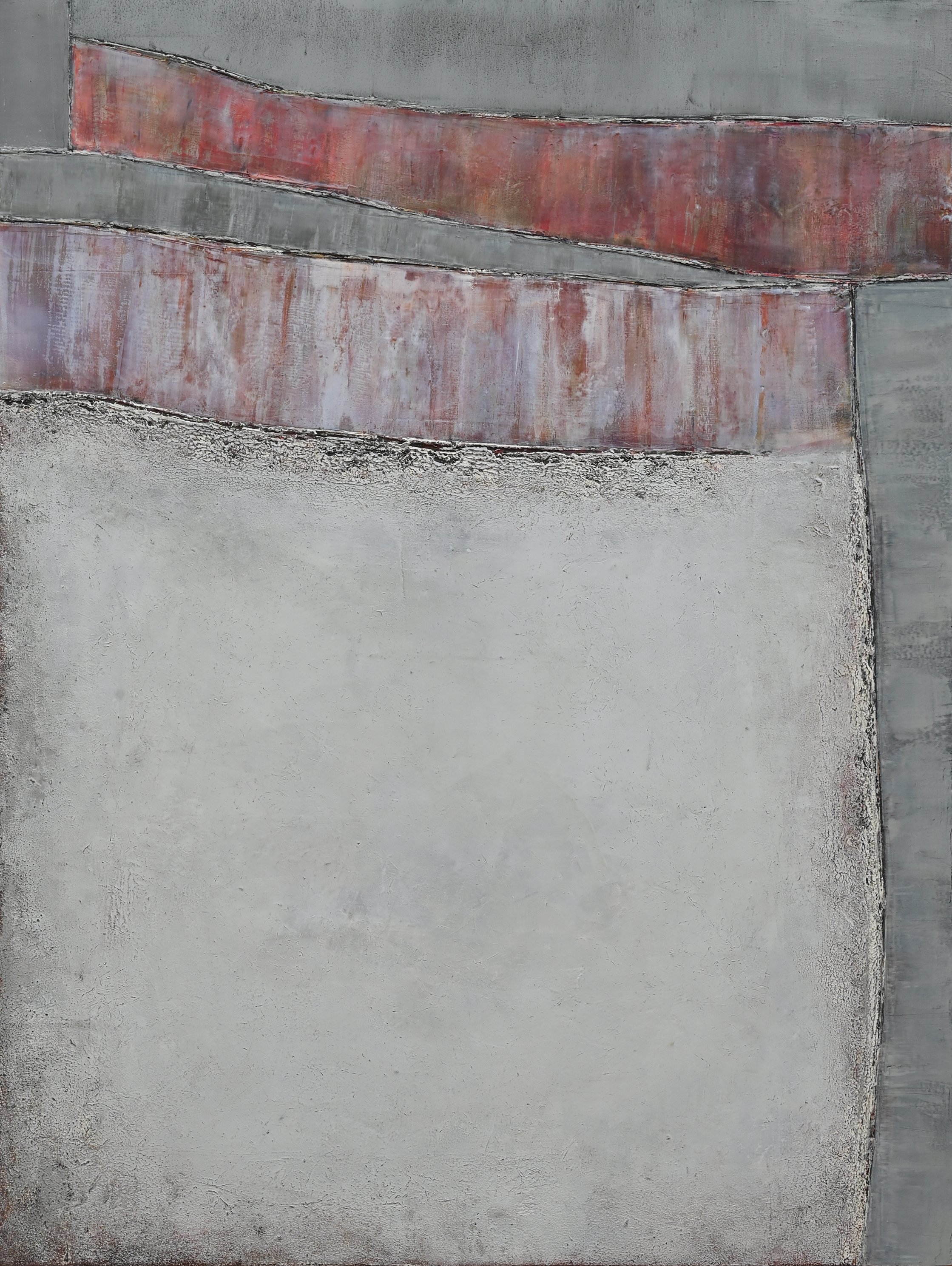
His monochromatic abstractions belong to a growing return to pure abstraction. Their geometry and weathered surfaces come from the high desert of central Mexico: adobe, concrete, hard light and deep shadow. The ash carries the history of whatever burned to make it.
His newest work turns to something closer: friendship, and closeness between two people as something built rather than simply felt. Below, he talks about leaving medicine, moving to Mexico, what ash means to him, and why he wants nothing to do with AI-generated art.
Artist statement
My work comes from thinking about friendship and about closeness between two people as something built rather than simply felt. I construct objects because relationships are also made: piece by piece, through choice, asymmetry, trust, hurt, adjustment, and repair.
I want the work to hold tenderness, damage, and endurance at the same time.
The repairs do not hide what happened. They become part of the structure.
— Jerry McLaughlin
In conversation with Jerry McLaughlin
01 · Origins
Tell us about yourself.
I was born in Southern Ohio, basically Appalachia. I knew I wanted to be a painter when I was 10 and saw a Jackson Pollock action painting in an encyclopedia. But for many of the common reasons so many people let go of art, I essentially forgot about art and ended up studying medicine.
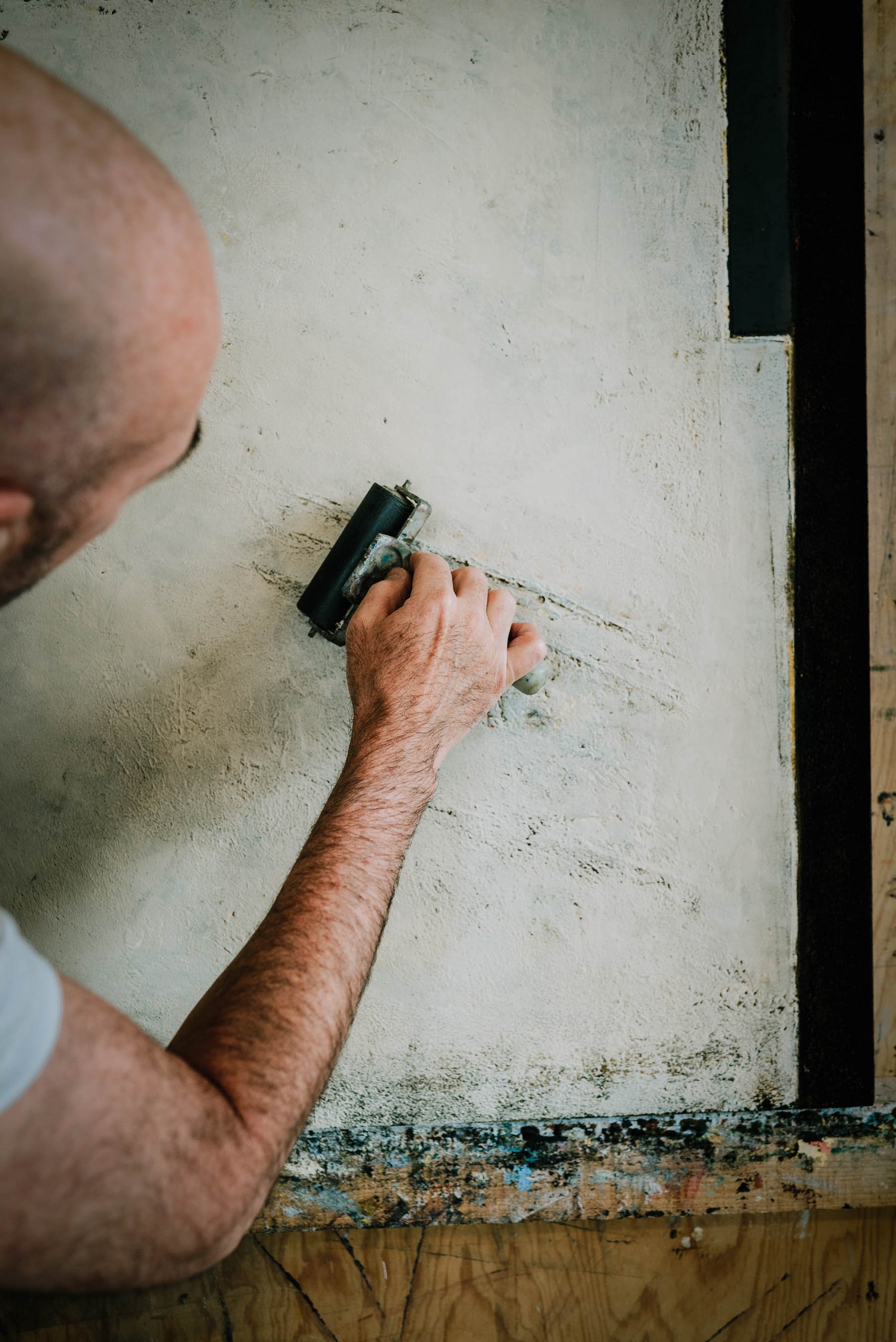
I practised pediatric critical care medicine for many years, but found art again after completing my training. Connecting with art again was powerful. I could see something different in myself, different possibilities for my life. So I practised medicine part-time and art full-time, and eventually found myself really doing art, really being an artist. I was fortunate. I was invited into some galleries. I was having shows, living in that art world, and still practising medicine.
I paint primarily with oils and cold wax medium. When I started painting there was no book about the medium, no videos, nothing out there. There was a void I knew needed to be filled, so I decided to write a book about the medium, a book I knew there was an audience for. I persuaded artist Rebecca Crowell to work with me, and we wrote that book together: the first and only comprehensive book on cold wax medium. That book opened some professional and entrepreneurial doors for me, and five years ago I retired from medicine. Shortly after, my husband and I, and our dog Bert, moved to Mexico.
We were not planning on moving. We were happy in the Bay Area. But during a workshop I taught in San Miguel de Allende, we both fell in love with the city and decided to move here. I had been an exchange student in Orizaba, Veracruz, in high school, so I already felt a connection with the country and the language. It just felt right, so we did it. It has been one of the best decisions we have ever made, and beautifully transformational for us as individuals and as a family.
02 · Place
How has living in Mexico shaped your painting practice?
It has had a huge impact. The biggest has probably been simply the change in pace. Things move more slowly here. I have time to think and work without the pressure and pace of life in the Bay Area. I noticed immediately what it felt like to have time. Having time is so important. I’m more relaxed, more open. My life feels calm, more expansive. More time and space with my art has expanded my views of my work and allowed me to explore new ideas, new media and new projects, as well as to keep developing my earlier pursuits.
Place has also had a strong impact on my work, much more than I anticipated. I live in the high desert of central Mexico, an area called the Bajío (“lowland”), interestingly, since our altitude is roughly 7,000 feet. There is an austerity and severity to the landscape. The sun is intense, the light is harsh and the shadows are deep. I’ve always loved modern Mexican architecture, but living in and among it, the shapes, surfaces and lines are always there, and they filter in. Straight lines, sharp angles and hard edges. The subtle surfaces of adobe and concrete are beautiful when they are new, and maybe even more so when they age.
These have all changed the form of my work. More simplicity. More geometry. More light. More lines. More subtlety of texture and surface. More expressive and more formal at the same time. It’s been interesting.

03 · Material
Your use of wood ash and other natural materials seems to go beyond the obvious tactile qualities they offer. What do these materials evoke for you personally?
I’ve always had a love for materiality. Each material has its own allure, its own set of qualities that draw me to it. And ash has its own unique physicality. Except ash is not one material. It is an almost infinite range of materials. Depending on what burned, how much oxygen was available and the temperature of the fire, the same fire can produce a range of different ashes. I love the physical texture, the grittiness, the chunky bits. But sometimes it’s soft, too, almost like talcum powder. I love what it does and how it behaves when it is mixed with a medium and applied to a surface. There is nothing like it.
But, as you said, there is more to it than its physicality. Ash captures the story of the fire that produced it: the time, the place, the material, the circumstances. Something beautiful and communal, like a campfire. Something devastating and destructive, like a forest fire. Something complex and provocative, like the burning of trash. The cremation of an animal or person we loved. It’s all there, reduced to that pile of remains. Because of its association with fire, ash evokes death and destruction, transformation and renewal, residue and remains, letting go, and on and on.
Working with ash feels very personal to me. I feel a deep connection with its symbolic and metaphoric qualities. I love how it captures time and place, and I love its materiality.
Ash captures the story of the fire that produced it.
— Jerry McLaughlin
04 · Abstraction
Figurative art has dominated for some time now. Do you think abstract art will make a comeback?
Of course it will. Everything changes over time: what’s important, what people like, what sells. These are always in flux. We just never know how and when the change will take place. But I think (fingers crossed) pure abstraction is about to make a return.
05 · Abstraction
What do you think abstract art offers that other art genres do not?
Abstract art is a broad term. A lot of current figurative work is quite abstract, so I’m going to answer this focusing on pure abstraction, or non-representational art.
I think pure abstraction offers a possibility, depth and potential of experience that other genres do not. The absence of recognisable things allows pure abstraction to be nothing and everything at the same time. It can be pure distillation to colour, shape, line, value or texture. Or it can be a deep, universal experience and emotion. Or it can be both.
In pure abstraction there are no references to person or place, to what or when. This gives the viewer a unique, and sometimes challenging, opportunity for experience, one I don’t think exists with representational work. Even when work is heavily abstracted, we still identify the who, the what, the where. That identification can be very grounding, even comforting, for the viewer, but I do think it is limiting.
06 · Technology
Your practice is rooted in analogue, physical materials and processes. Do you have any thoughts on the role, or potential, of artificial intelligence in art-making or the art world at large?
I do have thoughts about this, thoughts I’m sure some people will bristle at. My work is totally rooted in the analogue, in materiality and, despite its minimalist aesthetic, in romanticism, I suppose. The hand of the artist must be present.
I view technology as a tool, something to help us and make things easier. I think AI has tremendous potential for that: solving problems, finding useful patterns in complex systems, helping doctors better diagnose and treat patients, helping scientists better understand climate and weather.
But AI as an agent of genesis? I am totally against it. Maybe it’s kinder if I say, “I have no interest in it.” I think we should be painting our own paintings, composing our own music, and writing our own stories (and artist statements). I am all for artists tackling technology and AI as subject matter, but for actually generating content, I guess, again, I’m old-fashioned. I’m interested in work thought up and made by people. People have ideas, thoughts, feelings and stories I care about. AI doesn’t.
07 · Wellbeing
What does wellbeing mean to you?
For me, wellbeing means giving proper time, attention and space to what I feel are the fundamental aspects of human life: physical health, mental health, emotional health, spiritual health, relationships, creativity, contribution and low impact. I think it is almost impossible to give equal and constant attention to all of them, all the time.
I try to develop daily practices that nurture these areas. I go to bed early and wake up early. I meditate and journal. I have a gratitude practice. My husband and I work at home, so we see each other often during the day. We stop and talk. We cook and eat dinner together every night; virtually nothing gets in the way of that. It’s our ritual.
Our home is designed to collect and store rainwater for household use. We have a garden, and we compost. I’m a vegetarian. We have a dog, Bert, who brings us an immense amount of joy. We have friends and socialise. I have my art practice. Probably the hardest for me is movement. I should move my body more on purpose. I keep trying to develop a yoga practice… eventually it will happen. I hope.
08 · Next
What is next for you?
I feel like I’m at an exciting point. I’ve been travelling and looking at work in other places, comparing and contrasting what I do with what others are doing, trying to better understand my place in the art world. I’m viewing the possibilities for my work in a larger context: different media, different approaches. I feel a clarification of the conceptual and formal elements of my work happening. I’ve already started developing new exhibition projects in my studio, and I have two artist residencies lined up in 2024 which I’m really excited about.
I’m also focusing on slowing down more, creating even more space in my life for my art and my family, and that feels really good.
Materials & Sources
Cold wax
Mixed with oil paint and built up in layers, then scraped back. He co-wrote the standard book on it.
Wood ash
Gritty or soft as talc, depending on the fire. A record of time, place, loss and renewal.
Adobe & concrete
The surfaces of modern Mexican architecture, beautiful new and perhaps more so as they age.
Repair
In the newest objects, the mend stays visible and becomes part of the structure.
The Journey