From Vanity Fair to International Collections: A Conversation with Artist Alexandra Diez de Rivera
Alexandra
Diez de
Rivera
A practice that looks at the vacant space, the hollow shell, the skin of things. Vacant interiors, antique garments, and forgotten artefacts become introspective spaces that invite self-examination. When something is missing, we unwittingly fill in the gaps.
Alexandra Diez de Rivera's journey is as transnational as her heritage. Spanish-Argentine, British-raised, with a practice that found its voice first in Shanghai and has since expanded through large-format film, cameraless photography, and a sustained engagement with memory, mortality, and the uncanny. Her solo show Theatres of the Mind is open in Madrid through July 2026. Her work is held at the Saatchi Gallery, Flowers Gallery, and the Royal West of England Academy. She was selected for PHotoESPANA Discoveries 2022.
"A house that has been experienced is not an inert box. Inhabited space transcends geometrical space."
Alexandra Diez
de Rivera
"I am drawn to psychologically ambiguous objects and spaces that are empty but charged and marked by the passage of people and time. My subjects are inanimate but loaded, exposing the affecting remnants of past lives."
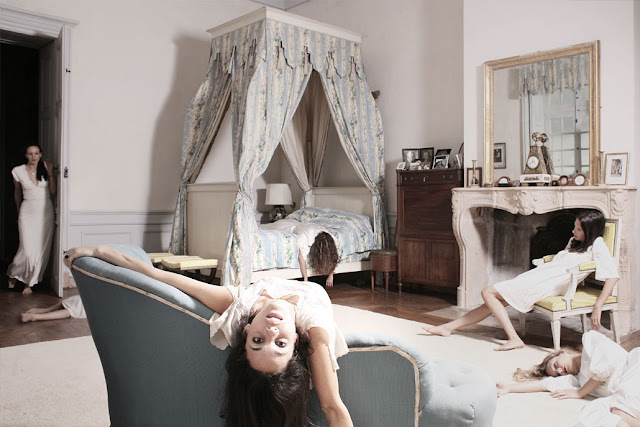
Her practice looks at the vacant space, the hollow shell, the skin of things. Working with large-format film, cameraless photography, light painting, and embossing, she reveals the emotional and historical weight of inanimate subjects. Vacant interiors, antique garments, and forgotten artefacts become introspective spaces. A confessional. A theatre box. A draped alcove with a bed in it.
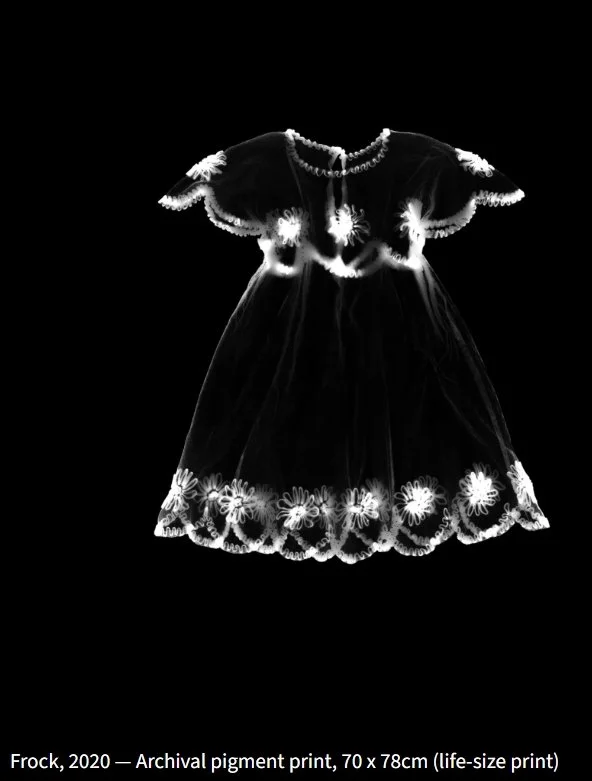
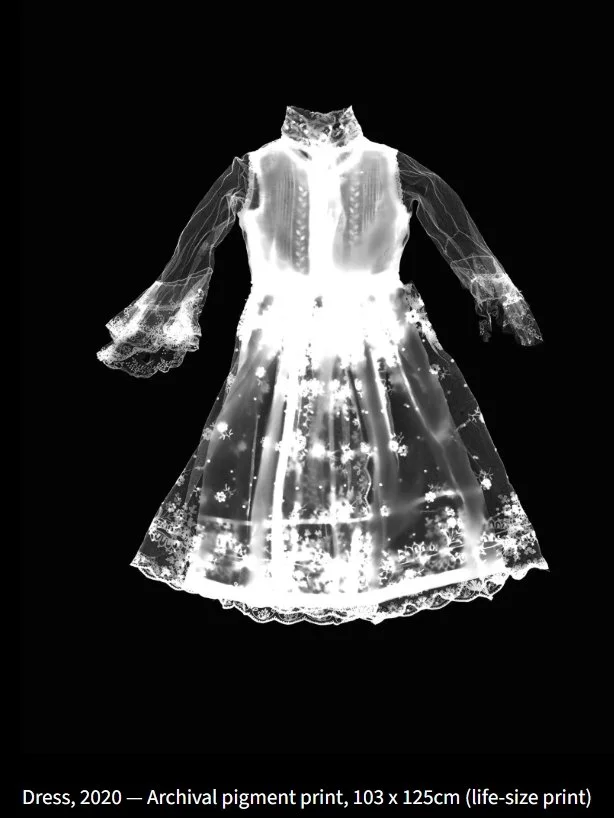
Her photograms of children's clothes are made without a camera, placing antique garments directly on photo-sensitive paper and exposing them to light. The skin cells and body oils of their wearers seep into the prints, becoming a part of them. Her Vessels series depicts dormant containers of rifles and pistols, crosses and medals, evoking hidden narratives and secret histories.
El Teatro Interior
The solo show that brings together her sustained investigation of interior space, psychological resonance, and the charged quality of the empty room. A theatre of the mind, not a representation of one.
Antique children's garments placed directly on photo-sensitive paper and exposed to light. The skin cells and body oils of their wearers seep into the prints, becoming a permanent part of them. The camera is absent. The body is not. A practice that makes presence from absence and absence from presence.
A series of locations which have been used and inhabited but are vacant in the photograph, allowing the viewer in. A confessional. A theatre box. A draped alcove with a bed in it. The emptiness is not absence but invitation. The space becomes a reflection of the viewer themselves.
Dormant containers of rifles and pistols, crosses and medals. Objects that evoke hidden narratives and secret histories. The camera as an instrument for resurrecting archaic and obsolete objects, turning them into something new, allowing us to observe and re-evaluate their cultural, political, and sentimental meaning.
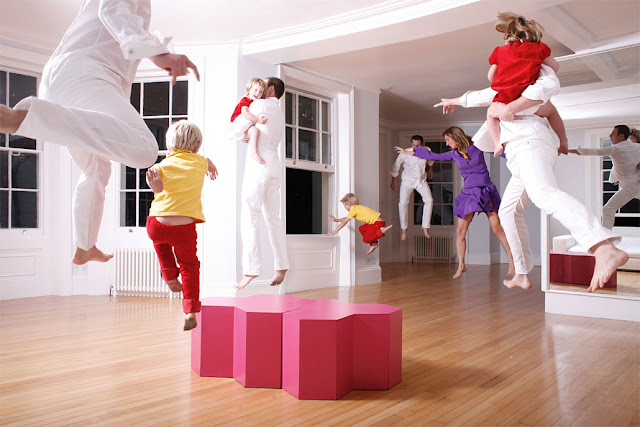
Intimate commissions placing real families in tailored, narrative scenarios, developed in Shanghai from 2007. The project that catapulted her to success in the East before the West. Now developed into a fully independent project: alternativeportraitproject.com
El Teatro Interior. The solo show at Espacio Valverde, Madrid, 21 May to 18 July 2026. The interior theatre as subject and method simultaneously. The space we carry inside ourselves that shapes how we perceive every exterior space we enter.
An unrealised dream: using the cloning theme to photograph an artist inside his or her own work. Kusama amongst her pumpkins. Ron Mueck climbing one of his sculptures. James Turrell in a landscape of light. "I love the idea of bringing my own art in to highlight somebody else's. Damien, you reading this?"
Greatest inspirations or influences?
Other photographers you love?
Favourite subjects or shoots so far?
I have to admit my favourite subjects are my friends and my favourite shoots are the ones I do spontaneously. I also had a lot of fun with the girls in Sophie, Agathe, Aure, Trixie, Marie and Agnes, drinking wine and dancing through the shoot. On a more serious note, I like shooting couples as the character content is more concentrated than with bigger families. Portrait themes can have more of an edge and it's always interesting to play on the relationship between two people.
What is the greatest challenge of your practice?
Photographing children can be a challenge, and if I didn't have two of my own I'm not sure I'd be able to do what I do at all. Getting kids to stand in a precise place and take on a precise attitude is not always easy. Some portraits are made up of many different photographs which means every person has a determined spot in the picture, it can get quite technical, and I have to make sure that never interferes with the end result looking natural. Coming up with a different scenario for each portrait can also be a challenge but strangely I'm finding the more portraits I do, the more ideas I have.
"My work deals with absence. When something is missing, we unwittingly fill in the gaps, occupying the space with our own lived experience and imagination, drawing from memories and emotions which may be hidden or suppressed."
On why fine art photography still needs independent voices
When Antakly Projects was formed, Leila Antakly wanted to create a project that brings together curators, artists, and experts deeply in love with photography. In times when everyone seems to be a self-made photographer, outstanding artists are here to show us photography that is fine art. It exceeds constantly our expectations of what an image can be.
They do it by carefully adjusting technical parameters and reshaping, with them, our own sensibilities. These artists show us that, even after the advent of the digital revolution, the delicate alchemy of photography is very much alive.
Photography artists around the world share the same challenge. Unless one is represented by a powerful gallery, it is extremely difficult for an artist to get exhibited by recognised institutions and gain international visibility. Having no gallery cancels many opportunities, from participating in major fairs to selling artworks to governmental institutions in a number of countries.
This forces photography artists towards intensive self-promotion as the only means, and the price is focus. Often the most socially active get noticed, not the most talented. We look hard to spot those names whose quality work is underrepresented outside of its local context. We give voice to their stories and exhibit their works worldwide.
Why Alexandra Diez de Rivera's work stops you in the act of looking
There is a category of photography that does not document. It does not capture a decisive moment or a beautiful face or an extraordinary place. It does something stranger and, ultimately, more durable: it makes the viewer aware of the space between the image and their own interior. Alexandra Diez de Rivera's practice operates entirely in that space.
When she places a child's antique dress on photo-sensitive paper and exposes it to light, the skin cells and body oils of a child who is no longer small — perhaps no longer alive — become part of the image. That is not a metaphor for memory. It is memory, made literal through photographic chemistry. There is no digital equivalent of this. There cannot be.
Theatres of the Mind is at Espacio Valverde, Madrid, through 18 July 2026. Go if you can. If you cannot, follow her work at @alexandradiezderivera and explore her full practice at diezderivera.com.
An independent platform dedicated to artists, musicians, photographers, designers, and thinkers at every stage, from emerging voices to established masters. Every interview is selected for depth, not reach.
✦ Explore all our interviews →"We need to support alternative films, art, any artistic form that challenges mainstream."
More personal essays and cultural commentary from Leila Antakly, on art, politics, wellness, and the complicated business of paying attention.
Read on Substack ↗