ARTIST ANNA HEPLER

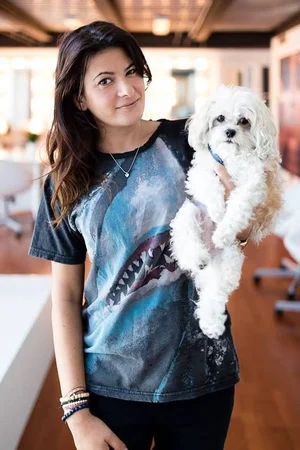
Anna Hepler
On shadows, blunder, and working with forces beyond her control
Anna Hepler (b. 1969) is a contemporary artist based in Greenfield, Massachusetts, whose sculptures and installations — ranging from hand-held to architectural in scale — have been exhibited around the world. Trained as a printmaker, she carries that discipline's logic of translation into everything she makes: wire forms flatten into drawings, clay impersonates metal, plywood coils like rope, plastic inhales and exhales. Hepler treats embarrassment, uncertainty, blunder, and fragility not as risks to manage but as active agents in the studio.
Tell us a bit about yourself — career highlights, where you currently live and work.
I come from a family of botanists and beekeepers who structured their lives around the unpredictable movements and challenges of the natural world. This life, collaborating explicitly with forces beyond one's control, establishes a dynamic of flexibility and acceptance — a respect for the unknown. It's this same dynamic that drives and guides my work, and within this philosophical framework I feel connected to past generations. I grew up in western Massachusetts and am based there now, with a studio in Greenfield, though I've spent most of my adult life living in Maine — in Portland, and on Moose Island. I miss that rugged coast.
My work is ever evolving, each present moment eroding the memory of past projects, so that I don't feel a sense of accomplishment in the studio — only the struggle of making new work over and over. That struggle does not change. In this way I'm always a beginner, unstable on my feet, without a clear path forward.
The origin of my work is in printmaking, and I still feel those threads connecting to my recent sculpture. More specifically, the manipulation of material — carving a woodblock, scratching a drypoint plate, then inking and translating the image onto paper, a print — shows how one material can paradoxically reveal itself in a completely new form. Which is the more interesting thing: the final print, or the block? It's with the awareness of how each material holds the potential to be transformed that my work remains rooted in printmaking, like a subject and its shadow. I'm just as interested in the shadow as I am in the object — perhaps it's the shadow I seek.
Your greatest inspirations or influences?
My greatest inspiration is folk art and craft traditions. I love to know how things are made — it's a kind of superpower — and I love the generosity of making objects, or useful things, as gifts or as a talisman. That's my root as a maker. But as I get older and have slowly gained in confidence, I trust the silent and mysterious parts of myself to speak. From here emerge works I can't always understand or describe, but I trust them. The impulse is still rooted in a kind of craft, but the process feels very disobedient to craft — untrained and serendipitous. I'm intrigued to work because I think with my hands, and find solace and curiosity when I'm absorbed in the moment. This is my preferred way to be alive.
- Arlene Shechet
- Martin Puryear
- Jean Pierre Pincemin
- Norbert Prangenberg
- Phyllida Barlow
- Alexander Calder

Over Easy, 2019 — glazed terracotta
Tell us about your creative process — work you're most proud of, and what you were looking forward to that year.
The opportunities I look forward to most are those that offer a chance to work. As I wrote this, I was a resident at the Ellis-Beauregard Foundation for a month in Rockland, Maine, and looking forward to another residency the following spring at the Montello Foundation in northeastern Nevada. But I have children, and other obligations, so I fall in and out of these saturated work periods — sometimes months go by and I make nothing.
I feel most gratified by any project tempered with serendipity, as though being an artist is like being a medium for forces beyond our control — a form of divination. I sometimes feel uncomfortable claiming authorship of work that comes into being so unexpectedly, as though it were a true collaboration with unknown forces — and it is. Often the larger, architectural-scaled projects have this magic about them, when all my physical effort is expended by the scale and the labor. Sometimes I think the work is better in those moments when control is lost.
"Sometimes I think the work is better in those moments when control is lost."Anna Hepler
How has this year changed your creativity, or how you see the art industry moving forward?
I've been necessarily impacted by the intense brutality of injustice and inequality in the U.S., and have spent many months this past year taking action outside of the studio. It seems the only thing to do — and still the only way to behave against so much violence.
From a 2021 conversation
Selected Record
Residencies, honors, collectionsHenry Luce Foundation Fellow, Seoul · Roswell Artist-in-Residence · Tamarind Institute · Nova Scotia College of Art & Design · Archie Bray Foundation · Surf Point Foundation · Montello Foundation · MacDowell
United States Artists Fellowship (2016) · Harpo Foundation · Nancy Graves Foundation · Gottlieb Foundation · Massachusetts Cultural Council
National Gallery of Art, Washington D.C. · Tate Modern, London · Portland Museum of Art, Maine
In the Studio
Surf Point Foundation, 2019
You Will Also Love
More artists working in clayLisa Geue: An Ocean on a Vessel
A self-taught ceramicist who makes her own glazes from minerals, sand, shells, wood ash, and rainwater — nothing else.
Ceramics — RomeGiorgia Piu of Rose de Nour
An ancient soul with a modern background — on clay as a language she remembered rather than learned.