Jonas Sun7

Sun7
Jonas
Bournat
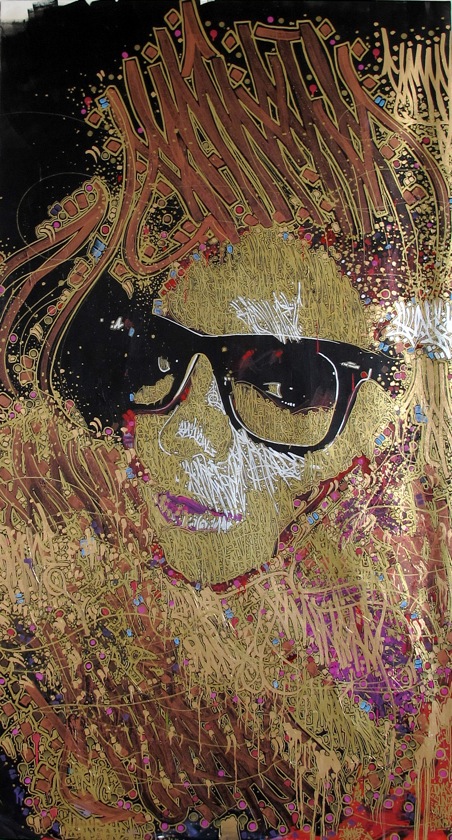
"His register became permeated by multiple new influences: action painting, Arabic calligraphy, Latino tattoos, but words and calligraphy remained dominant — a mesh of words, a lace of letters, most often indecipherable but which when combined made portraits and self-portraits."
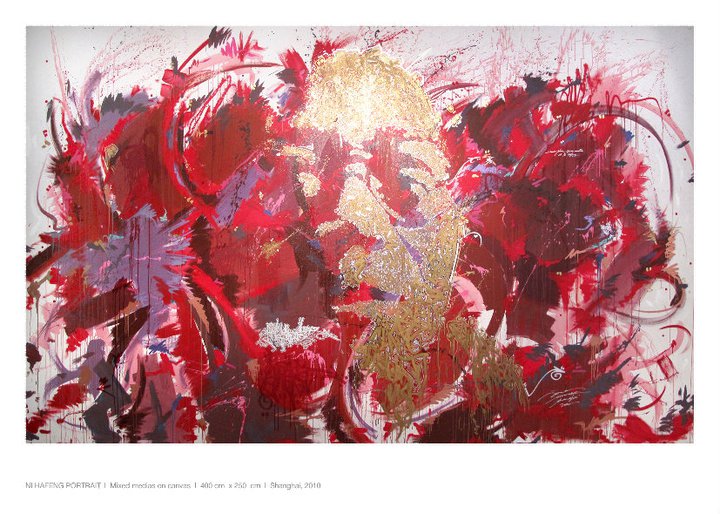
Sun7 — pronounced sunset — assembles words into subtle networks of condensed handwriting that reveal images while hiding their true meaning. Stand close and you see a tangle of loops and marks, lines that look almost like Arabic script, almost like tattoo flash, almost like the gesture of a painter working too fast for the surface to contain him. Stand back and a face emerges from the marks. A portrait was hiding in the calligraphy all along.
Jonas Bournat discovered the world of New York graffiti in the early 1990s — spray can in hand, streets of Paris and New York as his first surfaces. What he brought from those years was not just a technique but a way of thinking about text: not as something to be read cleanly, but as something to be inhabited, felt, decoded over time. The word is never fully available. The image is never fully legible. That space between legibility and illegibility is where his work lives.
"Obvious portraits and coded texts created a subtle play of appearance and disappearance, in which everything related to calligraphy, glyphs and ideograms became as unreal as can be — nurturing a deep sense of interest and mystery."
Three traditions meet in Sun7's work and refuse to separate. Action painting — the movement and spontaneity of Pollock and Hartung and Mathieu, gesture as meaning, the body in the work. Arabic calligraphy — the tradition that gave text its visual autonomy, where the word is also a form, where script is also image, where the line between writing and drawing has never fully existed. And Latino tattoo motifs — text as identity, as permanence, as a mark on a surface that cannot be erased. The combination produces work that feels simultaneously ancient and street-level, meditative and urgent.
His process is built on the live performance as much as the studio work. He has performed at major street art festivals across Europe, Indonesia, China and Marrakesh — places where the gesture of making is as important as the finished surface. This is not incidental to the work. The mark is always an event. The line always records a body in motion.
My daughter. Keith Haring, Pierre Soulages, Jean Miotte, Jackson Pollock, Hans Hartung, Georges Mathieu. Gustav Klimt, Seen. Hassan Massoudy — master artist and calligrapher, for whom the word itself remains the most sublime creative force. José Parlá. Sam Francis, Antoni Tàpies, Cy Twombly.
Gesture as meaning. The body in the work. Drip and mark as record of the making.
For whom the word remains the most sublime creative force. Baudelaire and Ibn Arabi in the same brush. The line between writing and drawing dissolved.
"Lying between the boundary of abstraction and calligraphy." He constructs paintings by layering memory and history. The city wall as archaeological site.
Who made text into gesture and gesture into text. The scrawl as high culture. The mark that is almost a word and never quite one.
The painter of black. The man who made darkness into light. Monumental scale and radical reduction — the surface as the whole subject.
Who brought the figure back to the street with a line so confident it looked like it had always been there. The public surface as the only real canvas.
Texture as meaning. The surface that accumulates rather than depicts. Material as the argument, not the illustration of one.
The decorative as the profound. Gold and pattern as a visual language that holds as much as an image. Ornament as argument.
An independent platform dedicated to artists, musicians, photographers, designers, and thinkers at every stage, from emerging voices to established masters. Every interview is selected for depth, not reach.
✦ Explore all our interviews →"We need to support alternative films, art, any artistic form that challenges mainstream."
More personal essays and cultural commentary from Leila Antakly, on art, politics, wellness, and the complicated business of paying attention.
Read on Substack ↗