Photojournalist Omar Havana
Omar
Havana
Spanish freelance photojournalist. Born Granada, 1975. Based in Brussels. Previously Cambodia, Nepal, France. Getty Images. New York Times front page. Visa Pour L'Image. Five languages.
"Photography arrived in his life after the suicide of one of his best friends, a photographer who had been in the Romanian Revolution. He had taken one photograph: a little girl with the most amazing look he had ever seen, surrounded by war."
While in Cambodia I had the great pleasure of meeting Omar Havana: a Spanish photojournalist with a social conscience. He is a freelancer born in Granada who had lived in seven countries including Cambodia, which he called home, and where he began his career in photojournalism. Photography arrived in his life in the way that the most important things tend to arrive: sideways, through grief. After the suicide of one of his closest friends, a photographer who had covered the Romanian Revolution, he found himself looking at a single photograph his friend had taken: a little girl with the most remarkable look he had ever seen, surrounded by war. Since then Omar has not stopped.
He has covered conflicts in Thailand, Tunisia, Cambodia, Burma, Laos, Vietnam, Malaysia and Libya. He speaks five languages. Since 2013 he has been represented by Getty Images. His photographs from the Nepal earthquake in April 2015 ran on the front page of the New York Times and in TIME Magazine, National Geographic and Paris Match. His work was exhibited at the Visa Pour L'Image Festival and the PhotoReporter Festival in 2015. He has published his first book, Endurance, a tribute to the people of Nepal. Bernardo Bertolucci wrote the foreword. He describes his own practice in one sentence: "We are who we are because 80% of this world is not who they deserve to be."
James Nachtwey: I had the pleasure to meet him a few times and he always gave amazing tips. And Miguel Gil, murdered in Sierra Leone in 2000, the best journalist in Spanish history in my opinion.
The eternal smile of the kids. The look of their people. Their stories, their lives, everything about Cambodia. It was in Cambodia I learned to smile, to live, to see. Cambodia has inspired me to be who I am. Cambodia belongs to those countries that I call the Forgotten World, since not many people know the reality there.
It means "the first smile." It was in Cambodia I learned to smile, to live, to see. It is an honour to show my Cambodia back in my hometown of Granada. It is called the first smile because Cambodia gave me that smile.
Eduardo Galeano, the writer from Uruguay. Gervasio Sanchez, the Spanish photographer. And James Nachtwey: the best photographer alive.
"The best shot is the one that I will take next."
Omar Havana · On his favourite photographthe dump
beside Angkor
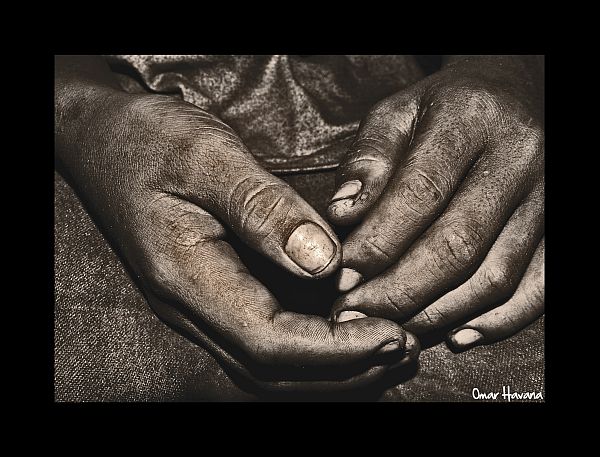
Just a few dozen kilometres from the world-famous Angkor temples, around 300 people have lived for years in a rapidly expanding rubbish dump, fighting the daily realities of extreme poverty. Since 2010, the situation at Anlong Pi has worsened: an exponential increase in waste doubled the capacity of the landfill, resulting in harmful chemical and biological reactions. Toxic by-products contaminate soil and groundwater, or are emitted into the atmosphere after being burned. Workers have begun setting ablaze large areas of waste to make space for new rubbish. The deterioration of air quality is just one of several factors that have gradually made life in Anlong Pi unsuitable for any human being.
In recent months, visits by tourists to the dump increased considerably, turning extreme poverty into a tourist attraction without considering the psychological impact on the inhabitants. The story was published in Al Jazeera English and The Diplomat. Part was shot on assignment for Getty Images.
View the project on Visura ↗On 25 April 2015 Nepal was hit by a magnitude 7.8 earthquake that killed almost 9,000 people and injured more than 22,000. Almost three million were made homeless. Endurance is a tribute to the people of Nepal: over 70 black and white photographs shot across the country immediately after the earthquake and in the months following. Foreword by film director Bernardo Bertolucci, who used images from the book for a fundraising campaign in Rome. It tells the story of resilience, of a life spirit that spreads, like the smiles on their faces, over the streets filled with debris.
FotoEvidence Publishers ↗An independent platform dedicated to artists, musicians, photographers, designers, and thinkers at every stage. Every interview is selected for depth, not reach.
✦ Explore all our interviews →"We are who we are because 80% of this world is not who they deserve to be."
More photography and photojournalism from the Antakly Projects archive.
Read on Substack ↗