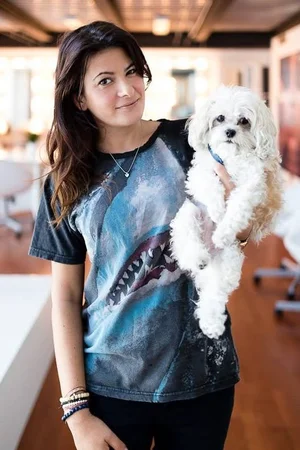
Austyn Taylor
On clay, creatures, and the ocean of fish tanks. Animals not as cute stand-ins for people, but as vessels for shared intelligence: the raw, cross-species fact of waking up into a body and figuring out how to live in it.
Who is Austyn Taylor?
Austyn Taylor didn't set out to be a sculptor. Trained as an illustrator, she was teaching at a charter school in Colorado when she found boxes of clay in a supply closet, a material she'd famously failed in high school ceramics, and began building pinch pots and imaginary creatures alongside her students. The room lit up. That accidental classroom experiment sent her back to New York to pursue an MFA in Ceramics at Alfred University, and from there into an eight-year run as a resident artist across the United States, China, Lebanon, Mexico, and Denmark: chasing porcelain in Jingdezhen, groggy stoneware in Guadalajara, and everything in between.
What emerged from that itinerant decade is a body of work built around animals. Not as cute or humanized stand-ins for people, but as vessels for something Taylor calls "shared intelligence": the raw, cross-species fact of waking up into a body and figuring out how to live in it. She works fast and instinctively, drawing on a self-described "duty" to dive deep into the history of her material. Clay is, after all, one of humanity's oldest art forms, and one she believes remains strangely underutilized in contemporary art.

You started as an illustrator before that encounter with clay while teaching in Colorado. What was it about that moment that pulled you toward sculpture specifically?
"I have a deeply held belief that 'art' is one of the most powerful tools for shaping reality. I wanted all my students to feel empowered to command art to their wills. I knew very little about ceramics when I found the boxes of clay. I got a D in ceramics in high school; it was too finicky and the glazes always looked terrible. So when I started teaching clay, I was learning right alongside the students. We began with pinch pots as a base, then imaginary creatures on top. The joy from the students took over the room."
"I started researching contemporary ceramic artists we could draw from for our projects, and the deeper I looked, the more I saw major gaps in communication and very few artists really participating. I thought it was the most underutilized material in 'Art.' For how ancient clay is, over 20,000 years, I was surprised it wasn't more celebrated in contemporary practice. Correcting that imbalance has become my life's work."
You've worked as a resident artist across the US, China, Lebanon, Mexico, and Denmark. How did each of those environments change what you made?
"The Beijing residency at the Central Academy of Fine Arts was the first time I'd left the US for an extended period. While in China I visited my artist friend Shī Yuè in Jingdezhen, the city where porcelain was first invented. Guldagergaard in Denmark was super intense, and more recently, Mexico was an absolute blast meeting resident artists from all over the world at Cerámica Suro in Guadalajara. I also did a residency in Beirut on invitation from Août gallery in Gemmayzéh, had an incredible time, and went back a few months later."
"It might not sound so romantic, but honestly, I bury myself in the studio wherever I find myself. My life is dedicated to the search for the simplest way to say the most complicated things, while welcoming everyone into the conversation. I've found people to be very similar everywhere: good, bad, everyone caught in their own narratives, worlds like fish tanks of reality, but all of us floating in one big ocean of fish tanks."
"Working within different limitations shaped the work directly. I've worked with incredible porcelain clays, silky, fired in electric kilns, and groggy stonewares that make your hands bleed, but whose roughness lets you build a sculpture faster and stronger, reaching some 7 feet tall. By the time I found my way back to California and Mendocino, I'd landed on solid color raw pigment as a way to manage the trials of travel and shipping."
"Worlds like fish tanks of reality, but all of us floating in one big ocean of fish tanks."
- Central Academy of Fine Arts, Beijing · Jingdezhen China
- Août Gallery, Gemmayzéh Beirut, Lebanon
- Cerámica Suro, Guadalajara Mexico
- Guldagergaard Denmark
- Archie Bray · Penland · Anderson Ranch · Haystack · Sonoma United States

What drew you to animals as the vehicle for that idea, rather than, say, the human figure?
"I've made a lot of human figure work in my life. I started formal figure drawing classes at 10 years old at the Memorial Art Gallery in Rochester, and made years of human-animal hybrids. But when I approach the human form, it's just too personal for public scrutiny. Being a full-time artist means baring your soul constantly to everyone; I keep a private drawing practice I rarely share. The human form is so loaded. It makes me think about how totally nuts it is that any of us exist at all. Why doesn't outer space just have dead rocks? Seems like a lot of hullabaloo. One day you wake up to your own consciousness and off you go. Maybe a wobbly human body, maybe a freshly hatched wood duck whose first duty is to jump 50 feet out of the nest its parents built in a tree."
"As for why animals and not humans: I didn't like how animals were usually presented in sculpture. I kept seeing them rendered with disembodied 'dead eyes,' or twisted into undignified, overly cute, forcefully humanized contortions. When I encounter actual animals, I feel a real acknowledgement, some consideration passing between us. I don't believe in free will. I think it's my fate to make animals."
"And when I say 'shared intelligence,' I mean the consciousness, the spark of life, that we share. The ability to figure out how to live given the body you're born into."
"I don't believe in free will. I think it's my fate to make animals."
Ceramics carries centuries of cultural and craft tradition wherever you go. How do you navigate working within those traditions without simply borrowing from them?
"Every working artist owes their originality to the aesthetic triumphs of those who came before. But if you borrow too directly as an artist, the work becomes illustration, propaganda, soulless: a dead scam. I believe you have a duty to look at as much visual variety as possible in your area of interest. You have to immerse yourself completely, then break away and work with the material directly. Amateur work looks similar all over the earth because the new artist hasn't seen very much of the aesthetic world yet. If you want to be an 'A'rtist, you owe it to the species to dive as deep as possible into your specialty, chasing ideas back centuries if you have to."
"Joseph Campbell had this idea of the artist as a 'modern shaman,' someone whose job is to reinvent and re-mythologize the world. To communicate one inward world to another, and in doing so connect the eternally isolated experience of being human. All the great ideas have been said before, but we constantly need them revivified. Good artists are like a kind of sociological forensics team: they find the bones of the past and build new muscle and skin that snaps into the awareness of today's people."
"My duty is to a pro-human vision, where people feel loved and seen no matter where, temporally or geologically, they land. Clay lets you feel things; ceramic is porous; sculpture is in your space. I have this grandiose idea that we're all in this together as a species."
Your MFA was at Alfred University. How did that formal training change, or complicate, the more instinctive relationship to clay you'd developed?
"I'm not sure I was trained, honestly. I think I'm too stubborn, my ego too big, my personal quest for greatness too compelling. I went to Alfred because I'd seen it ranked the #1 ceramics school. The best thing about grad school was just getting more mileage in clay: I worked all day and night, every day. Before that I'd picked up scholarships and workshops at Archie Bray (with Christina West), Penland (Kensuke Yamada), Anderson Ranch (Russell Wrankle), and twice at Haystack (Doug Jeck and Arthur Gonzalez). I'd really focused on Sergei Isupov's surface drawing, Beth Cavener's gestural marks, Anish Kapoor's dominance of form and solid color, and Ken Price's abstract form and color layering. The late Doug Jeck left a big impression on me. He bled in his heart for art. I admire artists with complete faith in Art. I have complete faith."
What are some highlights of your journey as an artist so far?
"The highlights have always been the impossible breakthroughs: when years of preparation, risk, and sacrifice meet luck in the most beautiful way. I've always loved crocodiles. For months they go without eating, waiting, watching. Then, boo-yah, a zebra. What luck. All the years of making these characters and giving them life: they've returned the favor. They gave me a career, and let me make friends with people all over the world. I really appreciate that."
What does your studio in Sonoma give you now that none of your past residencies could?
"As exciting as traveling constantly for eight years sounds, it's nice to have a home. I don't have pets, but the property backs onto Sugar Loaf Ridge State Park, and the grounds are always full of animal company: quail families, goofy deer, battling lizards, every kind of bird including some surprisingly smart turkeys, owls, hummingbirds, jays, woodpeckers. And I'm on a creek where sometimes salmon run up from the ocean after a flooded fall rain. This studio feels like a very modern campsite, where I get to make earthwork by a creek surrounded by animal friends. It's peaceful, sunny, and close enough to the ocean that you feel secure, like the earth's got you tucked in."
Your greatest inspirations or influences?
"The unnamed ancient artists from around the world who seemed to invent time travel through their work. Even working within a societally imposed aesthetic, there were forces powerful enough to communicate 20,000 years into the future. It invokes this feeling that we're all here together. How bizarre."
"My father is a glass artist, and watching his career made the pursuit of art feel possible. In the formal sculpture world right now: Botero, François-Xavier Lalanne, Ruth Duckworth, Antoine-Louis Barye, Nicola Hicks, Stefan Rinck, and Jaime Hayon. There's so much charisma packed into each of their works."
"I love a zillion artists, and it's taken me years to compile a list of some of the best working today. I keep spreadsheets and slideshows just to guide my own eye. Here, for you, is a selection of some of the best working now. And to whoever reads this, I'd love a conversation. Feel free to email or DM me on Instagram."
Hirosuke Yabe, Carlos Jacanamijoy, Alexander Deschamps, Shari Mendelson, Megan Ellen, Peter Opheim, Colleen Barry, Fatima de Juan, Jiri Mayer, Kyle Staver, Ryan Travis Christian, Miila Useche, Fernando Tinoco, Jing Huang, Alessandro Gallo, AES+F, Jordan Wolfson, Hikaru Narita, Takahiro Komuro, Eni Iwamura, Philippe Faraut, Rebecca Warren, Johan Creten, Justin Matherly, Clementine Keith-Roach, Theo Mackaay, Kristen Morgin, Christina Cordova, Folkert de Jong, Lauren Clay, Yoshitoshi Kanemaki, Oliver Laric, Pieter Janssen, Doug Herren, Ken Price, Ron Nagle, Yuki Ando, Chris Gustin, Brian Rochefort, Adam Parker Smith, Nick Lenker, Nils Erichsen Martin, Max Coulon, Ben Peterson, Taewon Ahn, Benjamin Spiers, Amy Lincoln, Mehdi Ghadyanloo, Jen Hitchings, Anna Ortiz, Loie Hollowell, Jennifer J. Lee, Justin Fitzpatrick, Zoe McGuire, Lucía Rodríguez Pérez, Paul Riedmueller, Austin Lee, Sarah Slappy, Juan de Morenilla, Theodora Allen, Ryan C. Brown, Adam Beris, Berlinde De Bruyckere, Alessandro Keegan, Lola Dupré, Maud Madsen, Rop van Mierlo, ROWON, Corey Lamb, Aleksey and Anton Tvorogov, Henryk, Lily Ramirez, Taehyoung Jeon, Jessica Moritz, Dorothea Tanning, David Altmejd, Tim Hawkinson, Mat Brown, Matthew Palladino, Fred Tomaselli, Nick Cave, Royal Jarmon, Claire Partington, Dirk Staschke, Janine Antoni, Thomas Houseago, Takashi Murakami, Otani Workshop, Nicola Verlato, Rafa Silvares, Inka Essenhigh, Philip Gerald, Robert Longo, Cleon Peterson, Du Jingze, Katsuyo Aoki, Amélie Bertrand, Kristi Cavataro, Zsófia Keresztes, Sarah Angèle Wilson, Paolo Puck, Kevin Francis Gray, Nicolas V. Sanchez, Yoshitomo Nara, Robert Russell, Ben Sanders, Laure Mary, Walton Ford, Eleanor Swordy, Gao Hang, Devin Cecil-Wishing, Paul Latislaw.
"For months they go without eating, waiting, watching. Then, boo-yah, a zebra. What luck."
Austyn Taylor's work is shown internationally and collected in over 25 countries. She currently works from her studio in Sonoma, California. Explore more at AustynTaylor.com and follow her on Instagram.
You will also love
From the Antakly Projects archiveWhere the table meets the kiln: the full Antakly Projects ceramics and food section.
Read on Antakly Projects ↗ Art · SculptureClay worked at the scale of the body. Material, gesture, and landscape pressed into form.
Read on Antakly Projects ↗ Art · PaintingTextured, sculptural figures built from palette knife and gold leaf. Presence over portrait.
Read on Antakly Projects ↗Antakly Projects has been in conversation with artists and creatives from around the world since 2003.
And for the personal rants, opinions you didn't ask for, and the occasional existential spiral: follow me on Substack.
Follow us on @antakly.projects (instagram) ✦ Stay curious.
One big ocean of fish tanks. ✦