ARTIST SPOTLIGHT JOHAN GELPER
Johan
Gelper
Johan Gelper makes drawings in space. Not drawings on paper but drawings that occupy three dimensions, that require you to move around them, that depend entirely on what they are near.
Since a young age he has been making drawings and creating things. In drawing, the idea that something can develop or grow from one simple line always fascinates him. In three-dimensional work, he likes the physical relation to space. The most important decision in the work he tries to create has been to see drawing as a way of thinking.
His installations, often described as "demountable spatial drawings," reveal an additional dimension through the transformation of materials. His practice connects the immaterial with the physical world by reconfiguring familiar objects and questioning their social value. By transforming everyday objects whose meaning is deeply embedded in our everyday experience, he invites us to look at them with new eyes.
Tell us about how the practice began.
Initially I was trained as a painter (2000 to 2004) but since then I mainly create sculptures, installations, and interventions. I also obtained a second diploma in the arts, mixed media from 2004 to 2006, that focused on a more conceptual approach, specifically on the idea that visual disciplines are but the means and not an end in themselves.
At first the intention was to see what happens in a still life, what different combinations of found materials could do. I discovered that, by looking directly in the space with materials, I could work more spontaneously. It eventually led to a personal visual language and something that changed in a very dynamic way. In sculpture, space itself has a perceived quality. It relates to the surrounding space or architecture. One must move around to see it. A similar directness I have found in drawing, which is a constant through my work.
Tell us about your greatest inspirations or influences.
Nature, art, and poetry. I am interested in many different works of art and artists. I always had a lot of admiration for Arte Povera, where a minimal, most direct path has been mapped out. I am also a fan of Naum Gabo's constructivism and his belief that sculptures should interact with the space around them. He rejected the idea that they should be static objects. But I just as much like very old art such as the paintings of Jeroen Bosch or Pieter Breugel the Elder.
A minimal, most direct path has been mapped out. The poverty of materials as the richness of ideas.
Sculptures should interact with the space around them. He rejected the idea that they should be static objects.
The very old and the very strange. Figurative, humorous, deeply uncomfortable. The banal made extraordinary.
The everyday observed with absolute precision and absolute strangeness simultaneously.
Beside a fascination for nature, plants, and biomorphic movements, I am always interested in everyday things we don't call art, and I often work with found objects and things that have become superfluous. From there I often look for associations and personal links to art history. This involves image associations, combinations, and substantive references, often out of wonderment, but also from a certain contemporary context. For me the result must always be a kind of shift that creates something new in a more poetical way. Sometimes it's almost humorous when the most banal objects can be linked to art. In this way I try to work on a kind of continuous research or assimilation of experiences, looking to add new experiences in form, content, materials, techniques, and means.
"In this way I try to work on a kind of continuous research or assimilation of experiences, looking to add new experiences in form, content, materials, techniques and means."
Tell us more about your creative process.
My creative process is a way of thinking where idea and result mostly coincide, so there's no linear design-like method. Everything comes from an organic and cyclic process. Sometimes I describe this as "demountable spatial drawing," the title of several in situ installations, but it might also be a metaphor for an inquiring and process-oriented method where each new work grows from previous works, often over a long period of time.
I often work with found materials, both natural and manufactured elements, which can be very various and frequently in situ. I look for forms that are open, for works that are present but not intrusive, and for compositions that create a balance between abstract and figurative.
How are current trends in technology and innovation affecting your work?
My work as a creative is analogue, in the present tense, and trends do not interest me. I mainly work with found materials, experimenting independently of fashions in my studio, looking for good images in a personal visual language and always try to be careful with techniques in order not to pursue a formal style.
I do pay a lot of attention to photographing my works, which is digital and evolving technologically fast, but it is also ubiquitous. I photograph my own works, use a camera, computer, and smartphone, beside sketching and drawing, to document inspiration from art history or to study natural forms and everyday objects. But so far this has been mostly documentary, a way to reflect and select. The whole process of photographing my own works from all angles, loading the photo, and selecting on the computer creates an interesting distance to look critically at which work is good enough and which is not. But in the end, everything arises organically. The final decisions and selections are always analogous. It remains very important to experience my works physically in three dimensions.
How did the pandemic affect your creativity?
During lockdowns I was drawing intensively, as a form of therapy.
What does wellbeing mean to you?
Wellbeing to me means caring for others, but also for yourself, for the environment, for the planet, for nature, a livable world, and context. It is the basis for living together in peace and harmony, mental and physical health, with good social relations, security, tolerance, freedom, and peace of mind.
Gold wire that loops around itself and lands on a heavy stone. A strange new take on the classical pedestal. The frame of a chair that transforms into looping fibreglass tubes, clamped to a few heavy stones that keep it upright.
A steel cable oval holds a single leaf at its exact centre. In this exhibition, the botanical and mechanical worlds are perfectly harmonious. Open, transparent forms that depend on their surroundings, reflecting nature's adaptive processes.
A large rake held upright by a cable that runs on as an extension. Gelper defies laws of gravity consistently. Everyday objects rearranged into dynamic structures that fuse natural, industrial, and geometric elements.
A constellation of yellow plastic tubes covered in cable ties bearing similarities to a sea urchin or amoeba. The most banal objects linked to art in a way that is almost humorous. Synthetic industrial material with the logic of natural growth.
His drawings, combining technical subjects and botanical pictures from encyclopaedias, function as autonomous works that explore the boundary between responsive mark-making and constructed form. During lockdown, drawing intensively as a form of therapy.
Found industrial objects meet found natural objects. The blue shovel leaning against a branch. Everyday things we don't call art, arranged until they become something else. The image associations, combinations, and substantive references that are Gelper's fundamental method.
There is a particular quality in Johan Gelper's practice that is very easy to miss in reproduction and impossible to miss in person
The sense that the work is thinking. Not that it represents thought, or illustrates an idea, but that the process of its making and the process of encountering it are both forms of inquiry. The wire loop balanced on the stone is not a statement about nature and geometry. It is a question about balance that you have to stand in front of to fully hear.
His refusal to pursue a formal style, his insistence on working from found materials, his description of the practice as "demountable spatial drawing" — these are not positions he has adopted for strategic reasons. They are the honest description of how the work actually gets made. That authenticity is increasingly rare.
Follow his practice at @johan.gelper and explore his full body of work at johangelper.com. All photographs: © Johan Gelper.
An independent platform dedicated to artists, musicians, photographers, designers, and thinkers at every stage, from emerging voices to established masters. Every interview is selected for depth, not reach.
✦ Explore all our interviews →"We need to support alternative films, art, any artistic form that challenges mainstream."
More personal essays and cultural commentary from Leila Antakly, on art, politics, wellness, and the complicated business of paying attention.
Read on Substack ↗
Geotropic, 2022
Bricks, steel cable, plastic, rattan, and plastic blinds Variable Dimensions
©photo: Johan Gelper
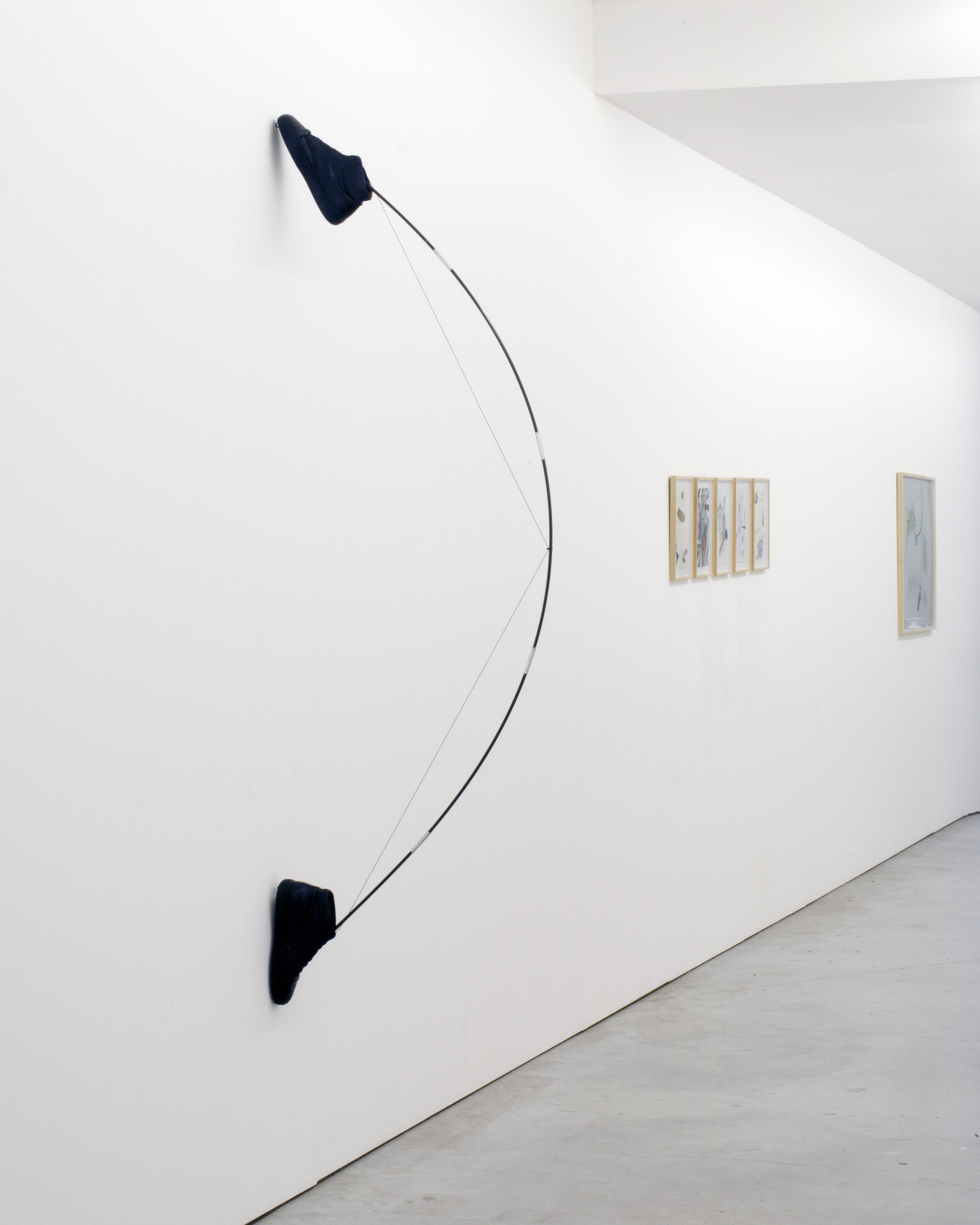
Shoestring tensegrity, 2018
Shoes, tentpole (carbon) and elastic rope
180 x 9 x 120 cm
©photo: Johan Gelper

Spatial squiggle, 2022
Painted aluminium, steel, and wood
©photo: Johan Gelper