FINDING THE SURREAL IN THE EVERY DAY
Brett Foraker
Finding Beauty in the Fragmentation
Director at Ridley Scott Associates, youngest-ever Creative Director of Channel 4, and fine art photographer whose InterZone series asks us to reconsider what digital really means in the age of screens.
Fine Art Photographer
Screenwriter
Brett Foraker began his career as a painter before turning to photography and filmmaking. All of his projects are imbued with a lyrical and at times surreal point of view. His early years were spent developing the brand identities of channels including TCM, Film4, and E4. He was then appointed the youngest-ever Creative Director of Channel 4 (UK), where he directed the multi-award-winning C4 Idents and Faces of 4 campaigns.
Since then he has been making films through Ridley Scott Associates, directing award-winning campaigns for Toyota, Sony, British Heart Foundation, Syfy, Lexus, Puma, and Samsung with Rihanna, among others. Among his many accolades are awards from Cannes Lion, Creative Circle, BTAA, and the coveted Black Pencil from D&AD. His book of photography, Drifter Pictures, was published in 2012.
As an artist, Foraker is focused on the pulse of our increasingly digital world. Where others characterise technology as cold and lifeless, he taps into the breath that runs through the digital as it integrates with the organic. He is not interested in the sparks and wires, but in the heartbeat we give that world when we engage with it. Instead of asking how the physical world led to the digital, he asks how the digital and technological can lead back to something organic.
A pivotal moment came when working with a photographer who placed a glass prism in front of the lens to distort and manipulate the image in-camera. That gesture, of confusing the technology into making something it was not designed to make, became the seed of Foraker's fine art photographic practice. He currently splits his time between London and Los Angeles, where he is developing several feature film projects.
What is the primary motivation behind your fine art photographic practice?
My primary motivation is to explore the line between figuration and abstraction. For me, this is the place where art is at its most spiritual. There are unexplainable energies in everyday life, and the work I return to again and again seeks to portray these in some way. In a sense, I try to make art that is both familiar and unknowable.
If you factor in our increasingly complicated relationship with technology, the possibilities increase exponentially. There is a non-zero chance that our brains are being profoundly altered by these devices. It certainly feels that way from the inside. And I simply want to find beauty in the fragmentation.
Do you have any rituals or practices that you partake in as a creative?
There are quite a few, but in general the first rule is to show up. Try to listen to your inner voice and put in the work every day, even if you are moving between disciplines. The second thing is to be open to accidents. Even seek them out. The subconscious mind is always straining to escape, and this is one way it can. You have already put your intention out into the world, so occasionally relinquishing control can be a good thing.
"Every new technique I have ever created started as a mistake."
Could you speak more to the importance of transformation in both your life and work?
From a very early age, I was obsessed with death. As a child, I was bewildered that people did not make a way bigger deal about it. Then I realised it made them too uncomfortable. But I never shared that discomfort. I always found all of the decay and corrosion to be fascinating. Not only was it poignant, it was often unspeakably beautiful.
I think once we accept that we are all involved in this basic transformation, all of the other transformations we wish to perform in life become that much easier. Measured against that, there is nothing to be afraid of.
Why is it important to find the human and organic in a digital space?
The digital space is one that seeks perfection. I personally find this concept to be sterile and often lifeless. I want emotion, a loosely controlled messiness. This is my experience of humanity. So I try to confuse the technology into making mistakes. This results in work that has distortion, repetition, beautiful flaws that I would be hard-pressed to create on my own.
I also find that this juxtaposition very accurately reflects my mental state. Technology is a drug and we are high almost all the time. Just as art from the 1960s reflected a sense of the psychedelic, so ours must reflect our current situation.
What role do you think art plays in an increasingly digital world?
In my view, art still has the same basic role it has always had: to explain ourselves to ourselves. How these human truths are delivered is less of a concern. When we talk about AI-generated or AI-assisted work, it will only ever be a simulation of art that has previously existed. So its utility in our inner lives is limited.
It is possible that AI will advance to such a degree that it can make art that addresses its own existence, and I would be intrigued to study it. But for now I am hoping to see more tools that will help more people express what is inside them.
As technology advances, do you think we can no longer return to what once was?
All art is a series of choices. Ignoring technology is also a choice. We can create little bubbles around painting and sculpture and shooting on film and listening to vinyl, but they are not in step with the broader sweep of commerce. So the question is: why do these things persist?
One element they all have in common is not nostalgia but texture. Those who have experienced real texture are left cold by newer technologies, but we are perhaps coming to a generation who either does not know about texture or who may not value it as highly. I find all of these questions fascinating.
Cityscapes
Portraiture
Floral Studies
Digital & Organic
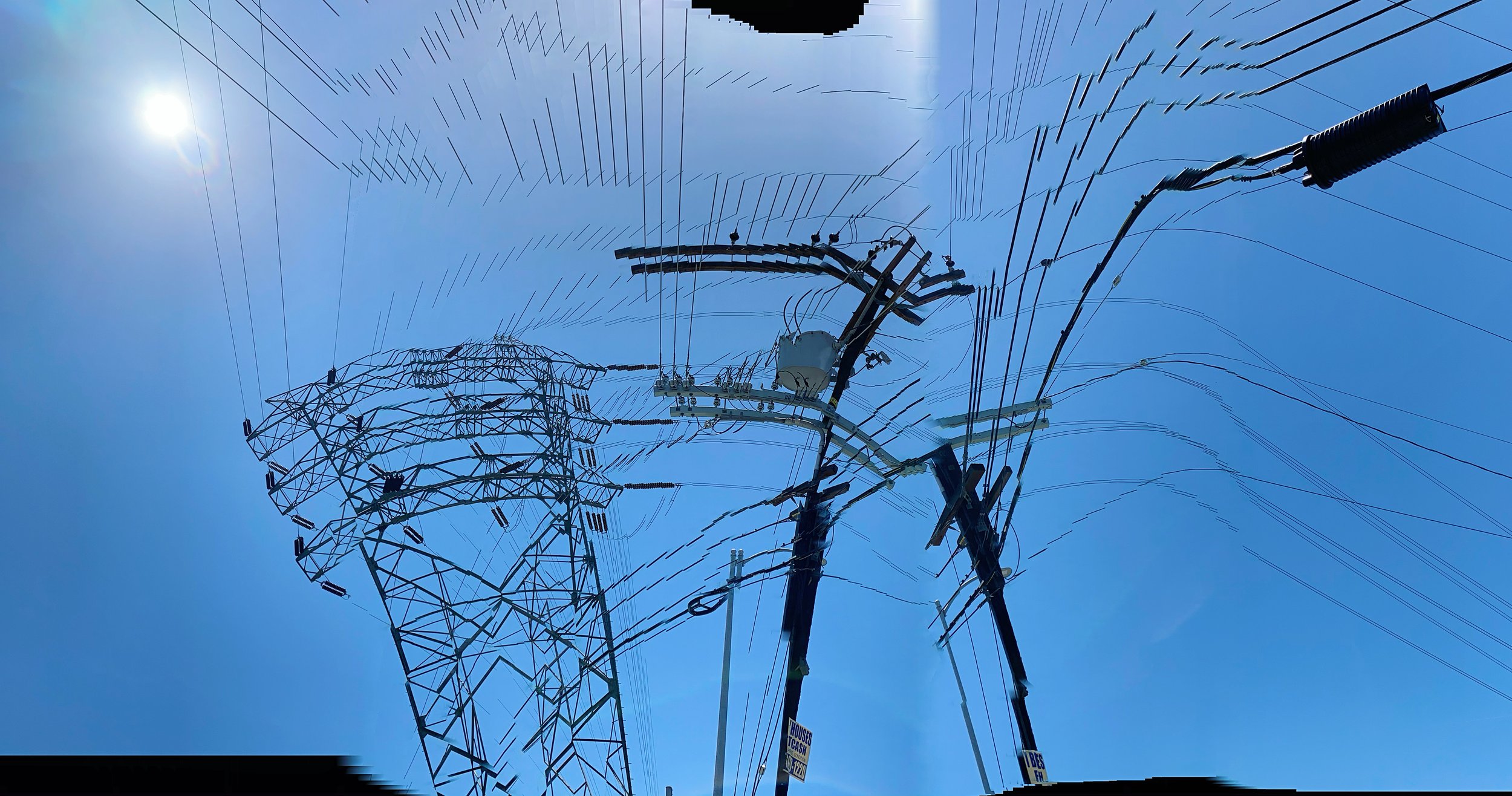
Broadly called the InterZone series, Foraker's photographic work encompasses cityscapes, portraiture, and floral studies. These pictures are his way of blending two states of consciousness into singular images: our attention is divided between the real world and the digital one, and these photographs inhabit that split.
The series is both a document and an invitation. A document of what it feels like to live inside a screen-saturated life, and an invitation to find the beauty in those moments where the physical and the digital overlap. The lesson, as Foraker puts it, is empathy. He wants the viewer to know that they are not alone in the fragmentation.
The work is created in-camera, using distortion, layering, and what he calls "beautiful flaws" to produce images that feel at once computational and deeply human. No pure CGI, no clean renders. The messiness is the point.
Stay curious,