Inside the Mind of Maxim Zhestkov
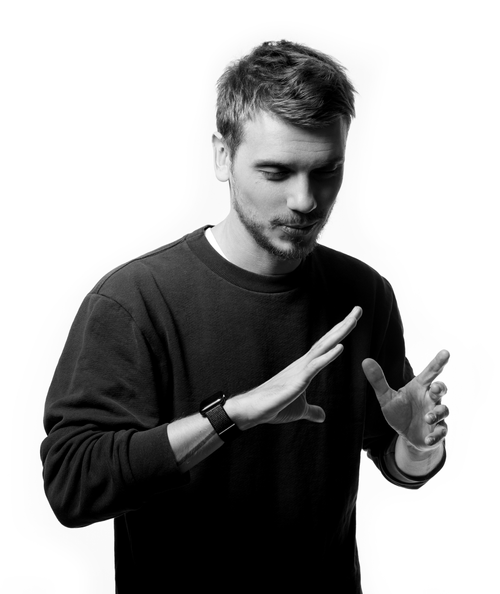
Maxim
Zhestkov
At just 23, this Russian director and video artist was not merely creating visuals — he was architecting entire universes born from the deepest corners of his dreams. A visionary who saw the future of digital art before anyone else did.
In the vast landscape of digital art, few voices are as distinct and philosophically grounded as that of Maxim Zhestkov. His work is a hypnotic synthesis of science, sound, and motion — challenging the very boundaries of what digital art can be. This rare archive interview is resurfaced and given the space it always deserved.
The Path That Broke the Rules
Zhestkov's journey began not in a lecture hall, but in front of a ZX Spectrum computer at the age of six. Days spent crafting huge, detailed illustrations — combined with a passion for video games — laid the foundation for a future in CG and design that no curriculum could have predicted.
He initially pursued architecture, a discipline whose structural precision still echoes in his compositions today. But he soon realised its constraints clashed with his need to experiment. "I felt that architecture would limit my ambitions" — and so he switched to graphic design, unlocking boundless creative exploration.
This pivot was everything. Static images became 3D spaces. Then he discovered his true calling: video art. "It all started with 2D illustrations, that smoothly turned into 3D illustrations and spaces. Then I realised that the most important thing is video art."
"Any composition needs to begin with one or two main elements. You need to start with one or two main ideas and gradually build up the smaller elements until the space becomes rich with life."
— Maxim Zhestkov on the philosophy of composition
Synthesis as Method
What sets Zhestkov apart is his unique creative philosophy. He is a master of synthesis — deliberately bringing together seemingly contradictory ideas to form something entirely new. The smaller the elements, the greater number of them there should be. Density creates life.
His ideas emerge from a methodical yet deeply organic process: "My ideas are the result of combining two or three stencils, and using existing patterns to form new ones." A philosophy that echoes the logic of the universe itself — simple rules, repeated at scale, generate infinite complexity.
Favourite Contemporary Artist
Carsten Nicolai — Alva Noto
When asked who inspires him most, Zhestkov points immediately to the German polymath Carsten Nicolai. What he admires is Nicolai's incredible ability to "compare and mix science and art" — a quality that mirrors Zhestkov's own pursuit of finding the art in data and the science in beauty. Two synthesisers, separated by culture and medium, united by the same fundamental obsession.
"I deeply believe in the power of sound evocation. I take a lot of time working on this part of the music. It is the foundation of everything."
— Maxim Zhestkov on process