
CONNECTING DOTS AT THE SHARJAH ART FOUNDATION
Sharjah Art Foundation
"After all, well, moon is a polka dot, sun is a polka dot, and then the earth where we live is also a polka dot."
This weekend Fatima el Malki and I took a road trip over to visit the Sharjah Art Foundation to check out Yayoi Kusama's Dot Obsession. Art Dubai, Alserkal Avenue, and events such as Art Nights in the DIFC have done an amazing job promoting cultural exchange and have put Dubai on the map. But we particularly enjoyed the less pretentious environment in Sharjah, where we got to engage and have fun in our interaction with the art.
There is something about the Foundation that resists the polish of the commercial art world. It does not perform importance. It simply holds extraordinary work in beautiful, light-filled spaces and trusts you to meet it. That trust is rare, and it is precisely what makes Sharjah one of the most important art institutions in the international arena: it has built credibility not on spectacle, but on a sustained, serious commitment to artists from the Global South and beyond, long before the rest of the region caught on.
"A tumultuous drive from Dubai to Sharjah, mostly because of Leila's driving, is the only downside when the destination is the Sharjah Art Foundation. My best recollection of discovering Sharjah was driving up to an enclave belonging to the emirate on the east coast of the UAE, where Adrian Villar Rojas's installation Planetarium was stationed at the abandoned Kalba Ice Factory as part of Sharjah Biennial 12.
It is exhibitions such as Enrico David's Fault Work that make up for the somewhat shaky commute to Sharjah tenfold. The space housing the show, with its floor-to-ceiling windows, welcomes a beacon of light that crashes onto the gorgeous metal sculptures and colourful wool tapestries. A delight to take in when looking for an escape from the bustling city life in Dubai."
Exhibiting for the first time in the region, this Italian artist based in London showed metal sculptures and large-scale wall tapestries. The floor-to-ceiling windows turned the daylight itself into part of the work, the light shifting across the surfaces as the afternoon moved.
Since the age of ten, Kusama obsessively experimented with dots and the repetition of forms, covering photographs and drawings to obliterate the image. This exhibition spanned small and large-scale works: works on paper from the 1950s, collage works from the 1970s and 80s, and twelve paintings from her ongoing series My Eternal Soul, combining her obsessive patterns with bright colour.
Her collages were inspired by her close relationship with the artist Joseph Cornell, who gave her a selection of collage materials before his death in 1972. Cornell's fascination with birds led to a series of aviary boxes that Kusama later references, birds and other creatures confined in complexly patterned circles that appear almost like nuclei surrounded by auras and biomorphic fringes.
"You become a participant, and ultimately a performer, of Kusama's Dot Obsession."
The Dots Obsession · Infinity RoomThe Dots Obsession is a series of oversized inflatable polka-dotted balls surrounding a domed infinity room which you can walk into. By looking into one of the other oversized balls, you are surrounded by an illusion of an infinity-like mirror space with endless lines of dots. This is the genius of Kusama: she does not ask you to stand back and admire. She pulls you inside the obsession until you are part of it.
A historical survey tracing the evolution of Sudanese modernism, showcasing paintings, drawings, pottery, and rare archival materials from foundational figures like Ibrahim El-Salahi, Ahmed Shibrain, and Osman Waqial. I loved the vintage photography display, particularly a 1975 portrait. There is a quiet radicalism in an institution choosing to tell this story with such depth, a whole modernist movement that most of the Western art world has never properly reckoned with.
Fatima randomly shot a photo at an exhibition titled Women in Crystal Cubes, and what is so interesting is that the subject turned out to be the artist Kamala Ibrahim Ishaq herself, which we only found out later. These are the accidents the Foundation invites: you wander in without expectations and leave having brushed against a history you did not know you were looking for.
Another highlight was the outdoor site-specific mixed media work by Bassem Yousri titled I Am Serious!. It is part of March Project, an annual education residency featuring site-specific works developed by five artists. The works draw on the history and social fabric of Sharjah, the daily lives of its residents, and their relationship to art, institutions, space and architecture. This edition spanned video, photography, sculpture and installation.
Reem Falaknaz's work, a video installation of interviews with Syrians living in Sharjah who run their own businesses, contemplates being away from Syria and building a new life. I was curious to know what makes this an art piece rather than a short documentary in the artist's mind, something I hope I get the chance to discuss with Reem one day.
Moon is a polka dot. Sun is a polka dot.
The earth where we live is also a polka dot.
And Sharjah, it turns out, is where you go to really see them.
With thanks to Fatima el Malki for the company, the conversation, and her patience with my driving. Photography credits: Sun Lady, Studio Mwahib, El Obeid © Fouad Hamza Tibin / Elnour · Bassem Yousri © Hind Mezaina.
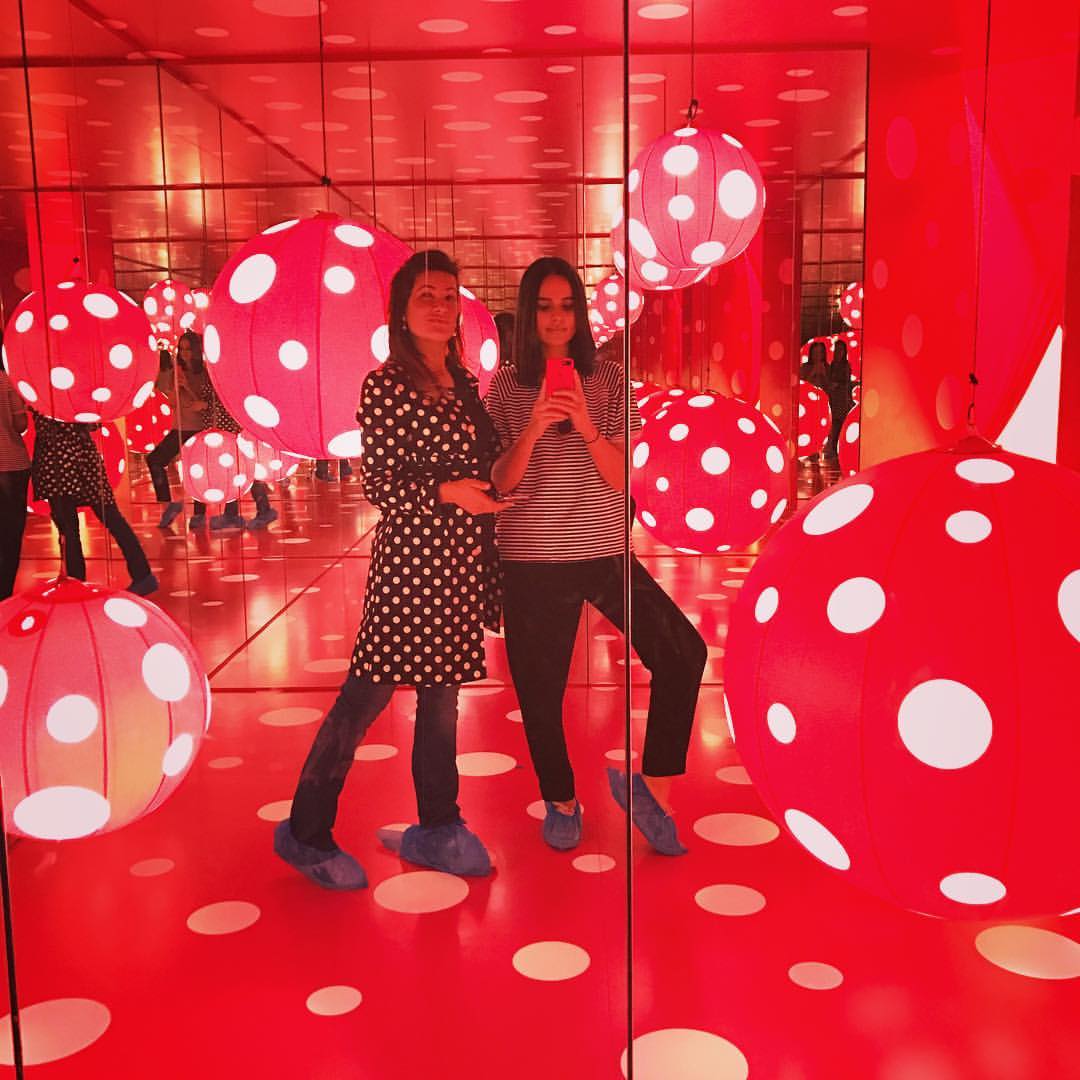
Leila and Fatima Sharjah Art Foundation Selfie

SUN LADY, Studio Mwahib, El Obeid © Fouad Hamza Tibin / Elnour

The Assumption of Weee, 2014, Courtesy Michael Werner Gallery, London and New York