SamiraMahboub

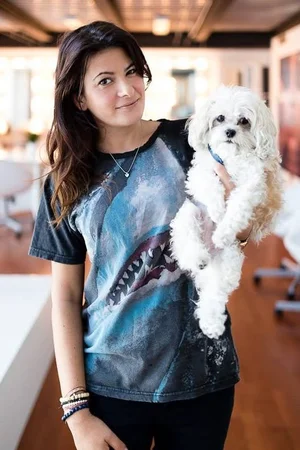
She doesn't fit into boxes, and that's entirely the point. Samira moves between continents, disciplines and identities: model, gender scholar, performance artist, collector of jewellery from Morocco, Afghanistan and India, reader of theory, lover of the desert.
Samira Mahboub is a gender scholar, performance artist and model who, when we spoke in 2016, was travelling between Europe and the US. She studied sociology and psychology at the Ludwig-Maximilians-Universität in Munich, then took an interdisciplinary master's in Gender, Media and Culture at the London School of Economics. Her research focuses on postcolonial theory, gender, sexuality and affect theory.
Born and raised in Munich to a Moroccan-Berber father and a German mother, she has lived in Australia, India (for about seven months), London, New York, Paris and Dubai. She is a passionate backpacker, loves Indian, Moroccan, Lebanese and Vietnamese food, dances to any kind of music, and reads “more theory books than novels, actually.”
An exploration of what the “mipster” veil signifies in the United States after 9/11.
“A mirror that is stimulating new perspectives and reflects different realities, not the moral police.”
Samira Mahboub on the work of SAMANIAOur 2016 interview
Interview by Leila AntaklyWhat are your greatest inspirations or influences?
Generally, I get inspired by people and my social environment. Every time someone around me says something inspiring, I put a note in my phone as a quotation and think about the implication and larger sense of that statement. However, some of my strongest influences are the theorists I was reading and encountering during my studies, such as Jean-Paul Sartre, Simone de Beauvoir, and more recent scholars such as Michel Foucault, Judith Butler (she definitely is my biggest intellectual crush!), Edward Said, Fatima Mernissi, Amina Wadud and Sara Ahmed.
More recently, I started getting very inspired by performance directions such as physical theatre (for example Pina Bausch) and performance art (one of the classic figures, Marina Abramović). In a wider sense:
- Artists: Shirin Neshat, Frida Kahlo, Pina Bausch. Writers: Susan Sontag, Nayyirah Waheed.
- Fashion and photography: Annie Leibovitz, Tim Walker, Peter Lindbergh, Helmut Newton.
- Cultures and traditions: we need to have curious hearts.
- Music: Tracy Chapman, Leonard Cohen, Joan Baez, Bob Dylan. I have a weakness for music that is more melancholic; it puts me in a place that is inspiring to me.
You are both an international model and a performance artist. How did you get into both?
I started modelling between my bachelor's and master's programmes, as a great platform to help finance my master's. During my master's, I met my creative partner Ania Catherine, and we soon started working as an art duo under the name SAMANIA. After finishing my master's, I continued working as both a model and a performance artist under SAMANIA.
What is SAMANIA?
SAMANIA is an artist/scholar duo composed of Samira Mahboub and Ania Catherine. We met in 2013 while pursuing master's degrees at the London School of Economics Gender Institute. In 2014, we collaborated on our first film, cloth (which we directed and performed), which was featured in the International Museum of Women's exhibition “Imagining Equality” and in the Huffington Post's “5 Amazing Ways Women and Girls are Breaking Gender Stereotypes Worldwide”.
Our initial motivation to collaborate was a desire to visually translate the subjects we studied (gender, sexuality, postcolonial theory, politics, media) into a medium that was digestible to a wider audience. We still incorporate our academic backgrounds into our work, bridging academia with art, performance and film, and more recently we have also used our daily life experiences and questions as inspiration. In addition, I work internationally as a model, and Ania works in Los Angeles as an artist and choreographer.
The most interesting response to your performance or art so far?
“I feel like I am watching something I am not supposed to watch, and at the same time I am mesmerised.”
Some people feel challenged in their views, perceptions, ideas, values and ethics, and people watching our work sometimes express a feeling of struggle and discomfort. That fits very well with what we try to achieve. SAMANIA is interested in disrupting and challenging mainstream perceptions, opinions and views. I like to look at our work as a medium that holds a mirror in front of you, but not a mirror that is supposed to be the moral police; rather, a mirror that stimulates new perspectives and thoughts and reflects different realities.
How do you view the fashion industry and modelling as a career?
First of all, modelling to me is always a performance. A performance of concepts and, what I find more intriguing, a performance of authenticity.
I look at modelling as a fascinating way to discover myself through body language, a constant medium of self-expression. It taught and still teaches me a lot about the relationship I have with myself, my body and mind.
I also see it as a promising platform, a stepping stone to gain more visibility in the public and media, in order to use that voice to address social issues and take on global responsibility. Ideally, I want to make a contribution to society, and modelling is one interesting way to achieve that.
What causes are you most passionate or vocal about?
I am passionate about addressing the still-existing lack of diversity within the industry. I would argue that the industry is still facing a problem of “whiteness”. Despite an increasing celebration of multiculturalism and diversity on today's runways, white bodies (as in white models) continue to be the reference point for non-white bodies. For example, I am confident in claiming that non-white models are proportionally underrepresented compared to white models in fashion editorials, unless it is part of some “diversity agenda” or a specific concept explicitly featuring models with “ethnic” backgrounds. It certainly is not the norm, and this needs to change.
I personally try to free myself from the “exotic” label I inevitably carry. Since I am an ethnic and cultural mix with light eyes (often labelled “ethnically ambiguous”), I have difficulty escaping the label of an “exotic model”. While I don't deny that this categorisation can open doors in specific ways, it gets me typecast and reduces me as a model and performer. As we know, labels and categories are very hard to disrupt and overcome, but I am working on it and will find a way :-)
Any pet peeves?
The problem of “whiteness” in the industry is not always recognised, so I feel very strongly about that point, and it is definitely a problem I would like to highlight.
Is there a part of the world or a culture you relate to the most?
Yes, absolutely. It is the Moroccan culture I worship, cherish and love from the deepest part of my heart. I love its richness of traditions, food and colours, and the strong sense of family connection and values. In my eyes, Morocco is full of beauty: people coming together, sharing food from one plate, people laughing and dancing together to traditional or any other kind of music, people praying in the streets for Friday prayer, people at the souks offering Moroccan mint tea, or strangers inviting you to their home for dinner and treating you like family…
Favourite websites, publications, social media handles?
Fashion and art:
More political: Qantara (Dialogue with the Islamic World). On Instagram:
“If you want to fully comprehend me, you must experience me in Morocco.”
Samira Mahboub, 2016Since we spoke
SAMANIA, 2014 to 2019- 2014cloth
SAMANIA's first film, made with no budget in a university building in central London, engaging with Leila Ahmed's Women and Gender in Islam and Chandra Mohanty's “Under Western Eyes”.
- 2017Mirror Stages and One, Dubai
A desert performance and movement installation, photographed by Dejha Ti.
- 2017Hex
A film adaptation of Mary Wigman's 1926 dance Hexentanz, the witch dance.
- LaterFashion and press
A collaboration with the Dubai womenswear label Alayna, and coverage in Vogue Arabia. By 2019, Samira was based in Berlin and Ania in Los Angeles (Berlin–Los Angeles, MilleWorld).


Limala
Limala is the vision of Samira Mahboub and Zaid Charkaoui, celebrating Morocco's artisanal culture by highlighting the beauty behind the art of rug making, within broader cultural storytelling.
“While we both feel deeply connected to our Moroccan heritage but are based in Berlin, it felt very organic to create a project allowing us to share our understanding of Morocco with the world. We travelled through the Atlas Mountains in search of places known for their artisanal communities specialising in rug making, and are now co-creating with small family businesses.
Understanding the responsibility that comes with engaging with Moroccan artisans, our core mission is to have a mutually uplifting working relationship with the artisans we work with, finding ways to deconstruct the postcolonial economic dependency of these rural communities. Ultimately, we are building an inclusive, mindful and conscious community with our customers and collaborators through Limala.”
“When I think of Morocco, I feel its red warm earth running through my fingers, knowing this is where my hands belong. This is where my hands unfold their destiny.”
We welcome you to join our journey. With love and salam, Samira & Zaid
Visit Limala ↗ @bylimala


Related reading
Explore the full archive. And for the personal rants, opinions you didn't ask for and the occasional existential spiral, follow me on Substack.