ARTIST JEANINE BRITO
Brito
Jeanine Brito is a painter and designer living in Toronto. She was born in Mainz, Germany, to German and Brazilian parents, and grew up close to the Canadian Rocky Mountains. As a child she spent summers with her grandparents in Mainz, surrounded by castles better suited to Bram Stoker's Dracula than any fairy tale. Back at school in Calgary, she channelled all that gothic inspiration into art. "The bulk of my drawings were of princesses wearing insane dresses," she says.
Brito studied Fashion Communication at Toronto Metropolitan University and later ran the online fashion magazine Sophomore. She applied her graphic-design expertise to various jobs, but quickly grew disillusioned by corporate constraints. "I was desperate for an outlet, something I could build for myself," she says. Now she divides her time between creative direction and painting. Her work is a theatrical, tongue-in-cheek commentary on the folly of traditional gender roles, the performance of femininity, and, in her most recent exhibition, masculinity.
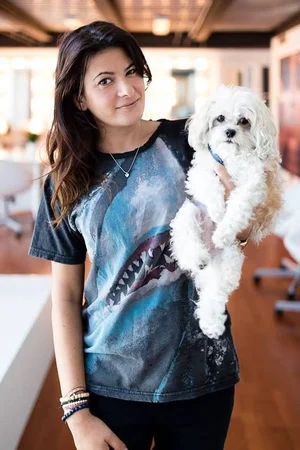
Her first solo exhibition, August and Other Stories, is about memory and remembering, cataloguing memories of her early twenties while also contending with how memory fails us. Portrait of the artist by Amy McNell.
Greatest inspirations and influences?
I have a few highly visual films I come back to over and over again. Sissi with Romy Schneider has been a favourite since childhood. I also love The Witches of Eastwick and Baz Luhrmann's Romeo + Juliet. I'll put these on when I need to feel inspired. They're all so lush and opulent.
For artists, I love Marc Chagall. There's a cathedral in the city I was born in with stained glass windows by Chagall that I always go look at when I'm there. His paintings are so emotive and tender. He reminds me not to get so caught up in perspective and seriousness, that a painting can be joyful.
Tell us about your creative process.
It took me almost a whole year to develop my creative process, where I now feel much closer to who I want to be as a painter. I think of it a bit like a funnel that narrows as you go on, you get more focused as you move closer and closer, but when you're at the top you're trying everything to see what feels right.
For a long time I was playing with collaging reference images in Photoshop and working from that. Then I started working very intuitively from imagination on a smaller scale, and that gave me the confidence to try larger paintings. Now I draw quick little thumbnails of a composition, and then I move onto the canvas. I try to keep some of that element of intuition by making the sketches very fast and loose, and then making decisions about colour as I'm painting.
My work is very much a therapy for me: it's how I try to understand myself and my life, so I often paint self portraits and objects or moments from real life that relate to something I'm processing.
How has the pandemic affected your creativity?
The year of lockdowns meant painting became my central focus. Instead of seeing friends and going out for dinners and travelling, I was at home in my studio, painting. I felt I could experiment more, which led to some important breakthrough moments. All that time at home was very insular, but I came to know myself very well. I started to trust myself more.
It's also been a very dark period. We are all exhausted. The news progressively gets worse. It's hard to feel optimistic about the state of the world, but I see so many people fighting for important, necessary changes, and it gives me some hope. There is so much power in collective action.
Who do you consider to be an icon of our time?
Joni Mitchell is my forever icon.
What does wellbeing mean to you?
Wellbeing means making space for my art practice and protecting that time. It's long walks through the city with my partner, beautiful meals with friends, saying yes, mending instead of discarding.
"My work is very much a therapy for me: it's how I try to understand myself and my life."
Jeanine Brito"In the beginning, I was painting these little figures on smaller canvases, and they were also a sort of a version of me. I was staring at my own face on Zoom all day at work and then going to paint. I was what I had on hand. Now the paintings are very personal and filled with my own internal symbolism, so placing myself within them feels important. I don't think I'd paint a stranger at this point."
Wellbeing means making space for the art practice and protecting that time.
Mending instead of discarding.
Explore more painting in the Antakly Projects painting archive.