ARTIST CARMEN D' APOLLONIO
D'Apollonio
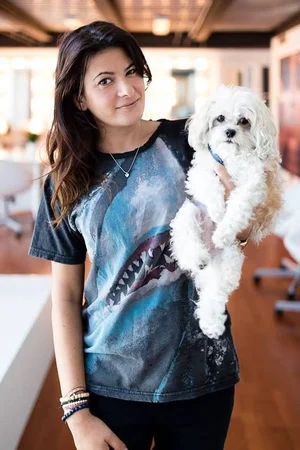
Carmen D'Apollonio investigates the entire spectrum from abstraction to figuration through her practice. Self-taught in ceramics, her approach to sculptural lighting and vessels celebrates the fusion of craftsmanship with functionality. Born in Switzerland in 1973, she previously worked as an art director for short films and commercials in the mid-nineties. In 1996, she began working with the artist Urs Fischer, assisting him for over a decade as he moved from Berlin to New York. She also co-founded the Swiss fashion brand Ikou Tschuss. She established her own studio in Los Angeles in 2014.
Her first solo exhibition at Friedman Benda, titled Don't Wake the Snake, investigates the spectrum from abstraction to figuration, realising intuitive renditions of familiar objects and human forms. Her titles, such as I Wish You Were Beautiful (2019) or Here Comes the Light (2019), range from the comic to the plaintive and offer narrative fragments entirely in tune with their suggestive, open-ended compositions.
Greatest inspirations and influences?
My grandmother. She was super creative and not afraid of anything. Other things that inspire me: nature, friends, architecture, Craft Horizons magazine, Karin Larsson, the Bloomsbury Group and the Omega Workshop.
Tell us about your creative process.
I get up between 6 and 7am, go walk my dog Dino, drive to my studio, have a coffee and a cigarette, then take a bag of clay and start coiling forms that I have in my mind. Or I go through my sketch books and see if there is a form that I think is interesting and then I start working. I worked on two solo shows this year: a March show at Linn Luhn in Dusseldorf and at Friedman Benda in New York.
How has this year changed your creativity?
I'm very lucky that I was still able to work in my studio this past year. I just keep up working and try to stay positive.
Do you think the art world needs to change?
I see myself more as a maker than an artist. I prefer to let artists decide if they want to change anything in the art world.
What does wellbeing mean to you?
Try to make the best out of your life and follow your dreams.
"My work is simple; it often gives way to humor. As if clay had its way of being, its own personality."
Carmen D'Apollonio"D'Apollonio's process begins with sketching, which she then translates into clay, evolving the three-dimensional form as she goes. Her lamps and vessels, which have grown in size gradually since she started working with clay seven years ago, are undoubtedly creature-like. Hulking, stooping, and squatting beside you or looking down from above, they engage in cyclical and spasmodic conversations, with their audience and one another." — Camille Okhio, PIN-UP Magazine
What was your first job?
I studied in Switzerland to be a window dresser for four years. In the program you go through all these areas, you work in wood, you make sculpture, you build pedestals. It's very creative. After I finished, I worked in a flower shop, in bars, for artists, then started working in galleries setting up exhibitions. That's how I met Urs Fischer. I was working at the Migros Museum in Zurich and Urs was in a group show there where he made a wall out of vegetables. We became close friends and eventually I offered myself as an assistant. He said yes and I moved to Berlin the next week. I stayed with Urs for over ten years.
Did working for Urs Fischer leave a mark on you?
Yes, of course. I did a lot of sculpture work for Urs. I was building sculptures with different materials, learning a lot.
What was it about clay that appealed to you?
Clay is just something that you can create anything with. You can build whatever! It's a beautiful material. It's dirt but you can wash it out. I always loved to work with my hands and with clay you can create something that usually matches your vision.
You've been working on larger and larger scales. What has that process been like?
I try to make larger and larger lamps without breaking them, but it's not easy. I eventually got a really big kiln, it's six feet tall, I can stand in it. But for a big piece to dry completely and nicely before firing, it takes up to six or seven months. You have to keep the piece in the plastic for this time, let it breathe a little bit, put the plastic on again. If you push it a little too hard, cracks can form.
Clay is dirt but you can wash it out.
"I always loved to work with my hands and with clay you can create something that usually matches your vision."
For more conversations with artists working in clay ninunina.com/ceramic-art.


Courtesy of Friedman Benda and Carmen D’ Apollonio
Photo by Schaub Stierli