PHOTOGRAPHER GABRIELE CECCONI
Gabriele
Cecconi
After finishing law school, he discovered photography and a hidden part of himself. Through this medium he found a way to reconnect with a more sensitive side.


From law school to Perugia to Bangladesh. Gabriele Cecconi on the Rohingya crisis, the fragility of our world system, Greta Thunberg's anger, and why quality of work is still a cornerstone even when you come from nowhere.
"After finishing law school, I discovered photography and a hidden part of myself. Through this medium I found a way to reconnect with a more sensitive side."
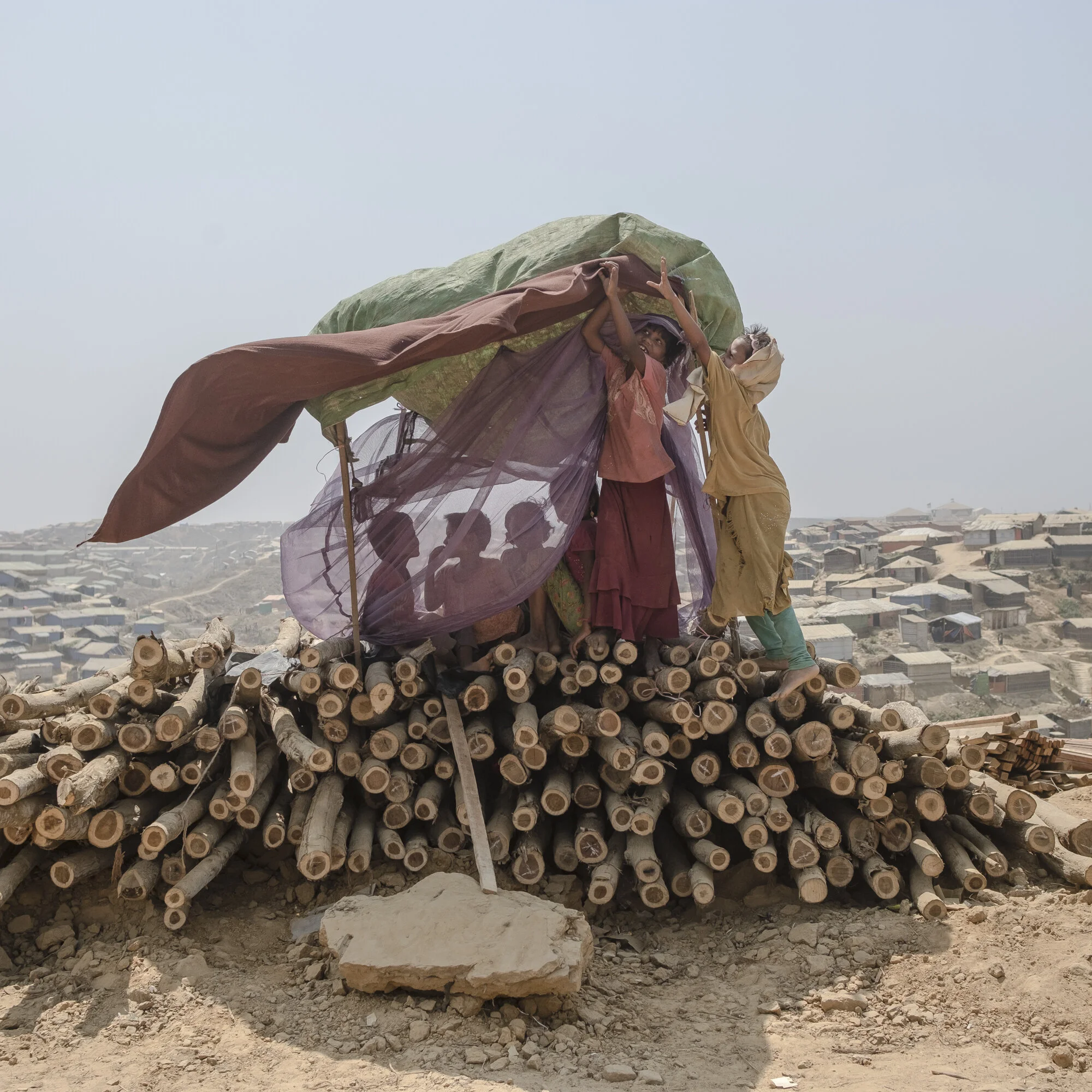
Gabriele Cecconi came to photography late. After earning a degree in law he picked up a camera at 27 and wanted to build a proper foundation first the masters, documentary tradition, the rules. Then he started to break them. In 2015, Camera Torino and Leica selected him for a masterclass with Magnum photographer Alex Webb. His work on the environmental impact of the Rohingya migration in southern Bangladesh went on to win the Yves Rocher Photography Award at Visa pour l'Image, POY, the Andrei Stenin Grand Prix, PX3 Photographer of the Year, and the LUMIX Sustainability Award.
His images have been exhibited at the Hermitage Museum in St. Petersburg, the United Nations headquarters, the Photo Vogue Festival, and the Fotofestiwal in Lodz. He is published in National Geographic, Geo, Der Spiegel, Internazionale, Newsweek, and Courrier International. He teaches photography and visual communication at NID Academy in Perugia and conducts training for the ITCILO of the United Nations.


Who are your greatest inspirations and influences?
My first points of reference were the first photographic masters: Nadar, Kertesz, Steichen and traditional documentary photography. However, during the past two years I started to work without any boundaries and my practice is constantly changing and evolving. Now I am also inspired by contemporary artists: James Welling, Dan Graham, Pierre Soulages, Richard Serra, Anish Kapoor.
Tell us about your creative process.
At the beginning my research was focused on classic photography culture. Since I started at 27 I wanted to get a good foundation. Straight away I realised the link between every field of art and life. I don't want to be attached to any labels and feel free to move beyond different fields. My last work is more complex from a conceptual point of view and I hope it will be the starting point of another step in my still short career.
"I was coming from nowhere, no photo schools, no friends in the field, nothing. And I am thankful because despite all this, my work has been recognised and exposed all around the world. So there is still hope."
Gabriele Cecconi
Who are the icons of our time?
I don't really like the idea of a process of idolisation. However, Greta Thunberg can be a good example. She's so young but she seems so angry, and this can be a good synthesis of the common feeling of youth in the world. While our parents grew up with a certain sureness about work and future, the youngest generation are born into a very uncertain world. In Italy 30% of youth is unemployed and global warming will change our earth deeply in the next decades.
Do you think the art world needs to change, and if so, how?
If you ever saw Orson Welles' "F for Fake" you could understand what can affect the art world, and that these theories are still more valuable today in the time of social media and globalisation. But from a certain point of view I can say that the art world is still inclusive and I want to say to all young artists and photographers that despite all, the quality of the work is still a cornerstone. If we know ourselves, we undertake a serious path towards our deep self. We can still find motivation and hope to find our own identity and spread our work.
"Ghana was the first sub-Saharan country to gain its independence from the United Kingdom, in 1957."
A country of 27 million inhabitants, one of the main actors on the continent. The economy is growing, education levels are high, and the absence of conflicts has too often overshadowed the media's attention. For Cecconi it represents an interesting exception in relation to its geopolitical context. An underrepresented story worth telling.
We have been a part of this change, using social media to expose the works of some of the most inspiring artists in the world and putting you, the reader, in touch with them directly. There is no need for only a few people in a flawed system to dictate what artists can and cannot be exposed to. Today it is more important than ever to preserve the artist's perspective. Because artists are. ✦