
Madrid’s Museo Lazaro Galdiano
The Museo Lazaro Galdiano is one of Madrid's most underrated cultural treasures. Sometimes called Madrid's Frick Collection, it houses Goya's Witches' Sabbath, a Hieronymus Bosch, Velazquez, El Greco, and one of the greatest collections of miniatures in Europe, all inside a spectacular neo-Renaissance palace in the Salamanca neighborhood. Hardly anyone goes. You should.
 Museo Lazaro Galdiano
Calle Serrano 122 · Salamanca, Madrid
Museo Lazaro Galdiano
Calle Serrano 122 · Salamanca, Madrid
The Museo Lazaro Galdiano opened its doors on January 27, 1951, and its inauguration was a pleasant surprise for the public and professionals related to culture. José Lazaro Galdiano was a publisher, journalist, and passionate art critic. Critics often note his collection is incredibly subjective and encyclopedic rather than rigidly curated, likening it to a lavish, multi-room cabinet of curiosities. His eclectic collection of some 13,000 works was amassed largely while traveling with his wealthy Argentine wife, Paula Florido, during extended stays in New York and Paris. Upon his death, he bequeathed the collection, library, and his magnificent neo-Renaissance residence, Parque Florido Palace, to the Spanish government.
"I definitely prefer this kind of place to large museums. An impressive collection without the crowds."
Leila AntaklyInside you will find works by Hieronymus Bosch, Velazquez and Goya, among other great artists, as well as an interesting collection of miniatures, armor, jewelry, sculptures, drawings, secular and religious manuscripts, ivories, enamels, bronzes, fans, textiles, and medals representing Hellenistic, Islamic, Gothic, Renaissance and Baroque periods. The collection of small portraits and miniatures is considered the most important in Europe.
 Ines de Zuniga
Juan Carreno de Miranda · c.1660
Ines de Zuniga
Juan Carreno de Miranda · c.1660Museo Lazaro Galdiano
The highlight of a visit, for many, is to see the wonderful Gothic masterpieces Galdiano collected throughout his life. Here you can find El Greco's melancholic paintings, the bizarre and esoteric works of Hieronymus Bosch, and the disturbing art of Francisco Goya. The museum also holds some of Goya's Witches' Sabbath oil paintings and the entire Disparates print series, which features haunting black-and-white sketches portraying visions as if from a datura-fueled waking nightmare. One note on Rosalia fans: Witches' Sabbath is a visual inspiration for her current tour.
The portrait of Ines de Zuniga, Countess of Monterrey, when she was about twenty, is considered one of the most beautiful portraits by Juan Carreno de Miranda and of his entire era. Her fine features and intelligent smile dominate the composition. Her elaborate clothing stands out with a tight doublet with two large flaps covering the upper part of an enormous skirt. A pink ribbon hangs from her waist, holding a curious toilet bag shaped as a pistol.
Another gem is Saint John the Baptist in the Desert by Hieronymus Bosch, the highlight of the museum. Here we see St. John reclining in a surreal landscape, pointing to a lamb that symbolises the road to salvation, beside a strange plant resembling a deformed pomegranate interpreted as earthly pleasure. Upon closer inspection the pomegranate hides a face: Bosch painted out the patron of the work after a dispute, distorting him into a strange-looking shrubbery.
One of Goya's Black Paintings, created on the walls of his home, the Quinta del Sordo, in his final years. A large he-goat representing the devil presides over a gathering of witches. The work is both a scene of witchcraft and a social critique of the ignorance and fanaticism of the era. It reflects Goya's personal anguish and his view of Spanish society as dominated by superstition and evil. The museum also holds the entire Disparates series, his haunting black-and-white print cycle of waking nightmares. Both series can be understood as an attack on the superstitious beliefs exploited by the established order for political gain during the bitter struggle between liberals and royalists in the early 19th century.
 La Vision de Tondal
Follower of El Bosco · Museo Lazaro Galdiano
La Vision de Tondal
Follower of El Bosco · Museo Lazaro Galdiano
The Vision of Tondal by Hieronymus Bosch is one of the artist’s most psychologically haunting meditations on sin, punishment, and spiritual reckoning. Inspired by the medieval Irish text Visio Tnugdali, the painting follows the knight Tondal through terrifying visions of hell before his eventual redemption. Bosch transforms this moral allegory into a feverish landscape of human anxiety, where grotesque hybrid creatures, burning architecture, and distorted bodies collapse the boundary between the real and the surreal. What makes the work so enduring is not simply its horror, but its extraordinary understanding of human weakness and fear. Bosch’s hell is not abstract; it is deeply emotional, exposing greed, vanity, violence, and temptation as forces that deform the soul from within. Centuries before modern surrealism or psychological art, Bosch created a visual language capable of turning morality into nightmare, making The Vision of Tondal feel startlingly contemporary even today.

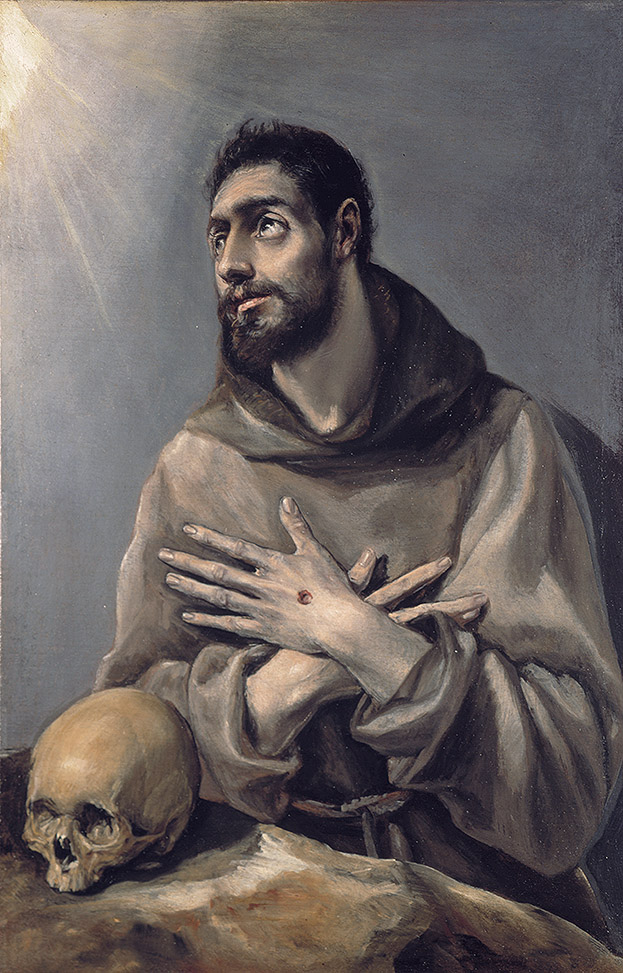
El Greco, St Francis