LALLA ESSAYDI
Challenging Orientalist Mythology
One of my favourite pieces from Art Dubai this year is by Lalla Essaydi, who grew up in Morocco and lives in the United States, where she received her MFA from the School of the Museum of Fine Arts at Tufts University in 2003. Her creative process is labour-intensive. Interested in the interaction between the female body and architectural spaces, she stages her models within existing sites or constructs her own elaborate settings.
Her art, which often combines Islamic calligraphy with representations of the female body, addresses the complex reality of Arab female identity from the unique perspective of personal experience. In much of her work, she returns to her Moroccan girlhood, looking back on it as an adult woman caught somewhere between past and present, and as an artist exploring the language in which to speak from this uncertain space.
Her work appropriates Orientalist imagery from the Western painting tradition, inviting viewers to reconsider the Orientalist mythology. She has worked across painting, video, film, installation, and analogue photography. Essaydi admires nineteenth-century Orientalist paintings for their beauty, but not their false narratives.
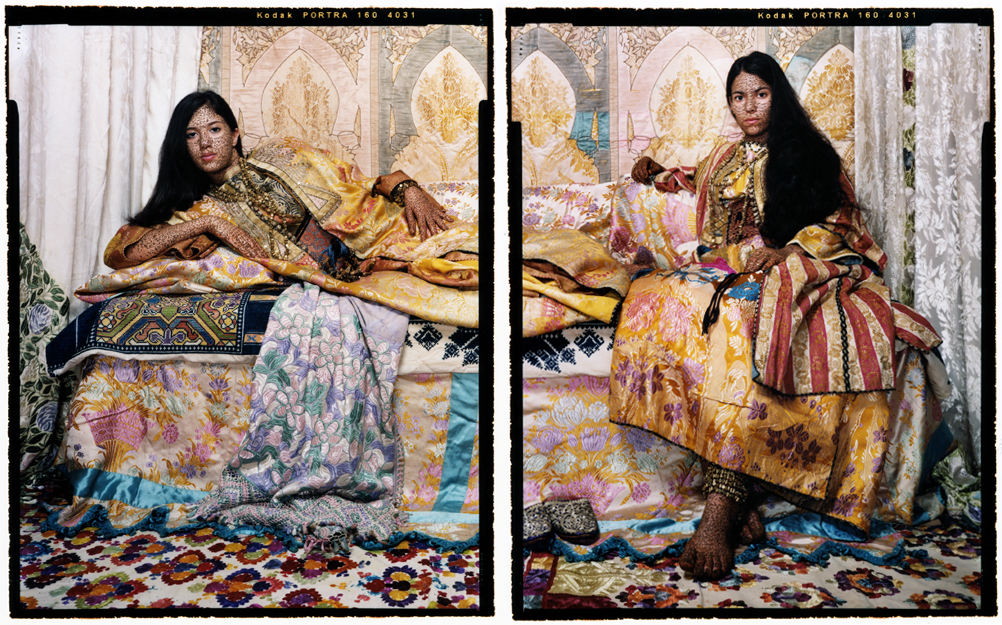
The Western fantasy of the secluded, sensual female interior, reframed and returned to the women who actually inhabited those private spaces.
Not as concealment imposed, but as private space claimed. A protection from the gaze of Orientalism, integrated with the expressive force of calligraphy.
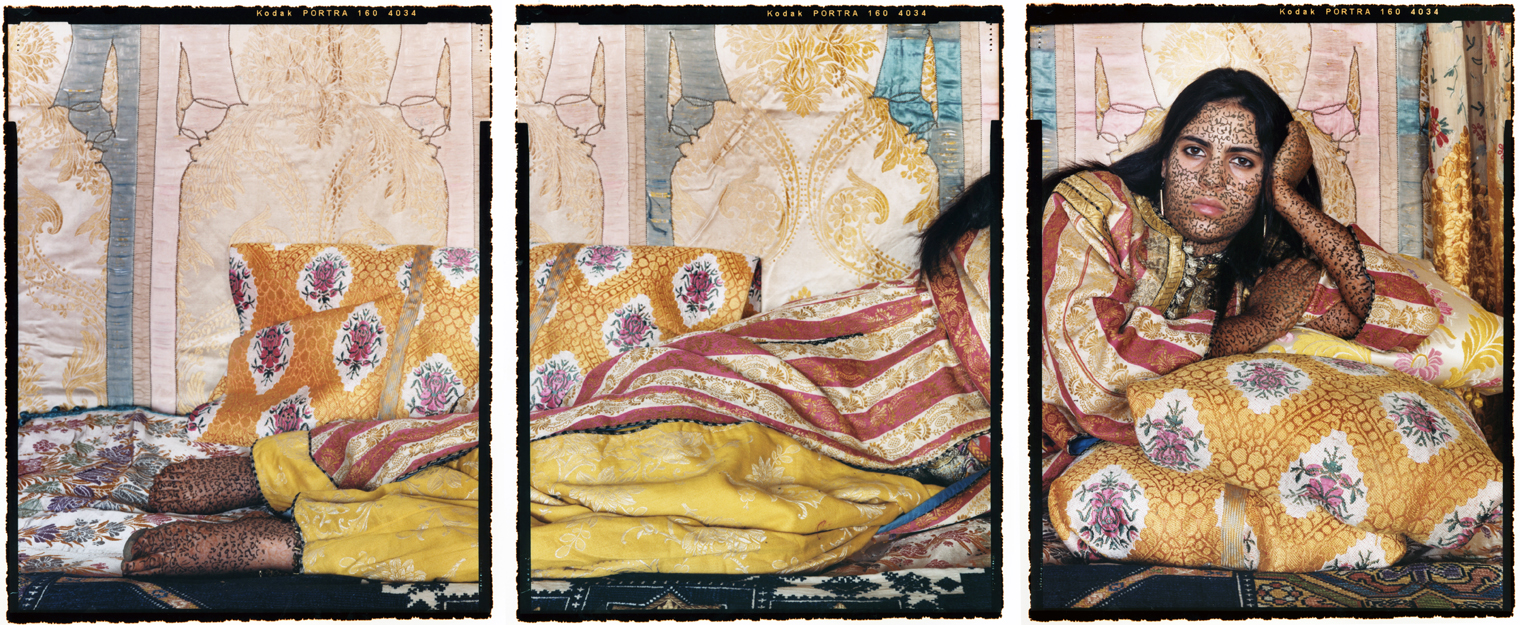
The seductive reclining nude of Western painting, subverted with a segmented body and, crucially, a returned gaze. The subject looks back.
"In my art, I wish to present myself through multiple lenses: as artist, as Moroccan, as traditionalist, as Liberal, as Muslim. In short, I invite viewers to resist stereotypes."
Lalla EssaydiMoroccan-born Essaydi watched the Arab Spring unfold from the United States. Moved to create, she embarked on a series of photographs. Bullets Revisited #3 evokes the odalisque, the seductive female nude, but subverts the voyeuristic tradition through the segmented body and the returned gaze.
"Bullets is about that violence projected on women, specifically physical violence during gatherings in the squares. I was not there. The only thing I could do is put it in my work and show the world what women were subjected to," the artist said.
"In a sense, my work is haunted by space, actual and metaphorical, remembered and constructed. My photographs grew out of the need I felt to document actual spaces, especially the space of my childhood. In order to understand the woman I had become, I needed to re-encounter the child I once was.
It is obvious that while my photographs are expressions of my own personal history, they can also be taken as reflections on the life of Arab women in general. But I am uncomfortable thinking of myself as a representative of all Arab women. Art can only come from the heart of an individual artist. It is the story of my quest to find my own voice, not an attempt to present myself as a victim, which would deprive me of the very complexity I wish to express.
"Traditionally, the presence of men has defined public spaces. Women have been confined to private spaces, the architecture of the home. Physical thresholds define cultural ones."
"The henna painted on their bodies corresponds to the elaborate pattern of the tiles. The women then become literal odalisques. Odalisque, from the Turkish, means to belong to a place. I want the viewer to become aware of Orientalism as a projection of the sexual fantasies of Western male artists, in other words as a voyeuristic tradition."
"In employing calligraphic writing, I am practising a sacred Islamic art that is usually inaccessible to women. To apply this writing in henna, an adornment worn and applied only by women, adds a further subversive twist. The henna and calligraphy can be seen as both a veil and as an expressive statement. The two are not so much in opposition as interwoven."
Essaydi's great impact is that she took the most fetishised image in Western art history, the passive, available Eastern woman, and handed the authorship back to the woman herself. The subject is no longer painted by a visiting European man. She is staged, written, and photographed by an Arab woman who lived the spaces she depicts.
She made calligraphy, a sacred art historically forbidden to women, into a feminine language by writing it in henna. That single gesture rewrites who is permitted to make meaning. For the generations of Arab and Muslim women artists who come after her, she proved you do not have to choose between your heritage and your critique of it. You can hold tradition and subversion in the same frame, on the same body, in the same beautiful image.
Her legacy is permission: to speak from the uncertain space between cultures without apology, and to refuse both the Western fantasy and the role of the victim.
The odalisque was always someone else's fantasy.
Essaydi gave her back her own gaze.
That is the whole revolution, in a single returned look.
Seen at Art Dubai 2014. Lalla Essaydi's words are reproduced from her artist statement. Explore her full body of work at lallaessaydi.com.
Harem_Revisited_62abc

Harem_Revisited_47abc