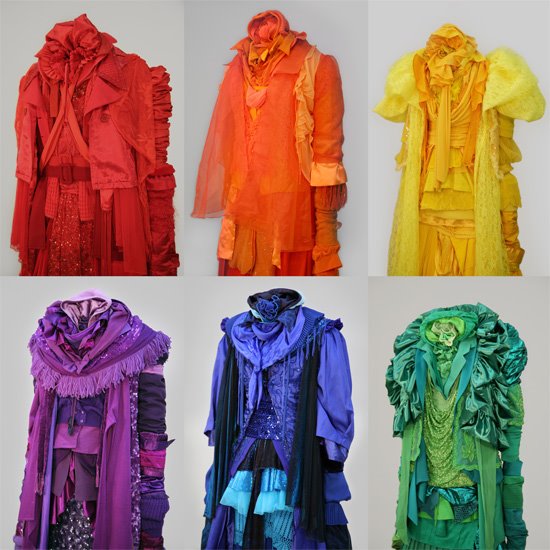
Guerra de la Paz is the composite name of Cuban-born American artist duo Alain Guerra and Neraldo de la Paz, who have been collaborating in Miami since 1996. They began working together the day they decided to share a studio — it happened naturally, drawn simultaneously to the visual language of their neighbourhood.
Originally sourcing garments from Haitian-American businesses involved in the "pepe" trade in Miami's Little Haiti, their sculptures are built from discarded clothing — each piece a relic carrying the absorbed histories of the individuals who once wore it. They see themselves as vehicles guided by the garment's essence and silent histories.
In Nine, a giant mound of clothing heaps with strata of prom dresses, Christmas jumpers, and embarrassing yesteryear fads — bearing down with the weight of a civilisation and its disowned memories. Beneath the fringes of the hulking mass can be seen the feet of nine people supporting the load: a testimony to the strength and value of community.
How did the collaboration begin?
We began working together the day we decided to share a studio. It was not our original intent but it just happened naturally and seemed to work. We were simultaneously drawn to the visual language of the neighborhood and felt the need to incorporate it into our own creative process. That forged a mutual dialogue that has grown over the years into an interwoven partnership.
What are you trying to tell your audience with your art?
We like to believe that the work speaks for itself. It often deals with the familiarity of a material or an image and can be ethereal, iconic, tactile and perceptual. Engaging awareness at various levels through a discourse of universal issues and personal recollections — always leaving it open to interpretation.
"Because textiles have a fundamental familiarity that everyone can recognize, we strive to transfer the same universal quality to our subjects — using archetypal imagery to reflect on current global issues."
Differences in the art world between Miami and New York?
New York is the archetype for culture — no doubt about that. There is more of everything. You can't really compare them in that sense. On the other hand, Miami has that frontier feel about it. And they're connected to each other in so many ways. They have both been very inspiring.
What are you most looking forward to at Art Basel?
Seeing some friends and perhaps making new ones.
Plans for the future?
Yes… but not everything goes as planned. We will keep on doing what we do.
Their neighbourhood was a hub for Haitian export businesses known as Pepe — an industry that buys secondhand goods for resale to Haiti. Inside these operations, bales of clothing enter a sorting process where purchasable items are separated and the rest is discarded into incredible piles that accumulate on a daily basis. The spectacle of vibrant colors, patterns, sheen and textures peaked their interest. Watch the Pepe documentary →
The plasticity and heterogeneous capacity of the clothes gives us an open window to explore the manipulation of the material while breathing new life to these rescued "relics" — transcending their original purpose. Building relationships with these resources permits us to rummage through their mounds of rejected apparel in order to accumulate vast quantities and utilize the clothes we have collected as a prominent medium. Garments carry the identity of the individuals who once wore them while simultaneously safeguarding their anonymity.
From applying principles of impressionist color theory into simulated scenes of nature's peaceful splendor, to employing the attributes of iconography onto personifications of war dynamics — they amalgamate a multiplicity of styles that demonstrate a comprehensive understanding of the abstract and figurative. Their neighborhood remains a paradox: gritty industrial warehouses cohabiting with lush tropical vegetation. A landscape that generated the work, and continues to.