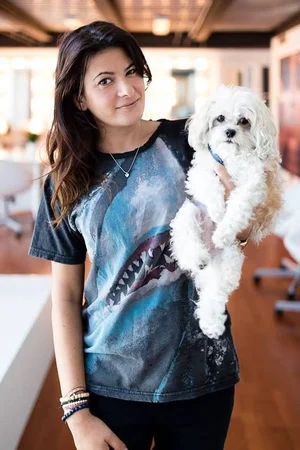
INTERVIEW WITH YOSUZI
Yosuzi Sylvester
The name means cactus flower. She was a New York model who lived for the moment, then went home to the Venezuelan desert and built a brand out of her people's craft.

I first wrote about Yosuzi Sylvester in 2008, when she was a New York model who wanted to conquer the world and mostly wanted to dance. Her name means cactus flower in the dialect of the Guajiro, her mother's people in Venezuela, a word her French-Italian father invented for his last child because it had never existed before. What I did not see coming, and what makes her one of my favorite kinds of stories, is what she did next. She went back to the desert she came from and turned a childhood of ceremony and craft into a brand, and into a way of giving back.
Conquer the World
Back then, Yosuzi was modeling in New York and living, by her own description, somewhere between eccentric and street-chic. She had grown up in Venezuela, boarded in Wales, and finished Boston University early and with honors. Mostly she lived for music and motion. Here is a little of that first conversation, in her own words.
From the 2008 Interview
How do you describe your style?
My style is constantly evolving, but I would say I am somewhere in between eccentric and street-chic.
Challenges of being a model?
Before you walk into a casting, clients already have an image of what they want in their heads. Whether you fit it is beyond your control, so there is not much you can do except be patient. A lot of it is being in the right place at the right time.
Your musical tastes?
I have a strong appreciation for any music that makes me dance, but good minimal and tech-house is what really floats my boat. Sven Vath is to electronic music what Michael Jackson is to pop. He plays this pretty yet evil tech-trance that makes you want to lift your arms and dance for another eight hours, and he is uncorrupted by his fame and loyal to his fans.
Tell us about Coachella 2008.
My favorite part was the smaller parties outside the festival, less commercial and less crowded. M.I.A. and Kid Sister gave amazing performances, though Prince and Roger Waters were the most popular with the masses. My favorite musical experience was Animal Collective, because I had never heard that kind of experimental music before. It was so weird that it was cool.
Best musical experience?
Burning Man is by far the best party in the world, though it is more about the art than the music, so for music I would say WMC. But really it is the friends you are with that make the experience that much better.
Favorite spots to go out in New York?
Gemma, Bobo, Pure Food and Wine, Bowery Bar, Rose Bar, Sheik and Beik, Minimoo.
Fashion icons?
Elsa Schiaparelli and Paloma Picasso.
Conquer the world.Yosuzi Sylvester, 2008

Cactus Flower
She did, in her own way. In 2014 she traveled to the La Guajira desert with her mother to find the artisans who make the woma, the hand-woven hat of the Guajiro. Her mother still speaks the dialect, and her great-grandfather, Cacique Yajaira, had been a well-known chief in the area, which opened doors that stay closed to outsiders. With the community leaders' permission, she began working with the weavers. In 2015 she launched YOSUZI. Hats first, each woma woven from native palm straw in a diagonal technique, carrying patterns particular to the tribe, then bags, jewelry, and homeware. Over a decade she grew it to seven figures, into Selfridges, Net-a-Porter, Harrods, and Le Bon Marche, with unpaid press in Vogue, Vanity Fair, and Harper's Bazaar, and pieces worn by Beyonce, Gigi Hadid, and Emma Roberts.

The WOMA Project
The part she is proudest of is structural. She built The WOMA Project, a sourcing model that pays artisan partners fairly and sends a portion of every sale to CEPIN, a nonprofit working on health and education for Guajiro children in Venezuela. Building the brand taught her, she says, that commercial success and social responsibility are not opposing forces. Today YOSUZI has become a bespoke, project-based atelier, working through a network of master craftspeople across five countries on custom collaborations, white-label commissions, and purpose-driven work that keeps meaningful income flowing to the artisans who are its heart.
Commercial success and social responsibility aren't opposing forces.Yosuzi Sylvester

The girl who wanted to conquer the world found a better verb for it. She went home, and made sure the conquest paid its way back.
About Antakly Projects
Antakly Projects has been in conversation with artists and creatives from around the world since 2003.
Explore the full archive →And for the personal rants, opinions you didn't ask for, and the occasional existential spiral: follow me on Substack
Follow us on @antakly.projects (instagram) ✦ Stay curious.