ARTIST WENDELL GLADSTONE
The Human &
The Alien
"I like when things hover in an in-between, ambiguous space." Wendell Gladstone
Figurative paintings that are at once human and alien, worldly and otherworldly, where the physics of entanglement becomes a language for intimacy.
In Spooky Action, his solo show at Shulamit Nazarian in Los Angeles, Wendell Gladstone examines the indescribable psychic impact of human relationships. Drawing on Jungian psychology and taking inspiration from quantum physics, he conjures extraordinary scenes free from the governing principles of reality.
The title borrows Einstein's incredulous quip about entanglement, "spooky action at a distance," the phenomenon where two independent particles stay tethered, sharing an identical state even across great distance. Gladstone finds the same curious qualities, entanglement and superposition, inside our closest relationships.
Shulamit Nazarian, Los Angeles

"The physical environment becomes plastic to the touch, and bends to the will and desires of the figures."Wendell Gladstone · On Spooky Action
"You will see highly textured figurative paintings that depict intimate relationships in supernatural settings," Gladstone says of the show. He tends to work on one painting at a time rather than a whole body at once, so the threads he pulls on have no abrupt beginnings or endings.
Some moves are retained, some fall away, a few new elements enter with each painting. Some shows shift noticeably within themselves; others cohere. Spooky Action, he says, landed on the cohesive side.
Gladstone likens his process to a kind of divination. Ideas arrive from books, television, the web, or just out of the ether, and he jots them into notebooks and turns them into quick sketches of things he is drawn to, without yet asking why. "Initially, I don't interfere and question what the attraction is. I just try to allow for my unconscious to steer the boat." As some images begin to speak louder than others, dialogues form, and he takes a more active role, threading elements into compositions.
"When the images start to talk to one another, I take photos and play with them in Photoshop until a composition emerges, and then I begin to paint."
From there, the surface does much of the work. He often lays down a thick coat of white with a palette knife, an impasto base, then applies a layer of acrylic colour to create a bas-relief he can etch back into, rendering tactile details like fabric or the pattern on a palm tree's trunk.
What rose to the surface in this body of work was a longing for human connection, physical and emotional. The figures touch and intermingle with a specific charge. Their world is split between inside and outside, brick and stucco facades dividing the two: figures peer from windows in domestic interiors, or are immersed in nature beyond the walls, often perched in trees. Subtle links hint that the barrier is permeable, that space is in flux, the environment turning plastic and bending to the figures' desires.
And then there are the eyes, strange and alien, hovering in that in-between space. The nonhuman elements already lived there: trees with a modular, plastic look, leaves and flowers and animals that seem made of stained glass. Gladstone wanted the figures to share the same liminal state. The trick turned out to be simple, inverting the lights and darks of the eyes, which made the figures mysterious while still feeling human. They became, in his words, the indigenous inhabitants of their environment.
He likes to cast a wide net and absorb whatever pulls him in, so his sources change often. One early and lasting influence was Matthew Barney. "The way he constructed his narratives by pulling from disparate sources and weaving them together to make something new really opened things up for me."
"What does wellbeing mean to you?"
"I am the most well when I am in the studio and lost in the process of making. You do need to come up for air every now and then, but I don't need much."
Gladstone paints the strange physics of being close to someone, the pull between two people who remain, somehow, entangled across the distance between inside and outside, self and other. He does not resolve it. He lets the barrier stay permeable. His work keeps travelling, too: his London show at Public Gallery, A Face Drawn in the Sand at the Edge of the Sea, takes its title from the philosopher Michel Foucault.
Spooky Action, Shulamit Nazarian, Los Angeles. A Face Drawn in the Sand at the Edge of the Sea, Public Gallery, London.
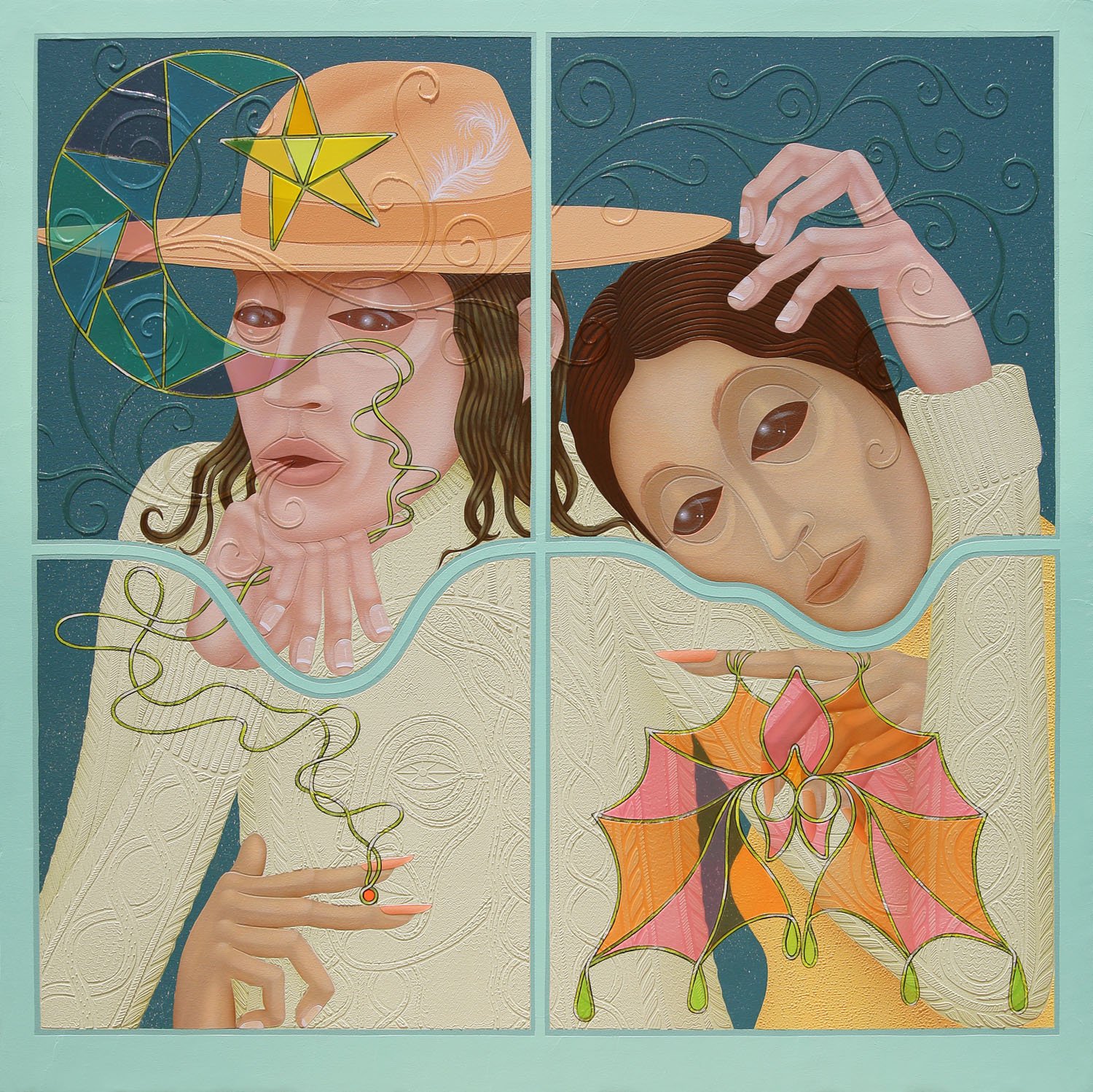
Moon Sheriff, 2023 Acrylic on canvas 48 x 48 in Courtesy of the artist and Shulamit Nazarian, Los Angeles

Superposition, 2023 Acrylic on canvas 80 x 72 in Courtesy of the artist and Shulamit Nazarian, Los Angeles.