MaximZhestkov
Everything you can imagine is possible
In 2009 he was a graphic design student in Ulyanovsk with two plans for the year: make three short films and graduate. Seventeen years later he runs a studio in London, a game company and an XR studio, and has just opened his first solo show in Asia.

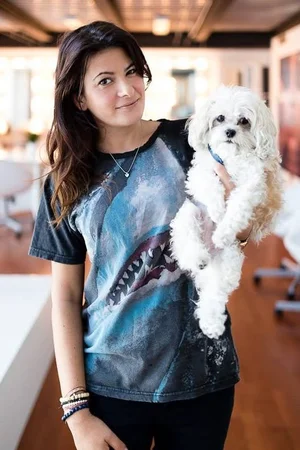
This is Maxim Zhestkov before the career: a student who had just left architecture for graphic design and decided that video art mattered most.
Read his 2009 list of influences against what he makes now. Physics, fractals, black and white, sound: every word is still in use. What changed was the tools. He went from a ZX Spectrum to real-time game engines, and from short films to worlds you steer with a joystick.
I live in Russia, in the city of Ulyanovsk, located on two rivers flowing in two different directions. I heard there are not many places like that. I think it gives our city some additional energy.
At the age of six I got my first computer, a ZX Spectrum. I spent whole days drawing huge, detailed illustrations. I was fond of playing video games, and it probably influenced my biggest desire, towards design and CG.
After high school I went to university to pursue a degree in architecture. But later I found out that it was not for me, because I like to experiment, and I started to have an impression that architecture would limit my ambitions. Then I transferred to another faculty, the faculty of graphic design, where I am currently studying.
There are no limits in graphics and everything you can imagine is possible. But I have to say I still love architecture.
It all started with 2D illustrations, which smoothly turned into 3D illustrations and spaces. Then I developed a passion for architecture and graphic design. Then I realised that the most important thing is video art.
“I like to experiment, and I started to have an impression that architecture would limit my ambitions.”
Maxim Zhestkov, to Antakly Projects, 2009
Science, universe, infinity, fractals, black & white, space, motion, architecture, physics, sound…
My favourite contemporary artist is Carsten Nicolai. He makes incredibly interesting things. He compares and mixes science and art. I also really love his music, as Alva Noto.
Plans for 2009: produce three short films… and graduate university!
Our reading: the pairings are ours. The project facts come from the artist’s studio sites and WePresent.
Carsten Nicolai, also known as Alva Noto
A German artist and musician who makes installations from sound, light and scientific phenomena, and records electronic music as Alva Noto. It’s a telling choice for a design student in 2009: Zhestkov didn’t name another animator, but an artist who treats physics as material.
“Then I realised that the most important thing is video art.”
Maxim Zhestkov, 2009
Playscapes, 2026. Generative artwork, real time. 52″ excerpt. © Maxim Zhestkov.
Playscapes / Making-of. 53″. © Maxim Zhestkov.
The viewer holds a joystick and moves through four abstract biomes. Because the worlds are built from parameters and algorithms as you go, no two journeys are the same. Playscapes was made over a few months in late 2025 and early 2026 with a team of developers, artists, architects and industrial designers. It was first shown at his solo exhibition in Beijing on a 7 × 7 metre screen across four rooms and the gallery façade.
Step into his worlds
 Antakly Projects · 3D motionRoy VeldkampThe 3D motion designer making infinite loops out of kinetic movement.
 Antakly Projects · Digital artCharles CrouzatThe Paris-born, Rome-based artist behind cotton.tv’s pastel, dreamlike rooms.
 Antakly Projects · AnimationFrank Nitty 3000The GIF artist who turns still fashion images into surreal animated loops.
 Antakly Projects · PhotographyFinding the Surreal in the Every DayDirector and photographer Brett Foraker on InterZone, where digital and organic images merge.
Who is Maxim Zhestkov?
An artist and director, born in Russia in 1985 and now based in London, who has worked with computer-generated imagery since 2001. He builds simulated worlds from architecture, sculpture and natural algorithms, and founded the game company Cosmos Interactive and the XR studio FUN AND AWE.
Where is Maxim Zhestkov from?
Ulyanovsk, Russia, a city between the Volga and the Sviyaga rivers. He began university in architecture there, then transferred to graphic design. His studio is now in London.
What is Playscapes?
A 2026 generative artwork: a never-ending journey through four abstract biomes inspired by physics, generated in real time and steered by the viewer with a joystick. It premiered at his first solo exhibition in Asia, Flow: Infinite Walk, at BOUNDED SPACE in Beijing’s 798 Art District (25 April to 28 June 2026).
Who influenced Maxim Zhestkov?
In our 2009 interview he named the German artist and musician Carsten Nicolai, who records as Alva Noto, for the way he mixes science and art. He listed science, the universe, infinity, fractals, black and white, space, motion, architecture, physics and sound as his influences.