Etching Palestine

Etching
Palestine
A conversation with artist Samira Badran and curator Àngels Miralda on art, guardianship, and the responsibility to keep looking
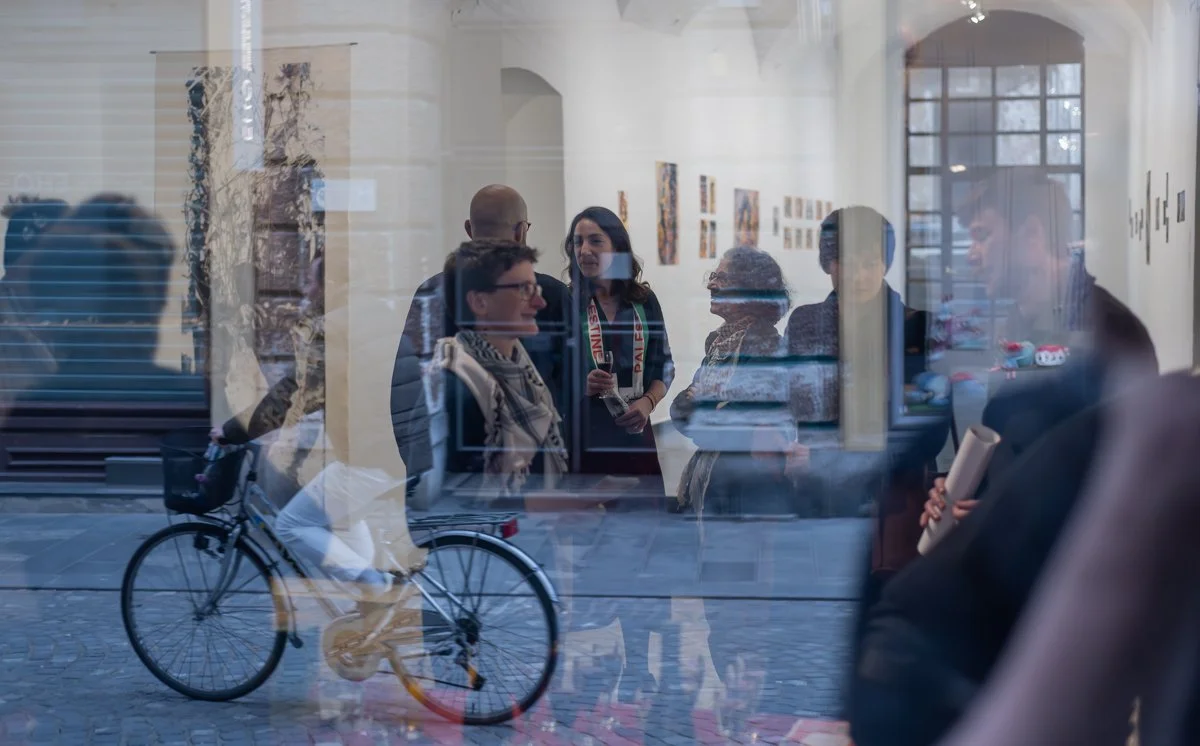
Škuc Gallery in central Ljubljana, one of Slovenia's most enduring pillars of culture operating since 1978, recently presented Etching Palestine, a solo exhibition of multidisciplinary Palestinian artist Samira Badran, curated by Àngels Miralda. From the 12th of May it opens at EPIC Gallery in Nova Gorica on the Italian-Slovenian border. The exhibition brings together drawing, photography, painting, collage and experimental animation, tracing a practice that has placed Palestine at its centre from the beginning.
For both of you: what brought this particular collaboration into being, and why Ljubljana?
Àngels Miralda"Etching Palestine" has been years in the making. The very first introduction I had to the work of Samira Badran was through you and my shared work on Chapter III of Falastin, a digital exhibition dedicated to Palestine on Collecteurs. That was an enormous collective effort that we were both a part of along with many others. Leila, I edited your article on the work of Palestinian artists in exile and you included Samira's work. At that time, it was a profile of her artworks and main themes, so I did not know that she lived only 30 minutes away from my hometown. It was later when I received a comment from the curator Amin Alsaden that I realized this fantastic coincidence, so I had to organize a studio visit. When I saw her work in person I was shocked that I had not seen it in any institution before, so I decided to organize something anywhere that I could find willingness and interest.
We pitched it to various places and there was a lot of interest in this exhibition. In the end we chose Ljubljana precisely because of the audience. Slovenia has been one of the countries in Europe that has been supportive of Palestine and has taken certain, though never sufficient, measures distancing itself from Israel's genocidal policies. More importantly than the political level, is the quantity of events for Palestine and interest of the residents of Ljubljana and the involvement of the artistic community. In 2024 I passed by Ljubljana to see some exhibitions and by chance there was a fundraiser at Škuc where local artists donated their works to raise funds to send to Gaza. I purchased a photograph by the Slovenian photographer Tadej Vaukman and met with the curator Jana Stardelova and artist Nevena Aleksovski at that time, so I knew there would be an open and engaged reception.
Samira BadranFor me, the work exists regardless of where it lands. It has to. What Àngels brought was the rigour to find the right context, the right audience, the right room. Ljubljana was not chosen for its convenience. It was chosen because the people there were already paying attention.
Samira, your father Jamal Badran spent his life perfecting Islamic calligraphy and contributed to the restoration of Al-Aqsa's pulpit after it was burned. Did you grow up understanding that art could be a form of guardianship?
Samira BadranMy father was fundamental in shaping my artistic perception and understanding. His work on the Minbar of Al-Aqsa Mosque was especially significant. After the Minbar was burned, he was able to redraw its motifs and designs from the remaining charcoal fragments, preserving an invaluable visual record that later made the reconstruction of the new Minbar possible.
His work was not only a remarkable achievement of expertise, but also a mission to safeguard a key feature of Islamic art heritage within the context of Jerusalem and Palestine. He carried out this responsibility with deep commitment, profound appreciation, and love for Islamic and Arab art, guided by a clear Arab decolonial consciousness.
Growing up close to this experience, and witnessing my father's lifelong devotion to the arts, I came to understand that art, in the Palestinian context, is not only a form of expression but also a responsibility. It carries the duty of raising awareness about the multiple layers of violence to which Palestinians have been subjected under Israeli settler-colonial occupation, while also preserving our Palestinian collective memory and keeping it alive across generations.
You've spent a lifetime formed by places that are not Palestine — Libya, Cairo, Italy, Spain — while making work that is entirely about Palestine. How has distance shaped what you see when you look at the land?
Samira BadranAlthough I was born in Libya, my formative adolescent years were rooted in Ramallah, among olive, almond, fig, and apricot trees, and within the warmth of my family and my father's studio, housed in a traditional old stone building.
My childhood was shaped not only by the pride of belonging to that land, but also by the profound and violent disruptions brought about by the Israeli colonial occupation and apartheid regime. As the conditions of daily life were turned upside down, ordinary experiences became marked by restriction, control, and uncertainty: curfews, school closures, and the constant presence of soldiers. These realities revealed to me, at an early age, that I belonged to a land whose very existence was under constant threat.
Life later took me beyond Palestine, yet distance never weakened my connection to it. On the contrary, it strengthened my commitment to understanding Palestine's history and its present realities. It deepened my bond with the land and enabled me to reflect on its condition from both emotional and analytical perspectives, while continually questioning the ways in which Palestine is represented.
The Siege series uses fractured limbs as metaphor for quartered territory. When you fragment the body in your work, are you mourning the connection between body and land, or insisting on it by showing what it costs to sever it?
Samira BadranThe dismembered body becomes the fragmented territory: body and land are no longer separate, but one. The violence inflicted on the land is inscribed onto the body.
Israeli policy does not only seek to seize and divide territory; it also targets the Palestinian body itself, mutilating it as a biopolitical tactic to immobilise, disable, and suppress any possibility of future resistance. The paralysis of the body becomes an extension of the paralysis imposed on the land: one is forbidden to move from one place to another without permission, until the body itself is rendered unable to move at all.
Yet, as in the short animation, the fractured limbs continue to move forward. They cross forbidden distances and overcome obstacles as an act of political resistance, resilience, sumud, defiance, and freedom. Meanwhile, the brain becomes a receptacle of memory, reviving collective memory and carrying it persistently across generations.
"The dismembered body becomes the fragmented territory: body and land are no longer separate, but one. The violence inflicted on the land is inscribed onto the body."
Àngels, you wrote in the exhibition text that "now that media attention fades, and people begin to look away, is when we most need to continue tracking what is happening on the ground." The art world also fades, also looks away. What is the curator's specific responsibility in that moment of collective forgetting?
Àngels MiraldaI agree that the art world fades, but at a different rhythm. The art cycle is much longer than the media cycle due to the amount of time that it takes to program, fundraise, and produce exhibitions. We can use this delay to our advantage to stay with issues beyond the value of "newness" which is an extractive value that often uses horror as clickbait. I wrote this text in the context of the illegal US and Israeli war against Iran and the continuation of genocidal policies of Israel in Palestine as well as in Lebanon. The news cycle moves on, but atrocities continue in Palestine and the violence has never ceased for Palestinians. Art has the ability to hold all of these issues inside of the complexity of our multifaceted and fast-paced world in which there is never a single issue and time tends to flatten events into insignificance.
You've described drawing as "a formative gesture fundamental to your practice from the beginnings to today." After collage, photography, animation, film — why does drawing remain the foundation?
Samira BadranDrawing is an experience that I profoundly enjoy. It is an act of discovering the world around me: looking, observing, studying, and entering into a deeper relationship with what I see. It is not merely a tool of representation, but a process through which thought begins to take shape.
Drawing can generate ideas, transform perception, and open unexpected paths of intuition. In this sense, I strongly relate to John Berger's reflections on drawing.
At the same time, drawing is one of the most ancient gestures of humankind. It is an act through which women and men first began to communicate with their surroundings, leaving traces of their existence, desires, dreams, fears, and struggles. To draw is, in this sense, to return to the origins: to the first impulse to see, to understand, and to hold time. Also an embodied practice to imagine possible futures.
Àngels, you've organised more than sixty exhibitions across ten years on every continent. When you're programming a show about Palestine in Guayaquil, or Riga, or Tallinn, how do you think about the difference between solidarity and spectacle? How do you know when you've crossed the line?
Àngels MiraldaThis is a sharp point and an important question to raise because there is a lot of spectacle in the art world, a lot of scammers, profiteers and this is a huge pet peeve of mine. Consistency is important and pointing out hypocrisy as well. It's senseless to programme an exhibition about Palestine with funding from the Goethe institute or through private funds with connections to Israel because the form of the exhibition is more important than its content. "The medium is the message" to quote McLuhan, so it is important to be aware of the spaces we operate with and collaborate with.
That being said, we are living parallel to a genocide and the steep rise of fascism in many parts of the world, so including Palestine in exhibitions is the only true reflection of our times. We need to persist in this issue, and by dedicating our time, energy, and work to centering this issue we help to keep people's eyes on Palestine. We operate in economies of attention which means that this is a form of currency, attention is popular political pressure, it is economy, and it means safety depending on whose gaze is looking. In this exhibition there are not only the works from Samira's individual practice, but two fundraisers that are going directly to Gazan artists. Solidarity as a concrete economic force is becoming more important.
"The form of the exhibition is more important than its content. The medium is the message."
Samira, you've been teaching drawing in Ramallah to new generations of Palestinian artists. What do you tell a young student about the purpose of making art under occupation?
Samira BadranI am not the proper person to give an opinion on this, since I have been living abroad for a long time, and not experiencing the cruelty of daily life now under a settler colonial occupation. I think the answer to your important question can be found in the Palestinian artists of Gaza. Their determination to continue creating amid genocide, and during this horrific war of extermination waged against the Palestinian people, offers a profound lesson to all of us, whether we are artists or not.
Their insistence on making art, even while surrounded by devastation and death, shows that art, in such circumstances, becomes part of life's defense against annihilation. The need to create becomes inseparable from the need to exist: to bear witness and to preserve human presence. It is a cry for life — the capacity to hold on to life despite everything.
Under colonial occupation, and even more so under genocide, art is no longer simply a form of expression. It becomes an act of survival, dignity, and resistance; a refusal of silence; and a declaration that, even under the most extreme violence, the human spirit continues to create. That Palestinians hold with pride and dignity our culture, our heritage, and despite all — as Rafeef Ziadah vindicates — we teach life.
Àngels, to close: what does this collaboration mean to you personally?
Àngels MiraldaThis is a fantastic question because sometimes we get so carried away pointing out the negative aspects of our environment that we don't make the effort to show gratitude to those who are doing a great job and leading the way. I'm always inspired by the artists I work with and I have to say that Samira Badran is definitely an inspiration — this was why I wanted to do this exhibition because I felt so much strength, solidarity, and genuine initiative to make the world a better place. I think she shows how much we can do when we collaborate with like-minded generous people.
Other than this, there are so many people doing important work of creating a better art world by writing policy, ethical statements, and thinking critically about artistic class-based and status-based hierarchies in tandem with global politics — such as the members of Platform BK in the Netherlands and the large community of people with whom I've initiated conversations on independent curating and alternative economies in the past couple of months. I am inspired by the artistic community rather than the individuals with important titles or powerful positions and am firmly convinced that the art world exists not because of them, but despite them with the enormous effort of thousands of individuals who work tirelessly to make the impossible possible.
A Palestinian multidisciplinary artist whose practice spans drawing, photography, painting, collage and experimental animation. Her work places Palestine at its centre, particularly the recurring themes of apartheid, collective memory, and the relationship between the fragmentation of the body and the land. She is the daughter of Jamal Badran, distinguished Palestinian artist and Islamic arts expert who contributed to the restoration of Al-Aqsa's pulpit, and the sister of architect Rasem Badran. She lives and works in Spain.
samirabadran.com ↗An independent curator who has organised over sixty exhibitions across ten years on every continent. Her essay "Who Killed the Independent Curator?" began as a series of Instagram posts, a grassroots, bottom-up critique that quickly went viral, reposted by curators, shared hundreds of times, and circulated around the world. She later published it in Frieze Magazine, a deliberate act of using the institution's platform to formalise a critique of the institution itself.
angelsmiralda.com ↗Škuc Gallery has been operating on the premises at 21 Stari trg in Ljubljana since 1978 as part of the Škuc Cultural Centre, one of the pillars of non-governmental culture in Slovenia for over forty years. Founded as a counterpart to the dominant exhibition policy of the established national galleries, it opened with a retrospective of the conceptual art group OHO and has since become one of the most visited exhibition premises in Slovenia, with approximately 1,000 visitors per exhibition on average.
Its history includes the work of Marina Gržinić, Barbara Borčić, and the early presentations of now-established Slovenian artists including IRWIN, Marjetica Potrč, and Tadej Pogačar, as well as international figures including Bas Jan Ader, Harun Farocki, Ulay, and Tacita Dean. The current artistic director is Ilija Prokopiev.
galerijaskuc.si ↗An independent platform dedicated to artists, musicians, photographers, designers, and thinkers at every stage, from emerging voices to established masters. Every interview is selected for depth, not reach.
✦ Explore all our interviews →"We need to support alternative films, art, any artistic form that challenges mainstream."
More personal essays and cultural commentary from Leila Antakly, on art, politics, wellness, and the responsibility to keep paying attention.
Read on Substack ↗