Reimagining Love and Freedom: An Interview with Koki Nakano and Wayne Snow
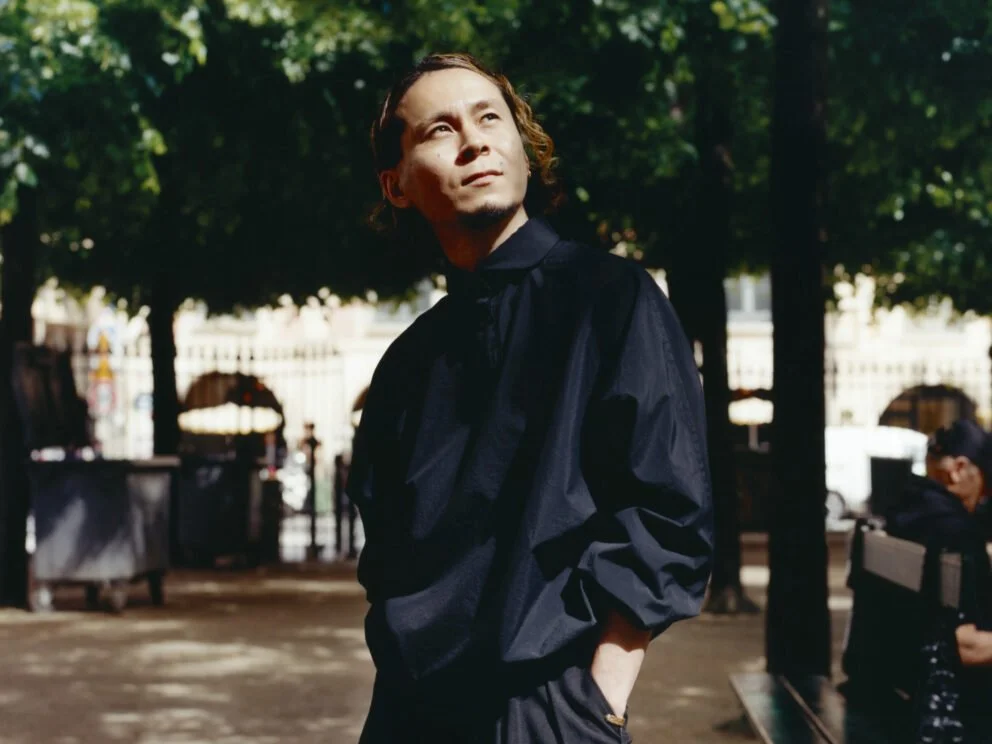
Nakano Fukuoka, Japan
Snow Lagos, Nigeria
"I really liked this image of a woman elegantly breaststroking towards the sky in a glass vertical pool. It's surreal, but I could still feel its sense of freedom — quite physically imaginable."
Koki NakanoIt was at a festival in Hamburg where Koki's attention was drawn to Wayne's extraordinary singing. Even before their first official contact, Koki began to compose.
Japanese composer and pianist Koki Nakano and Nigerian artist Wayne Snow bring their distinct sounds and stories together in Vertical Pool — a sublime meeting of piano, synthesizers, and voice that transcends genre boundaries and resonates with powerful themes of freedom, love, and rebellion.
Nakano explains that while composing, he envisioned a woman swimming skyward in a glass-sided vertical pool — a surreal yet vivid metaphor that encapsulates the liberating and defiant nature of the song. "The track is a love song for pursuers of freedom," he says, "and is about the sense of openness that comes from viewing the world through different perspectives."
Wayne Snow, celebrated for his 2021 album Figurine and his fresh approach to Neo-Soul, adds extraordinary depth with an expansive vocal range and the ability to infuse each note with feeling. His sensitivity to sound and space is almost spiritual — as if attuned to an energy beyond the music itself.
Koki, you kept a picture of a woman swimming in a vertical pool while composing. How did that image influence the musical and emotional direction?
How did you both approach blending piano, synthesizers, and vocals to create the soundscape for Vertical Pool?
When I proposed the piece to Wayne, most of the sound was already there. However, after he sent me his vocal lines, I reconsidered the balance between layers and started adding some to emphasize the flow defined by Wayne's vocals. The unexpected elements he brought made the process truly enjoyable.
Wayne, how did you connect with the idea of love as "rebellion" and translate that into your vocal performance?
For me, love has always been this rebellious force — something that makes you break down walls, challenge norms, and just surrender to the intensity of it. I wanted the vocals to carry that fire, to sound like someone unafraid to fight for what they feel, while also letting the vulnerability of love show through in quieter moments.
Where was the track recorded, and what was the collaboration process like?
All instruments were recorded in my studio. We spent a day together in the studio in Berlin working on the details of the vocals, but since the demo he sent me was very nice, we partially kept Wayne's home recording as well.
What techniques did you use to capture the sense of emotional and spatial openness?
It starts with a blend of organic textures — piano, splashing water, and artificial, granulated textures. I wanted to create a surreal yet organic sense of gravity. The long, sustained, vibrant notes of the synthesizer create filled energies that spring to support Wayne's vocals as they fly higher.
How did you collaborate creatively? Were there moments of spontaneous inspiration?
I made the music imagining Wayne's vocals — even when he didn't know anything at all about me! It was very important for me to have trial and error, carefully searching for styles that would be a crossing point for both of us. This initial process was the most important: finding the space for our styles to overlap naturally, without forcing anything.
For me, it doesn't make any difference in my general approach. I create music as it comes to me. I try to follow the flow and be surprised by the final result.
Koki Nakano's recent project Prodigal Weep — brought to life through a visually captivating music video by director duo Karl & Leo Cannone — deepens the narrative woven throughout Ululō. The gorgeous video reinterprets the Greek myth of Pygmalion and Galatea, pairing Nakano's emotive playing with themes of creation, transformation, and existential reflection.
Nakano recalls the profound experience of performing the piece in an empty stone quarry, where the echoes of sound seemed to infuse life back into the rock itself — redefining the space through art.
"Love has always been this rebellious force — something that makes you break down walls, challenge norms, and just surrender to the intensity of it."
Wayne Snow · Vertical PoolFormerly Ninu Nina.
Always the same passion.
Antakly Projects was formerly Ninu Nina — which continues as the production home for this platform. Ninu Nina was started as a passion project, and we have only evolved in how we share the stories of the people we talk to.
Please take your time to explore all our interviews, old and new — from the earliest conversations that started it all to the latest voices shaping music, art, photography, and everything between.
Every interview is chosen for depth, not reach. Every story is worth your time.
Artists chosen for their ideas,
not their visibility.
An independent platform dedicated to artists, musicians, photographers, designers, and thinkers at every stage of their practice. From emerging voices to established masters — every conversation is selected for depth, not reach.
Visit Antakly ProjectsNakano
Snow