Shirin Neshat: On Exile, Identity and Resistance
Shirin
Neshat
"Every project, image, and story is about framing a series of questions that are deeply important to me as a human being."
One of the most significant artists working today — and one of the most politically urgent. Shirin Neshat's work asks what most would rather avoid: what does it mean to be a woman, a body, a nation, under a system that defines all three.
Born in Qazvin, Iran, Neshat left for the United States to study art before the 1979 Revolution. When she returned to Iran in 1990 after a decade away, the country she found was almost unrecognisable. That collision — between the Iran she remembered and the one that existed — became the foundation of her practice.
Her early photographic series Women of Allah (1993–97) placed Farsi text across the faces and bodies of veiled women holding weapons. The images provoked everyone: the Iranian government thought they were critical of the regime; many Iranians thought she was celebrating it; Western critics thought they were erotic. All three were wrong — which was, in a sense, the point.
"I wasn't able to return to Iran after creating this series because the Iranian government believed the images were critical of their regime," she has said. "The truth is that I was an artist living outside Iran, without a clear point of view. I was framing a series of questions: What is it like for a woman who gives life to also commit violence?"
"Western art critics were completely puzzled; they thought I was making somewhat erotic images of veiled women with guns. The truth is I was framing a series of questions — I was an artist living outside Iran, without a clear point of view."
Shirin Neshat · Art Basel InterviewWhat is Women Without Men about?
It's a story that takes place in 1953 in Tehran — about four women who each suffer from some sort of dilemma and each flee their situation looking for an idea of 'change' and 'freedom.' As they leave the city, their lives converge in a mysterious orchard in the countryside.
The film was adapted from the novel by Shahrnush Parsipur, who was imprisoned for writing it. It creates a parallel between the women's personal struggles and Iran's fight for democracy during the CIA-backed coup of that year. It took six years to make, and we shot it in Morocco. One of the greatest honours in my career has been to make this film. It's not flawless — but I am very proud of it.
Greatest inspirations or influences?
- Andrei Tarkovsky — filmmaker
- Ingmar Bergman — filmmaker
- Forough Farokhzad — Iranian poet
- Ahmad Shamloo — Iranian poet
You've resisted being called a feminist. Why?
Other filmmakers you admire?
- Abbas Kiarostami — Iran
- Roy Andersson — Sweden
- Wong Kar-wai — Hong Kong
- Lars von Trier — Denmark
What are the challenges of what you do?
I keep changing mediums — I've moved rather quickly from still photography to video art and now to filmmaking. Each time I embrace a change it's thrilling but terribly challenging. I have to learn an entirely new language and always face the chance of failure.
A dream project?
My next project is a book I have optioned called "The Palace of Dreams." Making this re-adaptation is my dream.
Anything else you'd like to share?
Following the death of Mahsa Amini in September 2022, a protest movement swept Iran under the slogan "Woman, Life, Freedom." The art world responded. Curator Dina Nasser-Khadivi commissioned T-shirts and tote bags bearing the slogan in Farsi, English, and French — distributing them free at Frieze London. Neshat, alongside Hans Ulrich Obrist, Marina Abramović, Theaster Gates, and Emmanuel Perrotin, wore them in solidarity.
In 2026, with Iran once more at the centre of global crisis, the question of what solidarity actually means has become sharper. Neshat was recently seen at a no-war protest. This is not a contradiction. As her work has always insisted, you can be against a regime and against foreign intervention. You can believe in the strength and rights of Iranian women without welcoming bombs or coups as the vehicle for their liberation — Iran has already lived through one CIA-backed coup, in 1953, which is exactly what Women Without Men is about.
Art doesn't resolve these contradictions. It frames them — precisely, honestly, without easy resolution. That is what Neshat has been doing for thirty years.
"Every project, image, and story is about framing a series of questions that are deeply important to me as a human being, reflecting how they impact my life but also the world at large. I aim to make work that not only speaks to me but raises issues that transcend my small existence. Lastly, I feel my work has consistently been about finding a balance between fiction and truth, poetics and reality, and beauty and horror in the world."
Discover more artists chosen for their ideas,
not their visibility.
Antakly Projects is an independent platform dedicated to artists, musicians, photographers, designers, and thinkers at every stage — from emerging voices to established masters. Every interview is selected for depth, not reach.
"We need to support alternative films, art, any artistic form that challenges mainstream."
More personal essays and cultural commentary from Leila Antakly — on art, politics, wellness, and the complicated business of paying attention.
Read on Substack ↗
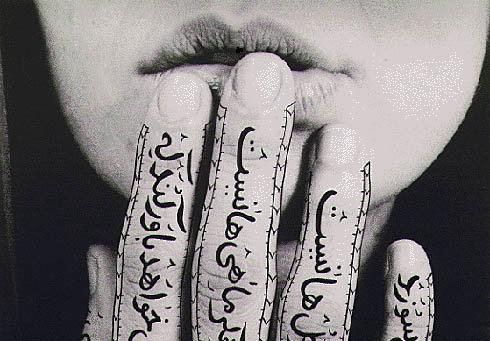
Courtesy of the artist
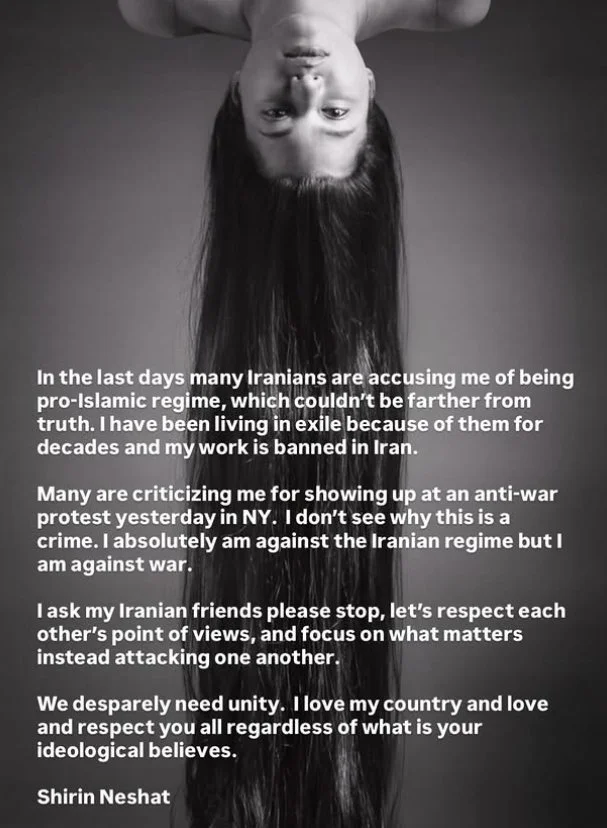
Screenshot from the artist’s Instagram page 2026