El Salvador to Debut Inaugural Pavilion at 2026 Venice Biennale
For the first time in its history, El Salvador will present a national pavilion at the Venice Biennale in 2026, featuring artist Oscar Molina's powerful meditation on migration and displacement, "Children of the World."
"Children of the World" emerged from Molina's attempt to process a trauma that has shaped millions of lives across the Americas. As a teenager fleeing the violence of El Salvador's civil war, he crossed the Arizona desert, an experience that remained dormant in his psyche for years before finding expression through art. What began as therapeutic exploration has evolved into a universal language about the experience of displacement.
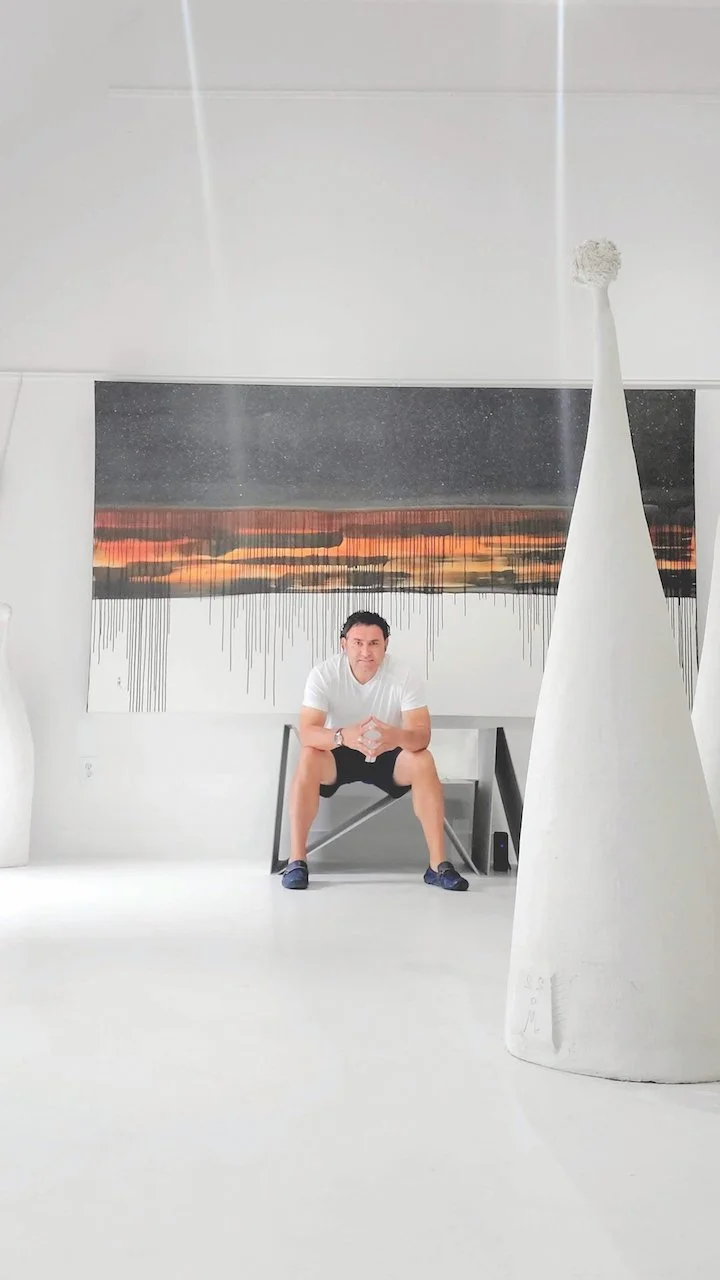
The series encompasses both paintings and sculptures, each element working in concert to articulate something often left unsaid about migration: its simultaneous terror and transcendence. In the paintings, elongated figures stretch upward across canvases, their forms reduced to essential gestures against skies that shift from daybreak blue to blood red to the velvet darkness of night. These attenuated bodies, crowned with barely defined heads, appear less like conventional human representations and more like aspirations made visible, vertical movements toward something beyond the present moment. The artist describes the challenge of translating the memories of migrants he has worked with over the years, people from disparate corners of the globe who share the common experience of being uprooted. What emerged was not literal representation but a visual vocabulary of yearning.
The transition from two-dimensional work to sculpture came naturally to Molina, who spent twenty-five years in construction before fully committing to his artistic practice. His mastery of cement and wire materials of infrastructure and containment, becomes a form of poetic justice when deployed to honor those who cross borders and build nations without recognition.
The sculptures maintain the cylindrical, tapering quality of the painted figures, some standing at human scale while others tower above viewers. They are never installed in isolation; rather, they appear in clusters of varying sizes, their postures subtly differentiated to suggest both community and individuality. Within each grouping, the sculptures create a dialogue, their arrangement evoking the way displaced peoples form bonds of mutual support in unfamiliar terrain.
At the Venice Biennale, each sculpture will be accompanied by QR codes linking to recorded testimonies from displaced communities worldwide. This technological layer transforms the installation into a portal viewers will not only encounter Molina's artistic interpretation of migration but will also hear directly from those living the reality of displacement. Among these voices will be Molina's own story: how war forced him to leave home at fifteen, how he journeyed to the United States, and how access to opportunity transformed his life.
Art in the Political Moment
The timing of El Salvador's debut pavilion carries unavoidable political weight. Since early 2025, the nation has been central to debates about migration policy in the United States, with the Trump administration's deportation initiatives and El Salvador's controversial acceptance of detained individuals at the Terrorism Confinement Center. President Bukele's governance has made El Salvador a flashpoint in discussions about security, human rights, and sovereignty.
Yet Molina resists being drawn into explicit political commentary. His focus remains on the human dimension of displacement rather than the machinery of policy.
"We are living in a very difficult moment as far as global displacement is concerned," he observes. "Migration is a word being used more often throughout the globe, and we are living it. We are feeling it." While migration has always been part of human history, contemporary displacement occurs at unprecedented scales, driven by climate change, economic inequality, political persecution, and armed conflict.
At the heart of Molina's practice is a philosophical stance: borders are conceptual impositions rather than natural facts. His art seeks to build bridges across these imposed divisions, creating space for viewers to access their own emotional responses and interpretations. He frames his work as social practice, an invitation to dialogue among cultures that might otherwise remain separate.
"I believe that this exchange is the key to the preservation and evolution of our traditions," Molina says. "It is this exchange that enriches each one of us and, as a result, our communities as a whole."
The Venice Biennale, as the most significant recurring event in the international art calendar, has long served as a site where nations present their cultural identities and engage with global concerns. National pavilions frequently grapple with their home countries' politics and the policies of more powerful nations that shape their realities. While some participants attempt to maintain an apolitical stance, the Biennale inevitably becomes a space where aesthetic and political concerns intersect.
"The message with 'Children of the World' is to make conscious that we all belong," Molina emphasizes. "For us to be more compassionate for others, especially the ones who have no place to be."