Exploring Reflection and Connection: The Art of Samara Couri
Samara
Couri
Oil paintings on mirrors that face one another. Psychological hallways of self-discovery. London born, Hawaii rooted.
From London to Hawaii — Samara Couri on painting oil portraits onto mirrors that face and reflect one another, creating psychological hallways where viewers confront themselves and connect with something they didn't know was there.
The mirrors don't just reflect. They reveal.
Samara Couri grew up in London and now lives and works in Hawaii, where the land, its history, and its people have shaped her practice in ways she describes as a great responsibility. Her work is built on a precise and poetic logic: oil paintings on mirrors, positioned to face one another, creating infinite reflections that draw the viewer in and refuse to let them remain merely an observer.
The installations function, she says, like psychological hallways of self-discovery — spaces where the gap between two mirrors becomes a place people unexpectedly open up in. Cinematic in sensibility, deeply rooted in place, and always in conversation with the person standing in front of them.
Interview conducted by Sophia Juan.
between
them
Could you tell us about the people featured in your mirror paintings?
"A lot of the people in my work become a certain subject matter in the paintings. Usually there is something that strikes me from their look, the energy I get from them, a particular look at that moment that I wish to capture. Very much like my inspiration of film, it is like choosing people to become that role in the story or situation. Some of them I know, some are from people watching, some are people that I would ask to model for me or get a quick sketch to then take home and paint from.
Currently, as I live in Hawaii, I am more focused on painting the Hawaiian people. The subject matter here is more focused, as there is a direct link from them to their land, holding on to their identities — because of the history that is still being lived."
What was the process like creating your mirror paintings?
"I knew that I wanted to continue using oil paints, and it actually worked really nicely with the mirrors — I enjoy the juxtaposition of it. Usually, I use a minimum of two mirror paintings to make a piece, to have that reflection from each other. After I paint them, I situate them at certain angles to have them face each other to make it complete. Sometimes it will evolve and I add more mirror paintings to that one piece, becoming either a cube or a wheel of mirrors. It does tend to take on a life of its own and that's something I never get tired of."
I hope they would be able to trust that space that is between the mirror paintings — and leave feeling they have gained some special connection to what is being represented.
Samara Couri — on what she hopes viewers take away
Did you have moments of challenge when creating your pieces?
"The main challenge is the final output — how to install them. Depending on where I am exhibiting, it is not always possible to install them the way I'd ideally like, which would usually be having them suspended from the ceiling, so there is that space between for people to move around and through them. So I have to adjust and install in a different manner, whilst still preserving the concept as much as I can."
You've described your mirror pieces as a way to explore deep interconnectedness with others. Could you elaborate?
"Oh, that shaped it in every way. A lot of the times, when people are viewing my work, they often open up in a very personal way — it was a little unexpected but a beautiful surprise each time. I saw the power of the reflection, the power of creating connections between the mirror paintings and viewers, how it reveals a lot more than what was initially there."
"I am looking into the Goddesses
and Gods of Hawai'i — it is a great
responsibility."
The Hawaiian people carry a direct link to their land — a relationship that is still being lived, still being contested, still being held. For Couri, painting them is an act of witness and reverence. Her current project takes on the most sacred figures of all — the deities of the islands — with the full weight of that responsibility. "I am loving every bit of it," she says, "and can't wait to have them put together in my work."
What upcoming projects are you most excited about?
"Currently I am looking into and learning more about the Goddesses and Gods of Hawai'i. This is my current project which I find to be of great responsibility, as they are extremely important figures to the island and most revered. I am loving every bit of it, and can't wait to have them put together in my work."
We have been a part of this change — using social media to expose the works of some of the most inspiring artists in the world and putting you, the reader, in touch with them directly. There is no need for only a few people in a flawed system to dictate what artists can and cannot be exposed to. Today it is more important than ever to preserve the artist's perspective. Because artists are. ✦
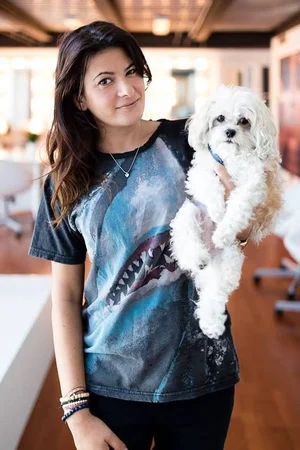
My career has never moved in a straight line, and that has always been the point. It began in fashion with a formative chapter at Vogue Italia, followed by an unlikely detour into finance. From there, film, PR, events and production. A role as Director at Wilhelmina Models in Dubai sharpened an eye already trained on people worth watching. Then came the years that shaped the platform: writing, editing, producing photo shoots, a short-lived photobooth business, lots of yoga and eventually Madrid, where the light is just right. Currently in the States in a new and exciting field — digital marketing for higher ed — but this remains my passion project. What started as a hobby back in 2003 evolved into Antakly Projects, leading to some exciting conversations, projects, and lots of joy. Throughout all of it, my best friend, one small white Shih-poo called Coco, has been present, unimpressed, and very fluffy.