PIANIST AND COMPOSER KOKI NAKANO
Nakano Oceanic Feeling
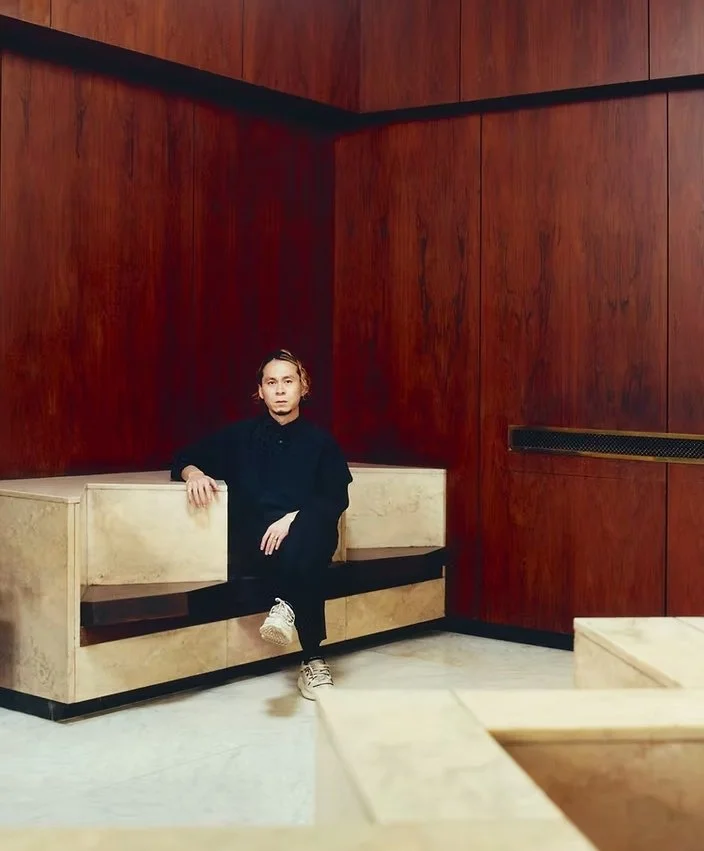
Japanese pianist born in Fukuoka, 1988. Piano since age three. Performed at the Louvre, Lincoln Center, Cadogan Hall. His music lives at the intersection of classical, electronic, and choreographic — where body meets sound meets water.
"'Oceanic Feeling' is the word coined by French poet Romain Rolland to express his sensation for infinity or oneness — a significant ambiguity which can simultaneously evoke contradictory feelings."
For Nakano, who has played piano since he was three years old, music has always been his way of finding balance in the world — a physical experience that acknowledges the bodily tensions of movement and gravity.
Born in Fukuoka, Japan in 1988, Koki Nakano graduated from Toho Gakuen School of Music in Tokyo before enrolling at the composition department of Tokyo University of the Arts. He released his debut album Lift in 2016, in collaboration with French cellist Vincent Segal. His second album Pre-Choreographed (2020) developed his dialogue between dance and music. Oceanic Feeling (2022) extends that research into the deepest waters yet.
In 2024, his fourth album Ululō arrived in collaboration with singers Yaël Naim, Wayne Snow, and Jordy — continuing to expand the boundaries of what a solo pianist can mean.
"At the first glance the skin seems like it has a role to protect muscles, bones, fats, organs. It's of course right. Although if our 'existence' means to maintain the boundary between the world and oneself, rather muscles, bones, fats, organs — these all seem to exist for protecting the skin itself."
Hello Koki, could you tell us more about your greatest inspirations or influences?
Contemporary dancers I work with always show me an infinite variety of gestures, playing with basic limitations which all human beings equally have — such as body limits, gravity, velocity, time. I believe that movement and sound are closely interrelated.
Tell us about your creative process. What was important for you while creating Oceanic Feeling?
When I had finished my last album Pre-Choreographed, a general picture of Oceanic Feeling had already popped up in my mind. I wanted to pursue the path I had opened previously — diving into more ample and wide soundscapes.
I started to focus on writing music on a topic which may be characterised as 'maternity.' Following this pre-motion idea, I could not stop myself thinking of the very image of a baby in the womb — as a half-determinate state of an identity perfectly echoing my concerns.
The album is an attempt to remind of the vague state and feeling of the prenatal period we all experienced in the water, linked to the mother by the navel cord.
What are some themes you explore in this new work?
Being shaken up inside this unstable milieu makes us incessantly look for a balance to stand. For me, the composition process is like feeding plants rooted in this milieu — and while waiting for it to bloom, there is an infinity of ways and shapes to flourish.
Do you think the art world needs to change, and how can it be improved?
As a Japanese-born person, I must say we didn't have the word 'art' in our language. Instead, the Japanese word Geijutsu we use now for 'art' occurred as a translation of the English word 'liberal arts' in the 19th century. Nevertheless, I can find so many rich, refined creations in our history.
"Being shaken up inside this unstable milieu makes us incessantly look for a balance to stand. For me, the composition process is like feeding plants which are rooted in this milieu — and while waiting for it to bloom, there is an infinity of ways and shapes to flourish."
Collaborators & Creative Worlds
A practice built through movement, bodies, and spaceOne of contemporary dance's most visionary creators. Co-composer of Brise-lames, premiered at Palais Garnier for Paris Opera's opening gala in 2021. A foundational collaborator.
Featured in the Oceanic Feeling music videos — also collaborated on the C.Bechstein Monumental film series at the Guggenheim Bilbao. A body that speaks Koki's musical language.
Known internationally for her work with Madonna and Dua Lipa. Brings pop culture's most commanding female energy into dialogue with Nakano's contemplative piano world.
French cellist and the partner on Nakano's debut album Lift — a meeting of two instruments, two traditions, and two sensibilities under the Paris-based Nø Førmat! label.
For his fourth album, Nakano adds voice — three distinct singers expanding the world of his piano beyond its solo nature into something genuinely collaborative and vocal.
At Ishinomaki's bay, alongside visual artist Kohei Nawa and Damien Jalet, Koki explored the fusion between human body and landscape — the roots of what became Oceanic Feeling.
"What does wellbeing mean to you, Koki?"
in this world every day. 感謝
Artists chosen for their ideas,
not their visibility.
Antakly Projects is an independent platform dedicated to artists, musicians, photographers, designers, and thinkers at every stage of their practice. Every interview is selected for depth, not reach.
Visit Antakly Projects
"Music has always been his way of finding balance in the world. A very physical experience — one which acknowledges the bodily tensions of movement and gravity."
Nakano
Portrait (biography): © Vincent Desailly