Dessi Terzieva Soaks Everything Up and Wrings Herself Dry Into Art
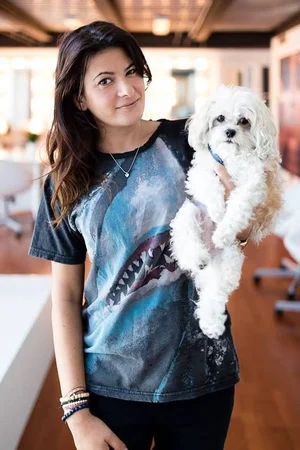
Dessi Terzieva moves between Sofia, Detroit, and now Mexico — and has been moving between worlds for long enough that staying still feels like the stranger option. A multi-disciplinary artist who works across sculpture, installation, interactive performance, and photography, she is driven not by medium but by absorption: taking in everything until it's time to make sense of it.
We spoke to her about junk drawers, functioning chaos, the pandemic dismantling the last wall between art and life, and why an icon has to be timeless or it isn't one.
Interview by Leila Antakly
The best way into Dessi Terzieva's practice is through the junk drawer. Not any particular one — all of them. The junk drawers she has encountered in the homes and lives of the people and places she moves through, each one, she says, telling more about its owner than they would ever dare to share directly. She finds inspiration in these things. In the sidewalk, in her grandmother's garden, in the fissures and quirks and sights that leave her delightfully puzzled. In functioning chaos. In the creativity and ingenuity of lack.
This last phrase — the creativity of lack — is doing serious work. It is the instinct of an artist who was born in Sofia, immigrated to Detroit in 1997, and has been moving between the two ever since, now wintering in Mexico. Someone shaped by cities that wear their faults openly, that have not been wiped clean of the imperfections that give them character. Terzieva is enthralled by these places. Not in spite of their difficulties but because of what those difficulties produce — the inventiveness that scarcity and complexity force out of people, the beauty that emerges precisely where things haven't been smoothed over.
Her creative process is physical in its metaphor and honest in its logic. She describes herself as a sponge: soaking up experiences, sights, ideas until the moment arrives to ring herself dry and make sense of it all. What comes out varies — sculpture, installation, interactive performance, photography — because the point is not to commit to a medium but to remain open to wherever intuition leads.
"The result will be honest: it may not always be good, but it is genuine, and the best I could do is express myself truthfully."
There is something clarifying about this. Not a pursuit of quality as an external standard, but a commitment to genuineness as the only standard that actually belongs to the artist. Good can be debated. Truthful is either there or it isn't.
The pandemic, when she turns to it, produces the most unexpected answer in the conversation — and the most revealing. It did not affect her creativity. It did something more radical: it demolished the already minuscule distinction she had between art and life. A line that was almost invisible before 2020 simply ceased to exist. For someone whose practice is built on absorption — on taking the world in and translating it into form — the collapse of that boundary is not a loss. It is the logical destination of the whole project.
What intensified instead was her attention to the intimate. She quotes Esther Perel: "The quality of your life ultimately depends on the quality of your relationships." Even if the world around her is falling apart, she nurtures the private sphere — family, friends, the people she laughs and dances and sings with — and finds ways to thrive regardless of the circumstances. It is a position that can sound like withdrawal until you understand it as a form of faith: that the personal, tended carefully, is where the real work of living actually happens.
On the subject of icons, Terzieva draws a line that most people don't think to draw. An icon, to her, must be timeless. Their words must ring true regardless of the era. She reaches for Seneca — "The whole future lies in uncertainty, live immediately" — and for Maya Angelou, who wrote about treating life as art, remaining flexible, inventing new scenarios as frequently as they are needed.
These are not fashionable references. They are the choices of someone who has been living nomadically long enough to understand that the only things worth carrying across borders are the ones that stay true everywhere.
Wellbeing, she offers simply: health, wealth, love, and perfect self-expression. Her practices shift with the seasons, but the constants are the sponge and the wringing — intuition nurtured, body listened to, mind stimulated, and always the people worth singing with close enough to sing with.
Dessi Terzieva is a multi-disciplinary artist currently based between Sofia, Detroit, and Mexico. Her work can be found at dessislava.xyz and her writing at slavadelic.substack.com. Discover more artists chosen for how they inspire, not just their visibility, at Antakly Projects.