Bridging Classical Composition and Contemporary Sound
Algorithmic composition. Algorithmic thinking. Classical training, electronic instinct, and the belief that silence is the greatest inspiration of all.
"The greatest inspiration for me is silence."
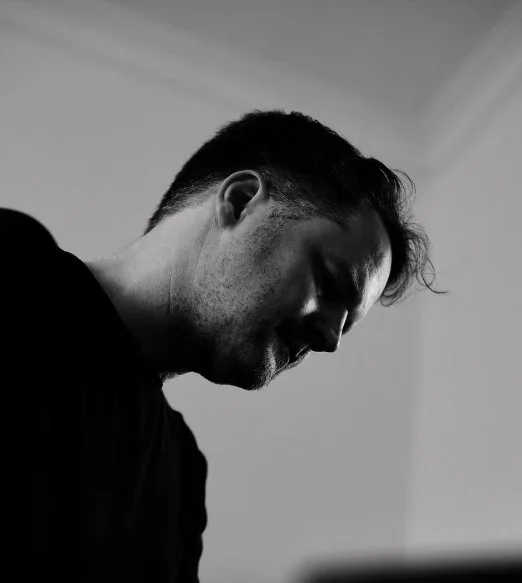
Johannes MotschmannA composer who began at nine, trained in Dresden, Karlsruhe, and Berlin, and has since built a practice at the precise intersection of classical rigour and algorithmic experimentation.
His father was a pastor who played piano. The family home was filled with music. By fifteen he was in a band. By adulthood, he was studying composition, electronic music, and music theory across three German cities — and then developing his own unique compositional method: algorithmic, systematic, and deeply personal.
Lifestream, his latest album, explores contrasts. The same material is stretched into entirely different forms: synthesizer-only pieces, a choir, a piano-cello duet, and simple solo piano. One album, multiple worlds.
with Boris Bolles & David Panzl
Tell us more about yourself, Johannes.
My father was a pastor and played piano himself. I grew up in a home that was filled with music — I played piano, organ, trombone and guitar. At fifteen I started my first band.
Later I studied composition, piano, electronic music and music theory in Dresden, Karlsruhe and Berlin. I became interested in algorithmic composition and today I still want to learn new things about composing. At the moment I work in a research project about artificial intelligence and music at the experimental studio of the SWR in Freiburg.
Greatest inspirations and influences?
Influences come from very different types of music. I'm fascinated by the complex compositions of Josquin or Bach — and listen to Arca, Boards of Canada or a new album by Tim Hecker in the very next moment.
Conceptional albums like Downward Spiral by Nine Inch Nails, or bands like Sigur Rós and Radiohead in general, influenced my thinking about musical genres a long time ago. I like musicians who combine different styles and genres. And I like contemporary composers like Georg Friedrich Haas, who works with microtonal structures.
Tell us about the creative process behind the new album.
The first month I worked completely isolated — then I worked with my trio and tried things out with David. I wanted to have electronic music that I can perform with my trio, without looping and sampling voices.
Tell us about your creative process more broadly.
I like to combine all methods I know: writing, improvising at the piano, algorithmic composition, AI etc. I also like to listen to my recordings outside the studio — to think about the music that you did and to imagine how it could go on.
Tell us about Lifestream specifically.
I wanted to create very different pieces of music with nearly identical material. You will find music that is entirely made with synthesizers — and on the other hand, there are moments for choir, a duet for piano and cello, and very simple piano pieces.
Anything else you'd like to share?
I would encourage listening to music without doing anything else. Unfortunately, we all feel that we don't have much time — that is why we start to combine all kinds of activities together. Music often becomes background noise or a soundtrack while you do other things.
From time to time we should listen more carefully, because many pieces require it. It will be more fun to listen to it again afterwards, even if you combine it with driving, sports or whatever. It's common knowledge — but we forget it from time to time.
Influences & References
// A constantly changing constellationThe complexity of Renaissance and Baroque counterpoint — voices weaving around each other in mathematical precision — echoes in Motschmann's algorithmic approach.
Three artists representing the full spectrum of electronic possibility: body-music fragmentation, nostalgic tape-warmth, and cavernous sonic architecture.
Albums and bands that challenged genre thinking. The Downward Spiral, in particular, showed him how a record could be a unified artistic statement.
Microtonal structure — music built on intervals smaller than a semitone. A bridge between the mathematical and the visceral that aligns with Motschmann's own methods.
Early Kasabian's fusion of Britpop and New Wave — proof that combining unlikely genres produces something genuinely new. Genre-blending as creative principle.
"The greatest inspiration for me is silence." Not an absence, but a presence — the space in which all composition becomes possible.
"I would encourage you to listen to music without doing anything else. From time to time we should listen more carefully — because many pieces require it."
Johannes Motschmann
Discover more artists chosen for their ideas,
not their visibility.
Antakly Projects is an independent platform dedicated to artists, musicians, photographers, designers, and thinkers at every stage — from emerging voices to established masters. Every interview is selected for depth, not reach.
Visit Antakly Projects