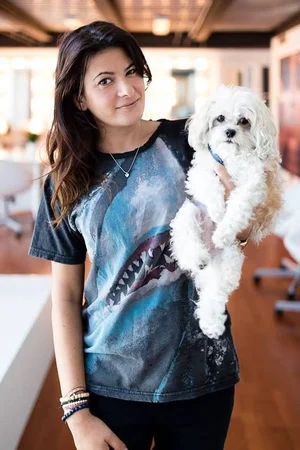
G1RL5 by Jessica Lichtenstein
STEIN G1RL5 competitive swimmer · literature & art history · yale
copywriter · lawyer · artist — in that order
She showed the G1RL5 piece at dinner in the West Village and the story behind it was immediately captivating. Yale, law school, advertising — and then the overwhelming urge to make art about the female body, power, and everything in between.
"Each girl uses her sexuality in a way that tells a story — her story, your story, every girl's story in some way."
She went to Yale to study literature and art history, became a competitive swimmer, worked in advertising, went to law school — and then made art about female sexuality, power, and the male gaze. Ironic. Cheerful. Completely unapologetic.
Jessica Lichtenstein's grandmother taught her to paint at age 10. Her first painting was a sailboat under a rainbow — and she made the rainbow in the wrong order. Her grandmother told her: you can fix things with paint by erasing it and starting all over again. Thanks, Gram.
Using the female body as a mechanism to explore deeper themes of power, female representation, fetishism, and objectification — usually in an ironic and cheerful way — Lichtenstein's work embodies the very paradox she is trying to explore. Her work consciously plays with the boundaries of power, commercialization, consumerism, fantasy, and propriety, provoking tensions that challenge the viewer to confront their own gaze.
The work emerged from a deep engagement with art history — Botticelli's rotund girls, Fragonard's ornate women, Ingres's elongated Odalisque, Picasso's abstract patterns. She was always amazed at how these women's sexuality emerged from the canvas.
Fascinated by the mass-production and fetishization of hyper-sexualized Japanese figurines, Lichtenstein's first series manipulated mass-produced anime dolls — taking them out of their plastic boxes and placing them within the white cube of the gallery.
Through these vignettes, the girls are placed on a stage for public inspection. The viewer can voyeuristically watch them examine and perfect both themselves and their lives — exposing the extremism of a consumer culture dominated by western ideals of beauty and lifestyle.
Building on the initial series, Lichtenstein's word sculptures examine the pornographic world of Japanese-inspired comic books. Creating her own imagined fantastical landscapes, she places appropriated heroines in scenes reminiscent of Renoir's, Cézanne's, or Picasso's nude bathers — scenes that harken back to "female as muse."
Layering these images behind a thick buffer of acrylic, the pieces take a critical distance from their own content and beg the viewer to do the same. Through this thick lens, the viewer is asked to question whether hyper-sexualized women are depicted solely to satisfy a male gaze — or if such a theory is too narrow.
"Does such a theory neglect to address the complex nature of women and their desire to enjoy their sexuality, enjoy their bodies, and their desire to be desirable?"
How did you get involved in art?
My grandmother was very artistic and she taught me how to paint when I was about 10. My first painting was of a sailboat under a rainbow and I cried because I made the rainbow with Red, Orange, Green then Yellow.
Inspirations and how would you describe your art?
When I took art history classes in college, I was always obsessed with the female form — from Botticelli's rotund girls, to Fragonard's flirty overly ornate women, to Ingres's elongated Odalisque, to Picasso's abstract shapely patterns. I was always amazed at how these women's sexuality emerged from the canvas.
In my pieces, each girl uses her sexuality in a way that tells a story — her story, your story, every girl's story in some way. You have the self-reflective stripper staring at herself in a mirror wondering why she is still stuck in the same place, the woman who tends her garden every day and one day decides to disrobe and stomp all over the roses she had grown, the woman who cooked dinner and waited naked for her husband to come home (but he is late again).
Other artists you admire and why?
I am really into art that has a comic-book, graffiti-esque, ironic child-like quality to it. Like taking all the images you held sacred as a child and distorting it a bit. If you've ever watched Robot Chicken or Family Guy, you know what I am talking about.
Galleries worth knowing: Gallery Nine5 in SoHo (Fabrizio del Rincon, Gonzalo Papantonakis) and Max Lang Gallery (Chiho Aoshima, Hye Rim Lee, Mrzyk & Moriceau).
Challenges of starting life as an artist after having established a career in law?
How does NY inspire you as a person?
Every nook, corner, crevice of NY is a piece of art, even the people. I literally walk around with a camera taking pictures of graffiti walls, weird colored puddles in the middle of the streets, construction sites, skyscrapers, happy people, sad people. Seriously, it's the biggest museum in the world.
3 things you can't live without?
- Sex
- Music
- All the time in between
Discover more artists chosen for their ideas,
not their visibility.
Antakly Projects is an independent platform dedicated to artists, musicians, photographers, designers, and thinkers at every stage — from emerging voices to established masters. Every interview is selected for depth, not reach.
"Every nook, corner, crevice of NY is a piece of art, even the people. Seriously, it's the biggest museum in the world."
More cultural commentary from Leila Antakly — on art, New York, and the world we're paying attention to.
Read on Substack ↗