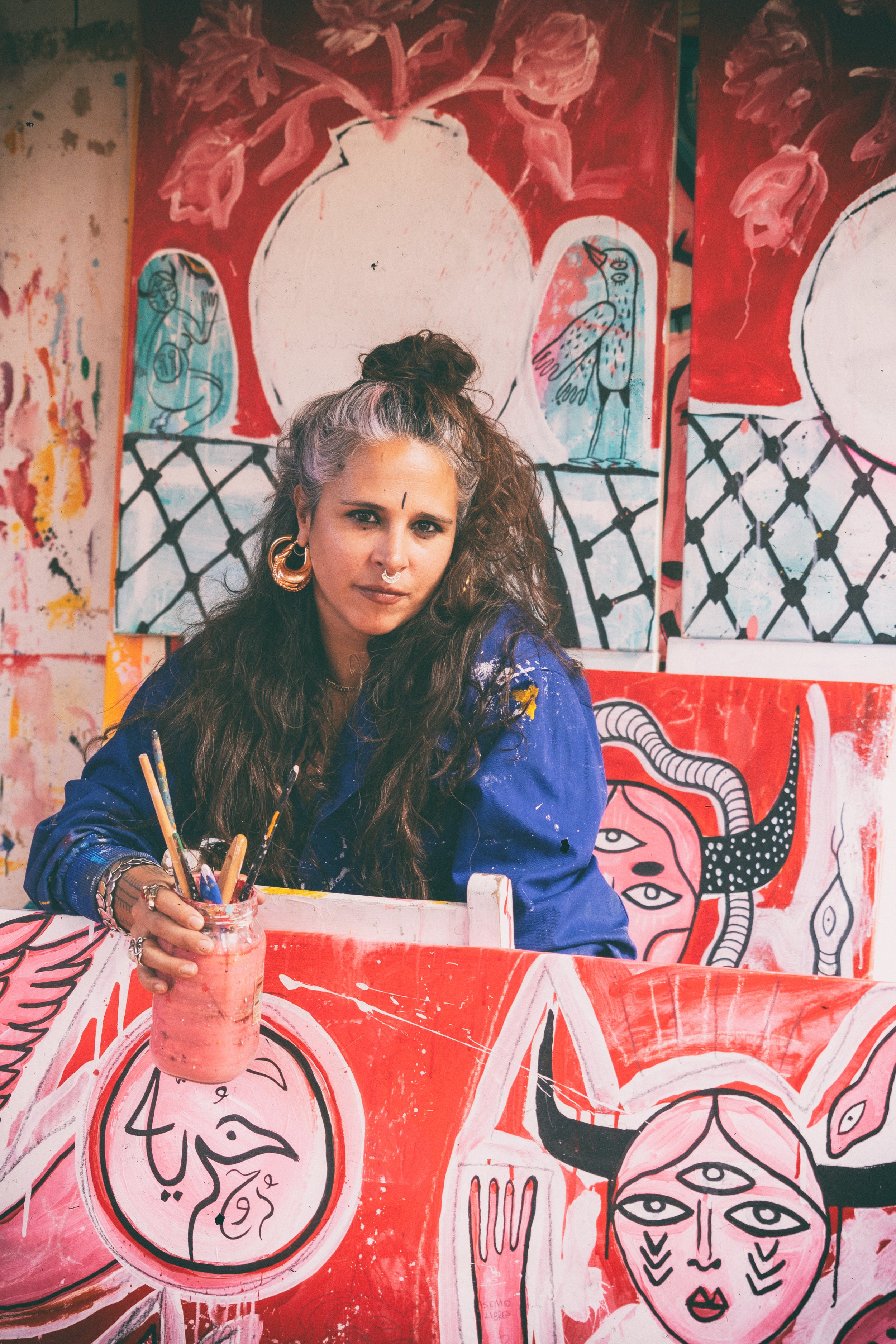
Violeta Galera: When Flowers Become Resistance – Art and the Refusal to Look Away
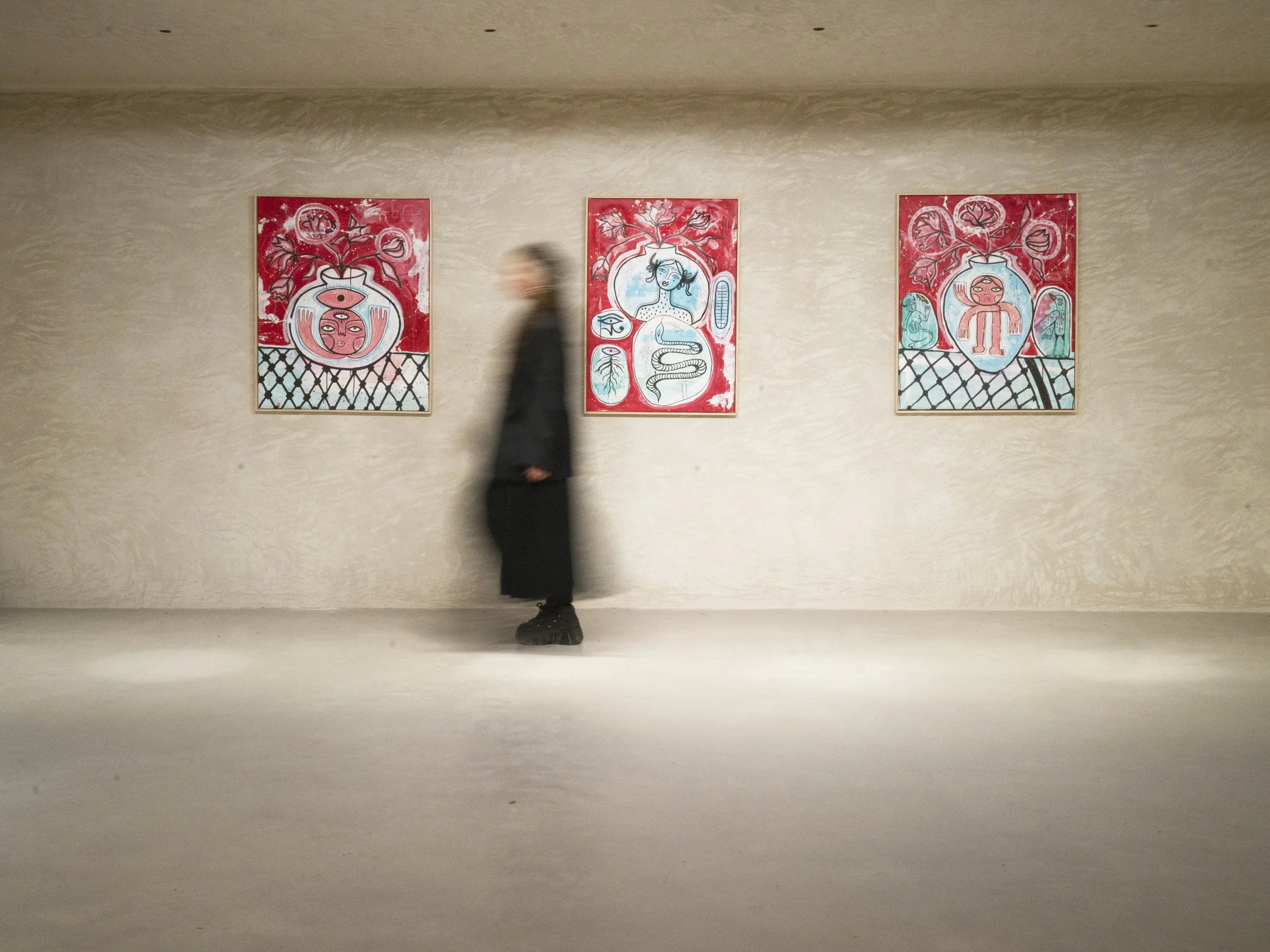
When we last spoke with artist Violeta Galera, her practice was already defined by an intimate dialogue between spontaneity and intention. Now, following the recent close of "El jardín que me habita", her first solo exhibition at Estudio Laterna in Ibiza– we return to her studio to explore how this significant milestone has shaped her artistic journey. Curated by Andrea Sanchez, the exhibition brought together works that don't just depict Galera's world but physically embody it. In this follow-up conversation, Galera reflects on what it means to cultivate a garden that lives within.
Now that your solo show closed, how are you sitting with it emotionally?
I’m sitting with it in a very tender way. There’s a mixture of relief, gratitude, and a quiet vulnerability that always comes after sharing work that is so close to the bone. This exhibition asked me to open very personal doors — about motherhood, fear, strength, pain, love, and transformation. Once those doors are opened publicly, they never close in the same way again.
I am especially grateful to Andrea Sánchez, the curator of the exhibition, for believing in me and my work, and for giving me all the care, trust, and love she did throughout this process. Her support made it possible for the work to exist as it does and for me to feel fully held.
There’s a sense of completion, but not closure. The work feels alive, still breathing through people who encountered it, and that brings me a deep sense of peace.
What did preparing for this show demand from you that previous projects didn’t?
This show demanded radical honesty. I couldn’t hide behind gesture or aesthetics. I had to stay present with uncomfortable emotions. Rage, grief, exhaustion, tenderness and allow them into the work without trying to make them pretty or easy to digest.
On a personal level, it required trusting my intuition over external validation. Accepting contradiction became essential: strength and fragility, beauty and violence, care and fury existing at the same time. As a woman and a mother, I felt I was carrying many layers simultaneously, and the work demanded that I don’t separate them.
Were there any unexpected reactions from viewers that shaped how you see the work now?
Yes, very much so. Many people connected deeply with the pictorial work. Viewers often spoke about them as mirrors of their own processes of transformation. That already taught me that the work functions more through resonance than explanation.
But what truly shifted something in me was the reaction to the video art created for Estudio LaTerna and to the performance ama y ensancha el alma. I wasn’t prepared for the intensity of the emotional response. Many people were visibly moved; some cried, some stayed in silence for a long time, others shared that something inside them had opened or softened.
That experience confirmed that when work comes from a place of truth and vulnerability, it can bypass the intellectual layer and go directly to the body and the heart. The video and the performance created a shared emotional space — almost like a collective breath or a small ritual — where people allowed themselves to feel without defense.
The audience taught me that my practice is not only visual, but also energetic and emotional. That presence can be more powerful than explanation. And that when I trust simplicity and honesty, the work becomes a place of connection, release, and remembrance.
You and I have stayed in touch through years marked by collective grief, solidarity, and emotional intensity. How has that shared global atmosphere filtered into your studio?
The global atmosphere enters the studio whether we want it to or not. We don’t create in a vacuum. Grief, injustice, Palestine GENOCIDE, and collective pain are in the air we breathe.
For me, making art has always been a form of resistance and responsibility. As Nina Simone said, “An artist’s duty, as far as I’m concerned, is to reflect the times.” I feel a deep obligation to speak about what is happening in the world — about Palestine, about silenced voices, about lives being erased while we are encouraged to look away. The studio is a place where I process what I’m living, yes, but also where I refuse silence. Painting, performing, creating images becomes a way of saying: I see you, I remember you, and I will not turn this into something comfortable.
When you look at your newest works, do you see continuity with your past self?
There is a clear evolution, of course. I’ve been working for over twenty years, and my work has changed as I have changed, through time, experiences, motherhood, and the world I live in. Evolution is inevitable and necessary.
But the essence has always been there. From the beginning, I was drawn to social and political critique, to observing what is happening around us and responding from an emotional, embodied place. That impulse never disappeared. Even in moments when the work is not explicitly political, there is always a trace — a brushstroke, a gesture that speaks about society, about power or about injustice.
So I recognize myself in the work. It’s the same voice, but more layered, more conscious, and more grounded.
What lesson from this last exhibition cycle do you want to carry forward and what are you consciously leaving behind?
I want to carry forward trust — in my intuition, in slowness, in depth. I want to continue working from truth rather than urgency or expectation. What I’m consciously leaving behind is the need to justify my voice or soften my message. I’m done with shrinking. This exhibition taught me that vulnerability is not weakness — it’s clarity.
Several works explicitly reference current political realities — Why was it important for you to name these struggles so clearly within the exhibition?
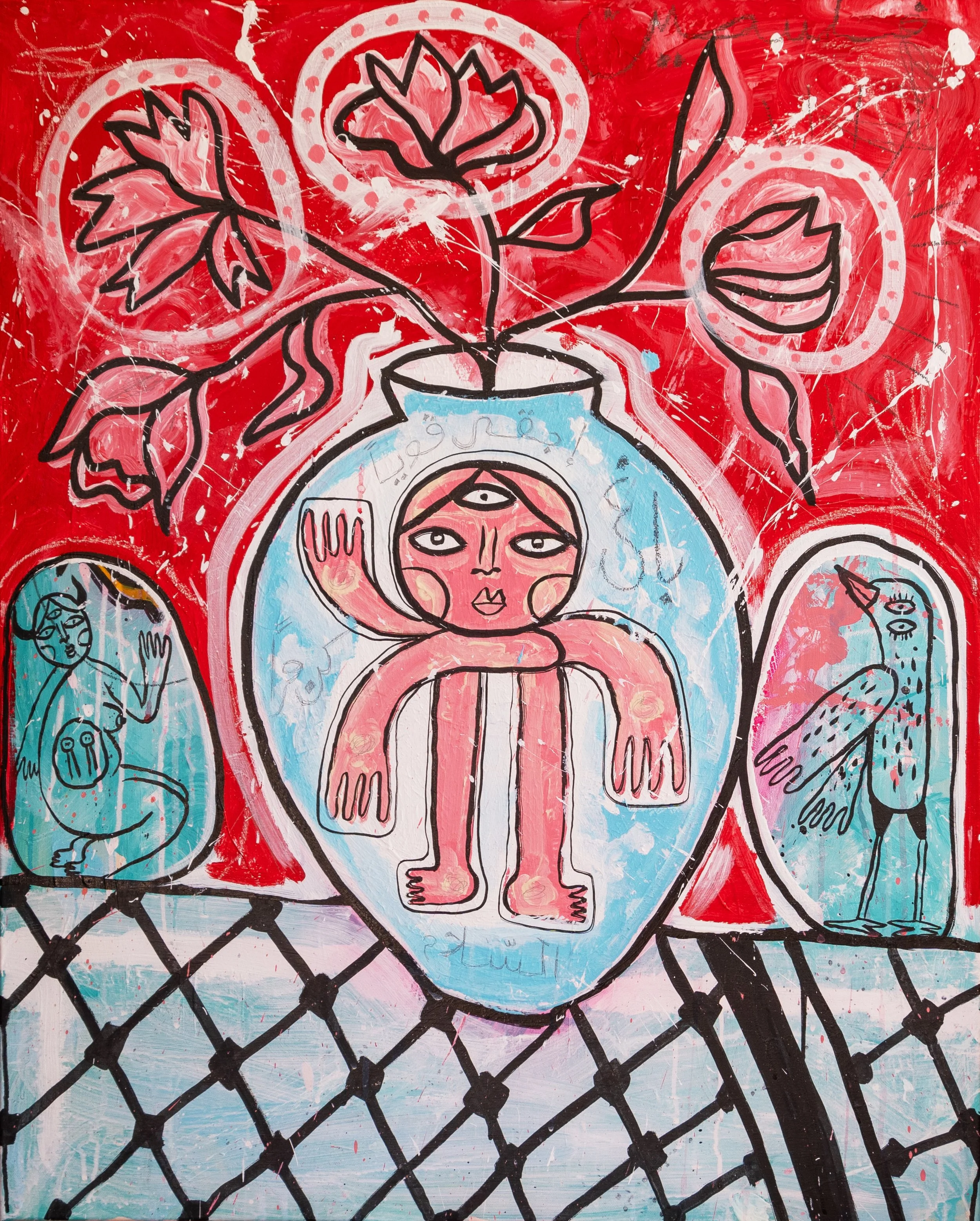
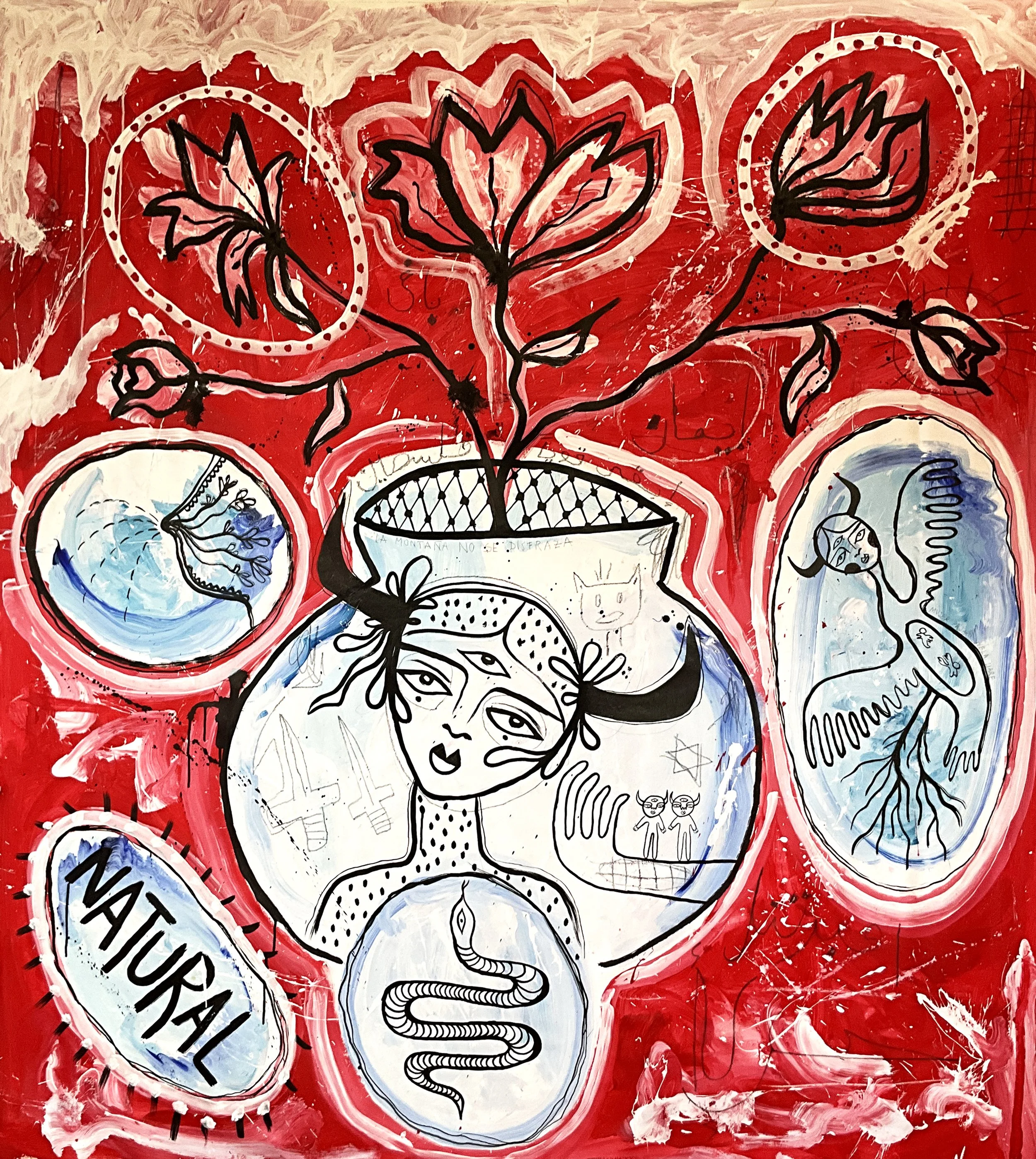
Because silence is never neutral. Not naming what is happening is already a position. In this exhibition, it was essential for me to speak clearly about Palestine — to name the genocide, to make it visible, to give space and presence to those whose voices are being systematically erased. Writing “Palestine” in Arabic and including the keffiyeh was a conscious act of remembrance and resistance.
The three paintings that reference Palestine are all still lifes with flowers — vases in which something continues to grow. That choice was very intentional. Even in the worst possible scenarios, there is always a seed of resistance and hope. Palestine blooms. Despite everything, it blooms.
The flowers speak about life insisting on existing. About a small flower growing among the rubble, when everything in Gaza has been destroyed. That fragile but unstoppable gesture is hope. It is dignity. It is the refusal to disappear. These works are not about decoration; they are about survival, memory, and the persistence of life.
I don’t believe art should look away from suffering in order to remain comfortable. As artists, we have a responsibility to reflect the world we live in and to stand with those who are being silenced.
The same urgency exists in the work that speaks about the women-led revolts in Iran. Women risking their lives for freedom, dignity, and autonomy cannot be absent from my visual language. Their courage, their rage, and their vulnerability resonate deeply with my own experience as a woman.
For me, naming these realities within the exhibition was a way of saying: this is happening now, these lives matter, and art is not separate from the world. To name is to refuse erasure. To paint it is to remember, to resist, and to stand in solidarity.
If you’d like to see more of her works, follow Violeta.