CHEN FEI
The New
Wave
Raised between tradition and globalisation, between Confucian values and the internet, between the one-child policy and the world's fastest-growing art market. This is the generation that changed what Chinese contemporary art looks like.
Today's young Chinese contemporary artists are enjoying opportunities their predecessors could not have imagined, from education abroad to international gallery representation, from social media as studio practice to major museum retrospectives before the age of 45. Less focused on the socio-political themes that defined earlier generations, they are instead interrogating something subtler and more personal: what it means to be Chinese in a globalised world, and what that world has done to the culture's most deeply rooted values.
With the advantage of a more open policy towards the rest of the world than their 35+ year predecessors, these younger artists are inspired by international art world processes. The scene is still at the early stages of its development but is rapidly growing, with audiences and collectors across the globe intrigued by the fresh energy that has emerged. This is what that energy looks like up close.
Chen Fei
"I like to paint bad taste. The not so pretty things leave a much longer lasting impression than beauty ever would."
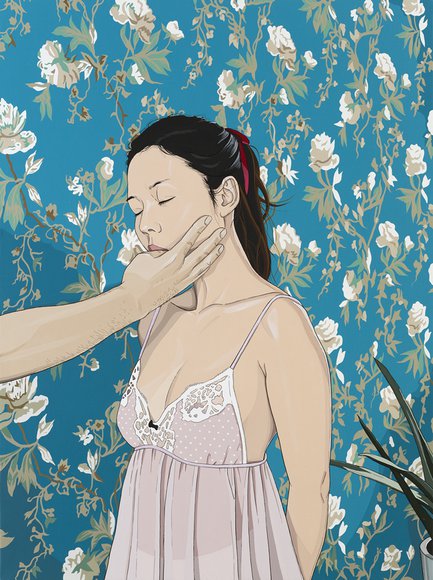
Originally trained at the Beijing Film Academy, Chen Fei faced the limitations of the film industry and turned to painting as his medium. He treats his canvases like film stills — known for his superflat technique, he continues to challenge his audience with the concept of good and bad taste in both the aesthetic and moral sense. What impresses him most are the rogues, not the upstanding citizens.
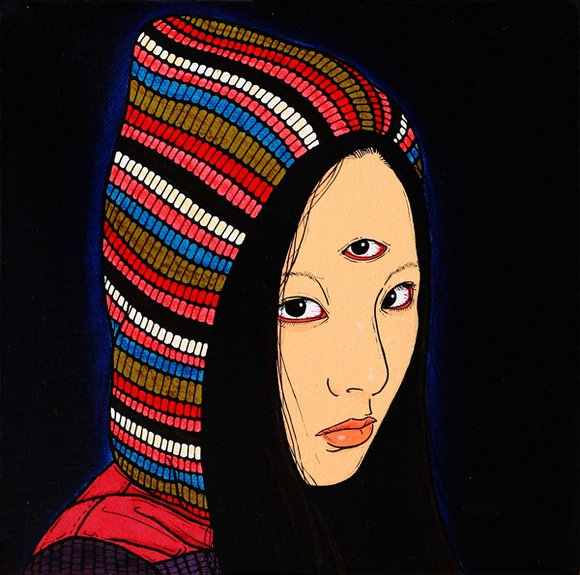
His narrative paintings are fantasy constructions, often perverted, transposing elements of his personal life into surreal or hyperreal pastiches. With photographic precision, his acrylic canvases appear computer-generated or cartoon-derived. He almost systematically exhibits his own figure, satirically hijacking the age-old tradition of the self-portrait to revisit Eastern and Western art history.
"A good artist is valid by two aspects, the academic value and the market. Only when these two factors are both considered can we decide whether an artwork is good or bad."
Further interested in how China's rapid economic growth has impacted its now globalised culture, Chen Fei questions his nation's collective taste and societal evolution through his work. He belongs to the post-1980 generation of Chinese artists raised under the one-child policy, whose aesthetics were influenced by mainstream culture, notably manga and anime. But while his generation tends toward collective themes, Chen Fei is typically concerned with the self rather than with grand history. A remarkably sharp sense of black humour informs his vibrant, ego-centred visions.
One of the most internationally acclaimed Chinese contemporary artists of her generation, and the only woman among the top 10 Chinese contemporary artists. Named Best Artist by the Chinese Contemporary Art Awards in 2016. The only Chinese artist commissioned to create a BMW Art Car (2017). Her multimedia installations explore the experiences of young Chinese people navigating a rapidly changing society.
Fondazione Prada, Milan — Dash (April 2026) · Kunstmuseum Basel — Testimonies to the Near Future (May 2025 – Oct 2026) · Vitamine Creative Space, Guangzhou (Oct 2025)
Trained in traditional Chinese painting and calligraphy before studying visual communication, Yang Yongliang works with photography like a painter. He constructs vast digital landscapes that appear, at first glance, to be classical Chinese ink paintings — but are in fact composite images built from photographs of contemporary urban China. Cranes, motorways, and tower blocks are hidden within traditional mountain mist and flowing water.
Liu Ying views existence as energy. When she paints, she doesn't depict a human figure, she conveys the universes it contains. Her explosive brushstrokes and powerful impasto trace the paths of breath and record the rhythm of the heartbeat. As a female painter, she understands what the body expresses without words. She chooses to give form to the imperfect, the trembling, and the unbalanced. Graduated from the China Academy of Art.
He Wei's works reference iconic female figures from cinema spanning the 1920s to the 1980s. They appear as recognisable yet elusive presences, embodying the elegance of a bygone era and evoking atmospheres of mystery and refinement. The hidden faces create a subtle distance: you are captivated, yet slightly disoriented. Bold, incisive colours and deliberate oil paint stains and brushstrokes carry the weight of what cannot be seen. Received the Laguna Prize at the Venice Arsenal (2014).
Creates miniature models of old houses to capture nostalgia, often sharing their process online. Craft as cultural memory.
Shanghai-based conceptual artist whose works have been featured in international galleries. Emerging fast.
Street painter and "ground illusionist" who uses chalk and paint to turn pavement into portals. Public space as canvas.
Designer who created a comic book titled Gayuan based on his rural hometown in Fujian. Personal geography as artistic subject.
Lead artist on a Shanghai team utilising AI to restore lost faces in portraiture. Where the ancestral and the algorithmic meet.
Integrates her work into the contemporary technological landscape. A practice built in and for the digital present.
These artists grew up between Confucian values and the internet, between ink painting and Instagram. That tension produces work that no Western artist can produce, and no older Chinese artist could have either. The specific collision is unique to this generation and this moment.
Centre Pompidou exhibited 21 Chinese artists in 2024–25. Cao Fei is at Fondazione Prada, Kunstmuseum Basel. Galerie Perrotin, one of the world's most powerful galleries, represents Chen Fei. The international institutional recognition is arriving, which typically precedes significant market appreciation.
The scene is still at early stages of development. Major Western collectors and Chinese domestic collectors are both circling. Collectors who found Chen Fei through Galerie Perrotin or Urs Meile are typically ahead of the market, which has historically rewarded that position with significant appreciation.
What makes this generation genuinely different
The older generation of Chinese contemporary artists, those who came of age before the opening up, had an inherently dramatic subject: the collision between a closed society and modernity. Their work carried the weight of that collision. The generation explored here carries something subtler and, in some ways, more difficult to articulate: the weight of having both worlds simultaneously, and not quite belonging to either.
Chen Fei paints bad taste and means something very precise by it. Cao Fei builds digital worlds for people who feel dislocated from the real one. Yang Yongliang hides the factory inside the mountain. Liu Ying traces the energy the body cannot speak. He Wei paints the faces you cannot see. These are not simple statements about China. They are complex, personal, and internationally legible in ways that work of the previous generation often was not.
That international legibility is why global collectors are arriving. That personal complexity is why they will stay.
An independent platform dedicated to artists, musicians, photographers, designers, and thinkers at every stage, from emerging voices to established masters. Every interview is selected for depth, not reach.
✦ Explore all our interviews →"We need to support alternative films, art, any artistic form that challenges mainstream."
More personal essays and cultural commentary from Leila Antakly, on art, politics, wellness, and the complicated business of paying attention.
Read on Substack ↗