What we find
when we aren't looking
On an unexpected encounter with Etel Adnan and the exhibition Shifting the Silence at the Lenbachhaus, Munich
I went to the Lenbachhaus and what I found stopped me. One of my favorite artists was on the walls — and I had no idea she would be there.
The exhibition is called Shifting the Silence — the title of Etel Adnan's last book, published in 2021. The German translation, Die Stille verschieben, appeared posthumously in 2022. Adnan, who died that same year, was writing at the edge of her own life. The book knows it. Short prose pieces, everyday observations, feelings, anecdotes, memories: a non-linear structure that mirrors the way time actually moves when one is very old, very lucid, and utterly unafraid of depth.
Born in Beirut in 1925 to a Greek mother and a Syrian father, educated in philosophy in Paris and California, fluent across cultures and languages, she turned to painting not as decoration but as a form of political solidarity. During the Algerian War of Independence, she refused the colonial tongue and chose a medium that could hold what words, in French, could not.
Her leporellos — those Japanese folding-book forms she made her signature — hold poetry and painting in the same physical space. The line between writing and drawing dissolves. That dissolution is the point. The book weaves the personal and cosmic without strain: everyday observations alongside the war in Syria, space exploration, the climate crisis. Wildfires and ecological grief appear not as polemic but as feeling. The silence she writes toward is not just the silence of death — it is the silence that surrounds anything that cannot quite be said.
The difficulty of saying what a work of art is
The curators, Eva Huttenlauch and Matthias Mühling, have taken a genuine intellectual risk. The central concern of this show is not simply to exhibit art — it is to propose a question about the act of describing art. Linguization, as they call it: the translation of aesthetic experience into language. The question being: what is lost? What can never arrive in words?
Adnan's suggestion, embedded in the book's title, is not to resolve the tension but to shift it — to move the edge of what can be said, without rationalizing the poetic, without forcing it into logic it doesn't need to wear. This is not passive acceptance of silence. It is an active expansion of the territory of meaning.
Halaby taught herself a programming language in the early 1980s and used it to generate what she called Sound Paintings from 1986 — constantly shifting geometric abstractions displayed on a monitor. Computer-generated art, made by hand through code, decades before the language of "generative art" existed. Seeing these works reframes the entire genealogy of computational aesthetics. She was there first, and almost no one knew.
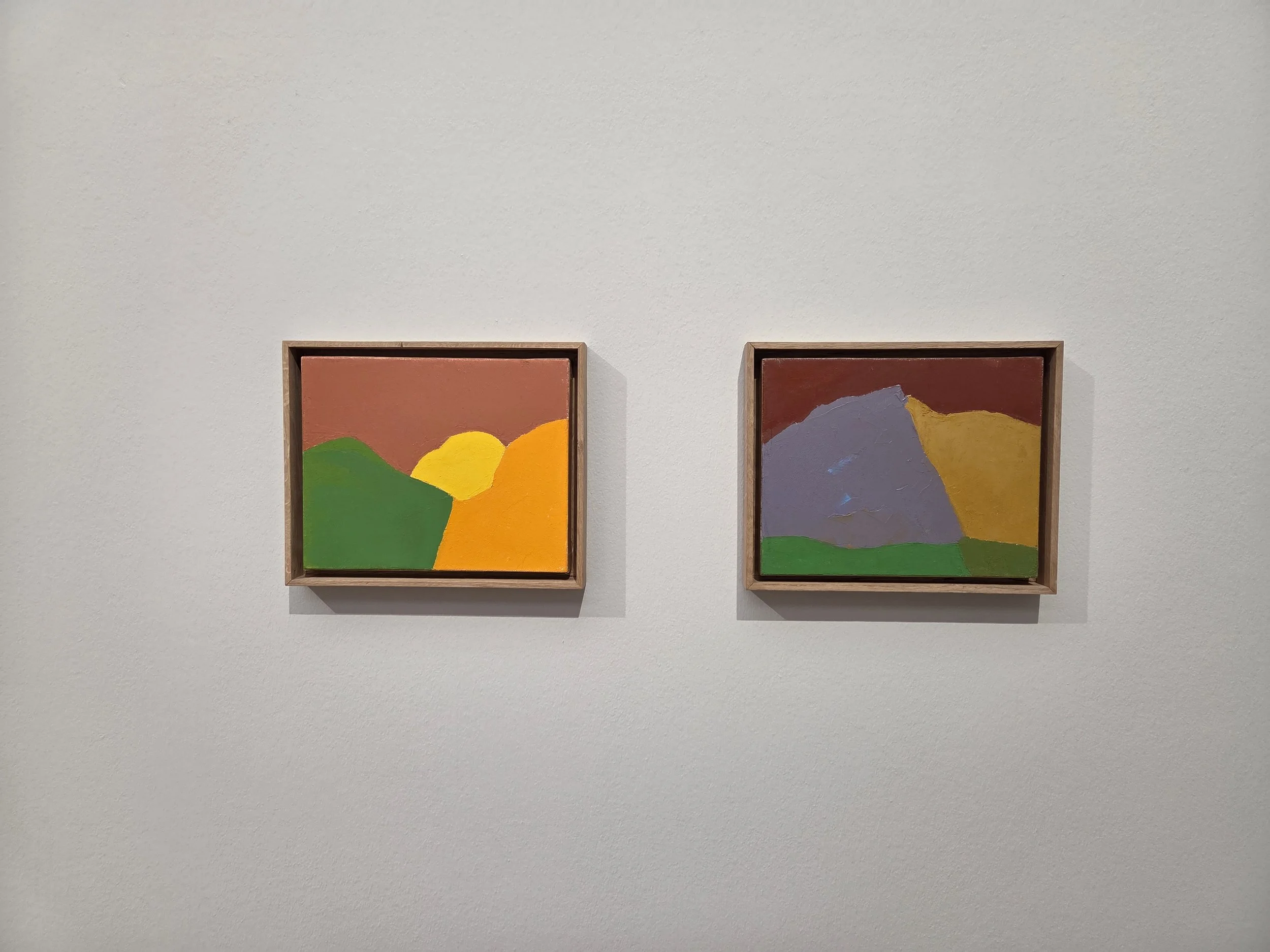
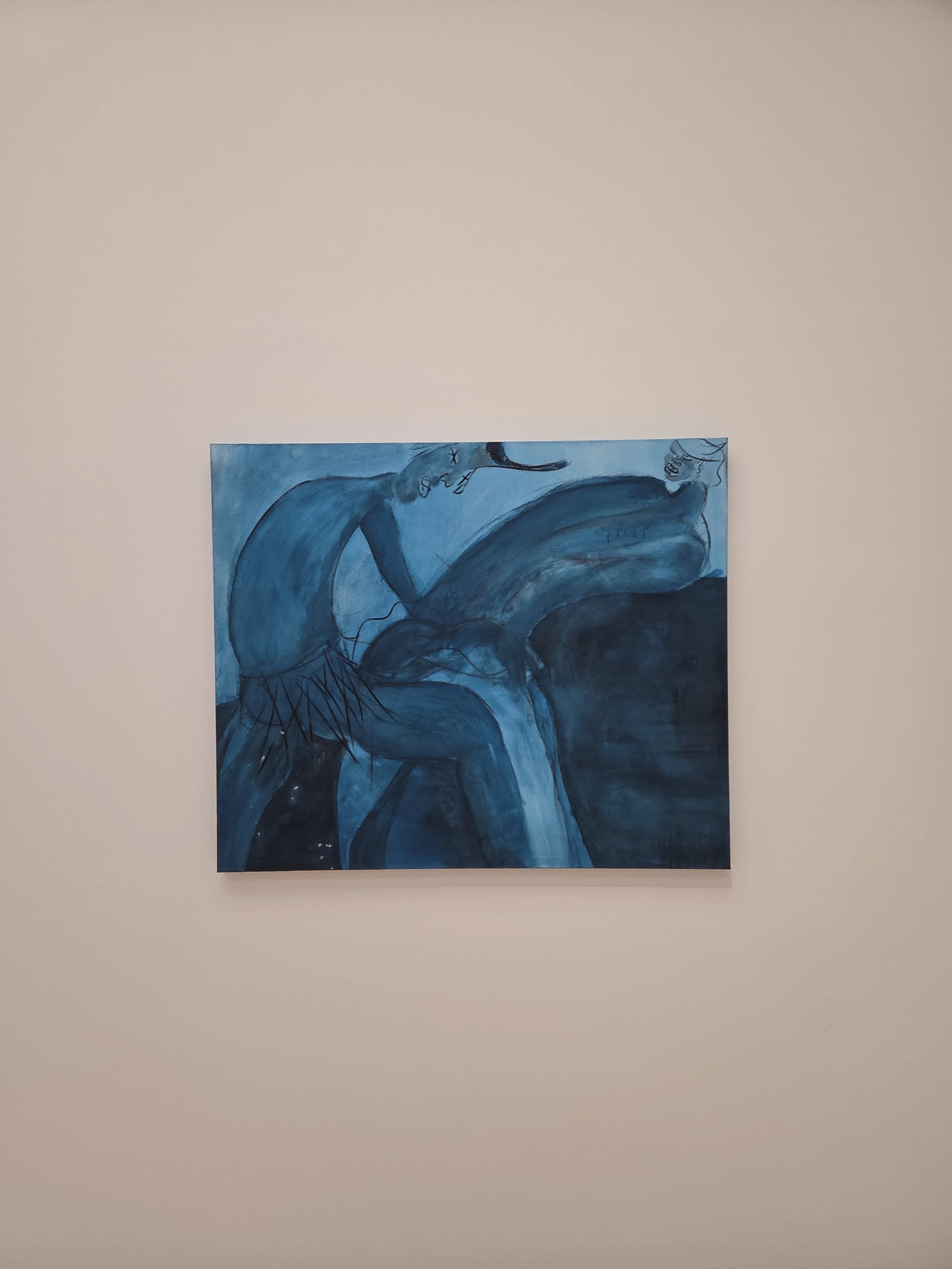
The artists assembled here — nearly forty of them, including Małgorzata Mirga-Tas, Cana Bilir-Meier, Jenny Holzer, Dan Flavin and many others — are in conversation rather than competition. The logic is associative, the structure open. One room is dedicated to Adnan's own paintings: small, luminous, full of the Mediterranean light and political sorrow she never could separate from each other.
A building with its own argument
The Städtische Galerie im Lenbachhaus is itself a layered thing. Built between 1887 and 1890 as the studio-residence of Franz von Lenbach — a portraitist of Munich's high society, technically brilliant and socially ambitious — it became a public museum in 1929. Lenbach's restored reception rooms still carry the weight of that world: Old Masters technique deployed in service of power, the new medium of photography quietly employed alongside oil on canvas.
And then there is the Blue Rider collection. In 1957, on her eightieth birthday, Gabriele Münter — painter, companion to Kandinsky until 1914, keeper of the archive through decades of war and exile — donated more than a thousand works to the museum. Ninety Kandinsky oils. Three hundred and thirty watercolors and drawings. Works by Franz Marc, August Macke, Paul Klee, Alexej Jawlensky, Marianne von Werefkin. It is one of the most consequential acts of cultural preservation in modern history.
Adnan spent a lifetime insisting that beauty is not apolitical, that the lyric and the urgent are not opposites, that a painter who began as a philosopher never stops being either. Her final book, written at the end of a long life lived through war, exile, and constant geopolitical disruption, is a celebration of what survives the worst of what happens.
I left thinking about language and its limits, about what images do that sentences cannot, about the generosity of an artist who, knowing she was dying, chose to write about the beauty of the world.
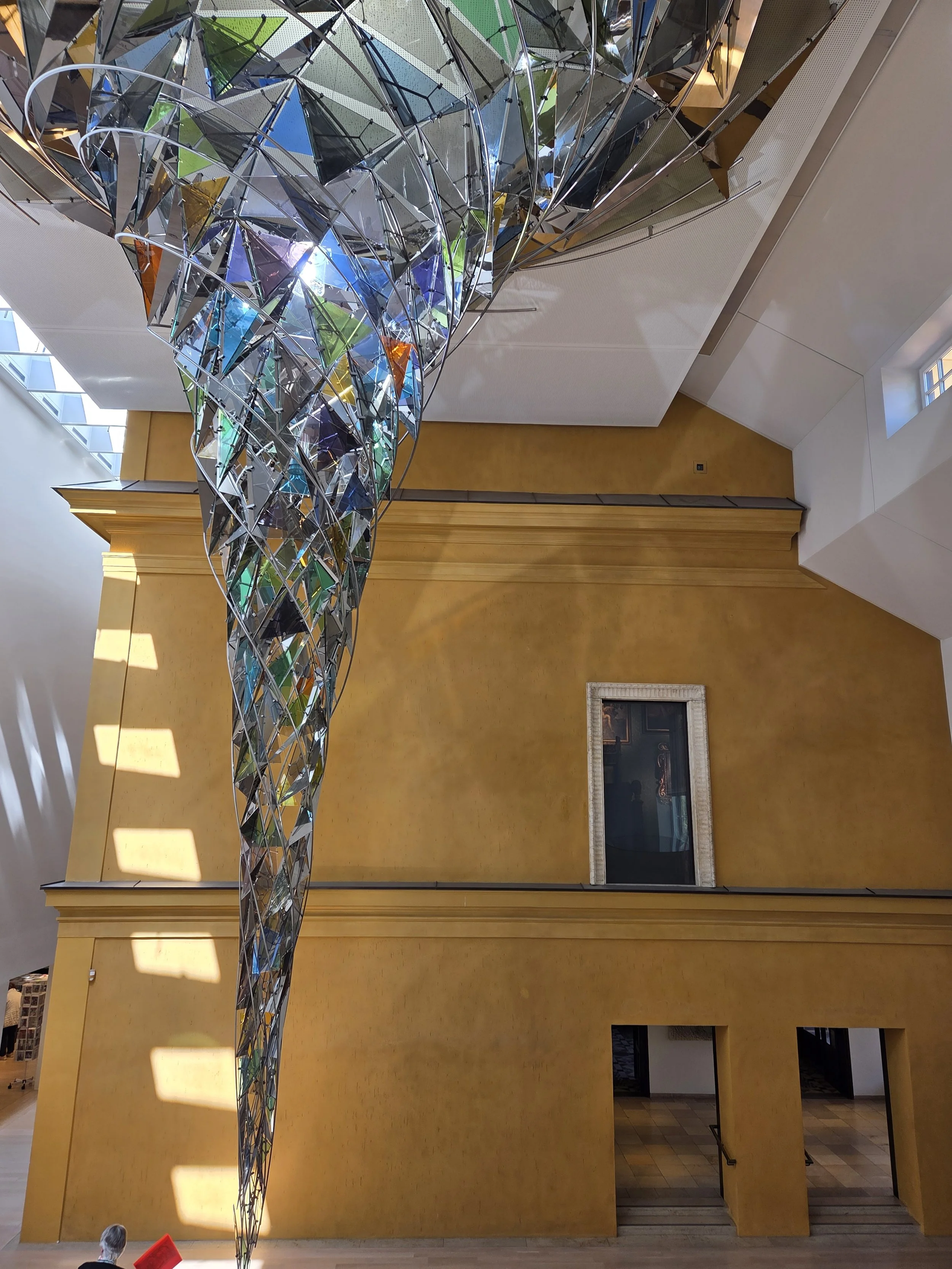
There was one more surprise. Descending into the atrium: Olafur Eliasson's Wirbelwerk — a vortex of conical spirals coiling in opposite directions, polished metal tubes and hand-blown coloured-glass triangles, hanging from the roof down to just above the visitor's head. Illuminated from within, casting flecks of coloured light and slow-moving shadows across the surrounding walls. The projections shift with the daylight — sometimes sharp, sometimes dissolved — so that the work is never the same twice.
It felt like a perfect closing argument for everything upstairs. Adnan shifting silence, Halaby making paintings from code, Münter preserving what others would have buried — and then this: a sculptor of light making the air itself visible, reminding you that perception is always already an act of translation. That what you see depends entirely on when you choose to look.
Shifting the Silence is on view at the Städtische Galerie im Lenbachhaus, Munich. Curated by Eva Huttenlauch and Matthias Mühling. · Wirbelwerk by Olafur Eliasson is a permanent commission in the museum atrium.
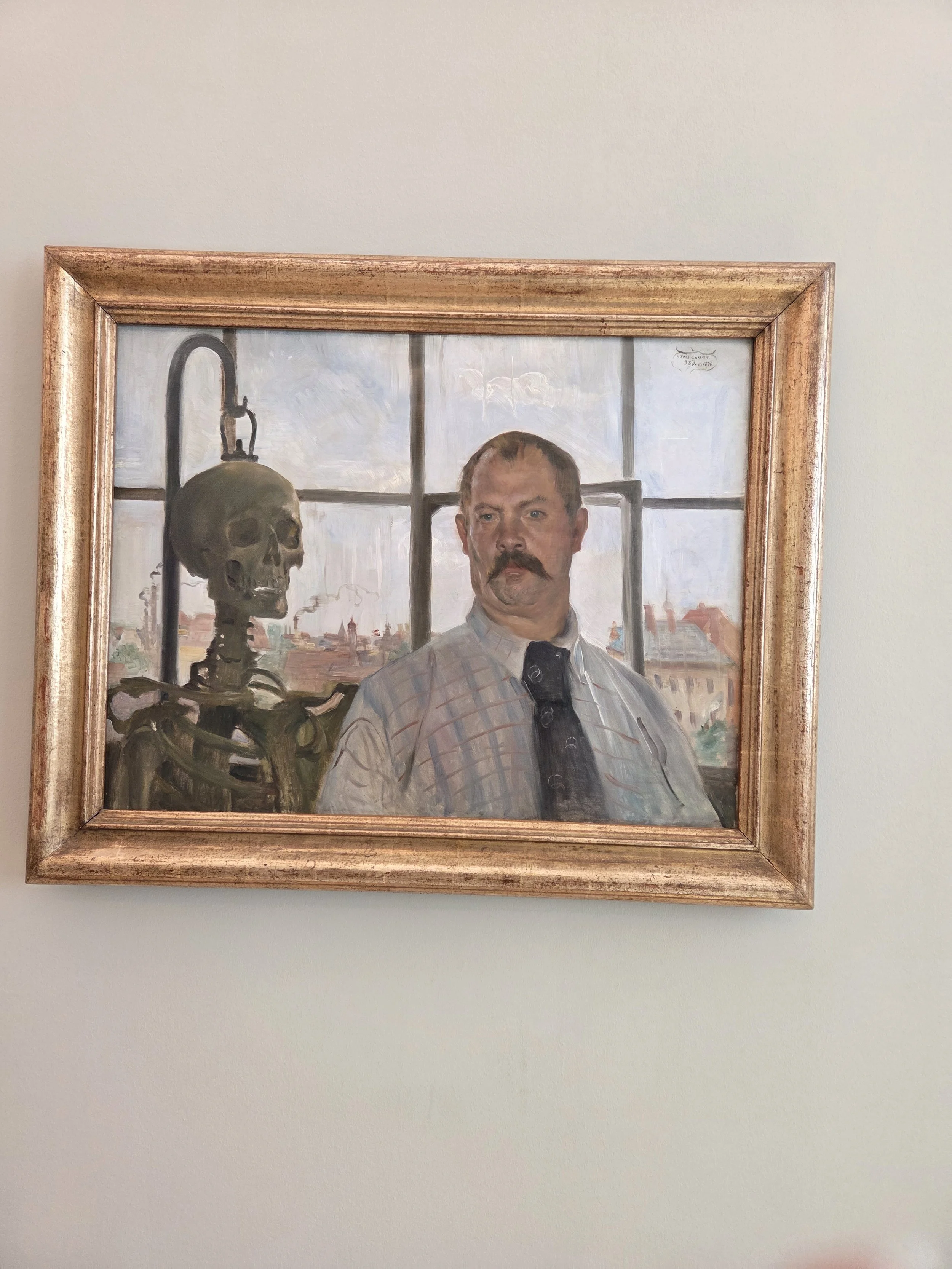
Lovis Corinth, Self-Portrait with Skeleton, 1896, Städtische Galerie, Lenbachhaus, Munich, Germany.