
IN CONVERSATION WITH RISAKU SUZUKI
Opening Statement
"To bring out 'the power of photography' in any era or situation, a strong passion based on the photographer's mindset to structure concept is essential."
— Risaku Suzuki
Risaku
Suzuki
Shingu, Wakayama, 1963
Christophe Guye Galerie
Most Prestigious in Japan
Risaku Suzuki does not look through the viewfinder. This is the first thing to understand about him. Standing before a field of cherry blossoms or the surface of still water, he turns his attention to the subject itself — the light, the presence, the season shifting — and trusts the camera to receive what his eyes have found. The image is a collaboration, not a capture.
For over three decades, working with large-format analog film, he has photographed the same recurring motifs: snow, water, the sacred mountains of Kumano where he was born, the brief yearly violence of cherry blossoms. His fourth solo exhibition at Christophe Guye Galerie visits the threshold between winter and spring — the exact moment the monotony breaks.
Greatest inspirations and influences?
Monet. Cézanne. The Impressionists broadly. There is something in their relationship to light — light as subject rather than condition — that maps directly onto what I'm trying to do with the camera. They were not painting objects. They were painting the experience of seeing objects in a particular moment, under particular weather, at a specific time of day.
That is the conversation I want my photographs to be part of.
Tell us about your creative process.
I work with a large camera, on film. The motifs return across years: cherry blossoms, snow, water surfaces, and Kumano — the sacred place in Wakayama where I was born. These are not simply subjects. They are recurring encounters.
Once the work is made, the next question is how the photographs relate to the space they will be shown in. The image is not complete until it meets its room. I think about that relationship when I select and compose the final sequence.
"The camera is a mechanical perception that takes place outside the body — as if only the eyeballs are removed and the image on the retina is seen again."— Risaku Suzuki
How does technology impact your work?
Technology extends the body. It opens new experience. Digital photography in particular has moved increasingly close to painting — the image can be transformed in almost any direction after the fact, which is a genuinely new kind of freedom.
But I stay with analog film. Not out of nostalgia or resistance. I stay because analog holds something digital is still reaching for: a direct, unmediated photographic expression. The original encounter between light and surface. I am interested in that purity.
What does wellbeing mean to you?
The wonder of seeing. When I produce a work that immerses the viewer fully in the experience of looking — not thinking about looking, but simply being inside it — I feel a deep satisfaction. That is my wellbeing. The moment the image gives the viewer back to their own perception.
Anything else you would like to share?
The camera is a mechanical perception. It happens outside the body — as if only the eyeballs are detached and the image forms on the retina without the rest of you present. This is fundamentally different from ordinary seeing.
When we see with our own eyes, the image is never pure. It has been eroded by memory. We cannot separate what we are seeing now from what we have seen before, what we are remembering, what we expect. Seeing and remembering overlap and cannot be cleanly divided.
The machine has no body, no memory, no action-orientation. Its perception is clean. The central question of my work is this: how do I preserve the purity that exists at the moment of shooting, all the way through to the finished, printed photograph? How much of that original clarity can survive?
at the
Moment of Shooting
Suzuki's practice is a forty-year question: can the untouched light that reaches the film survive all the way to the gallery wall? His answer is a body of work collected across three continents and a fourth solo show exploring the exact threshold where winter ends.
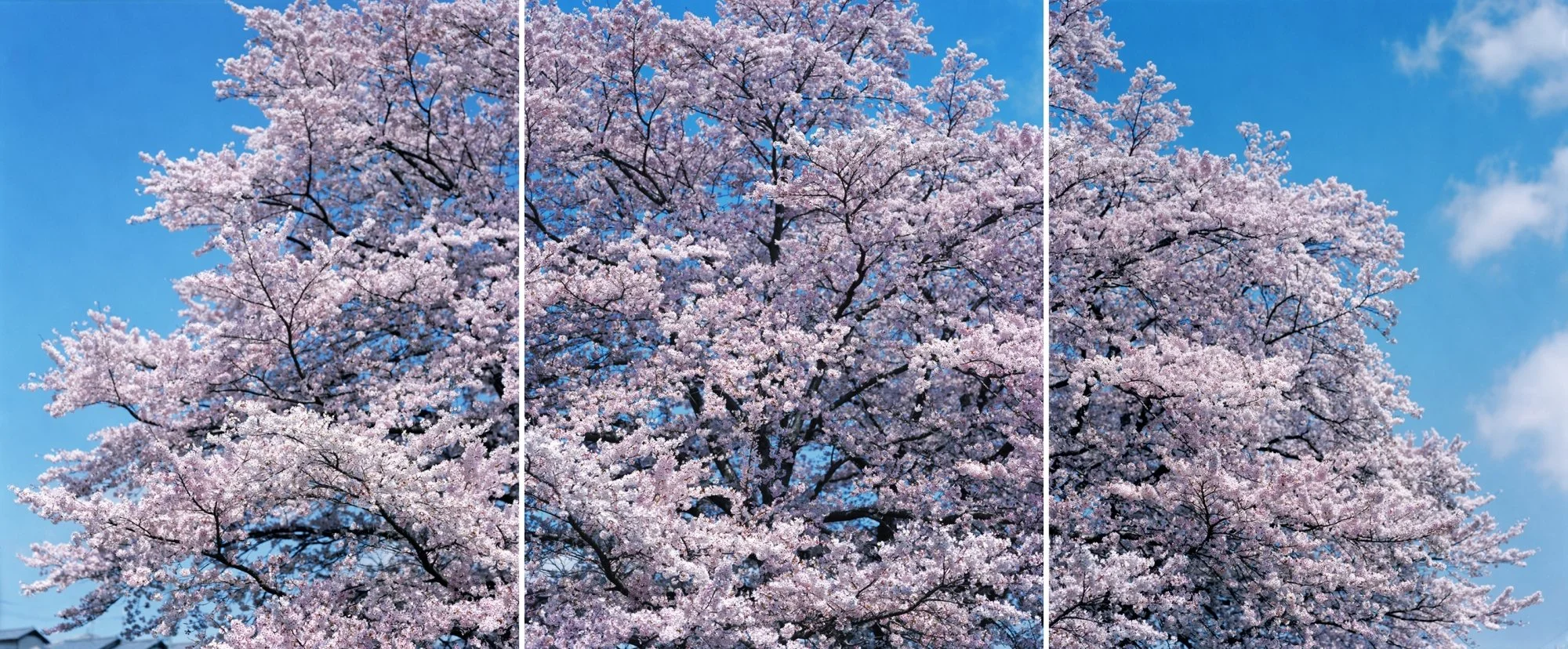
Chromogenic print
(3x) 155 x 120 cm (61 x 47 1/4 in.)
Edition of 5