Johan Bergelin: The Perfume as Counter-Cultural Act
19-69
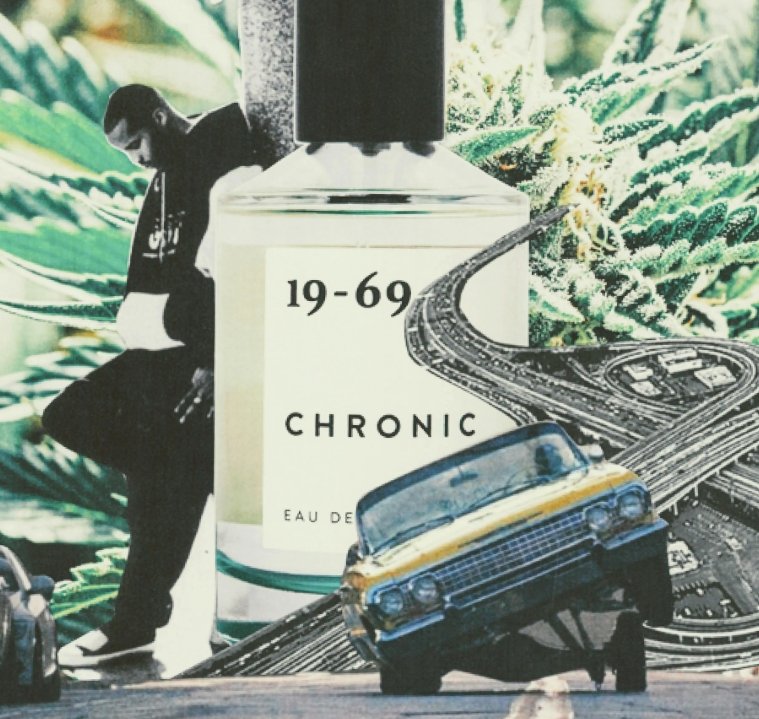
The name contains both a political year and a personal one. 1969: the year of Woodstock, of the bed-ins, of the moon, of counterculture cresting. Also the year Johan Bergelin was born. He chose it without apprehension. "This is real. This is who I am."
The founding capital of 19-69. The kitchen table was the first office and workshop. After two years of development with artisans in Scandinavia, France and Italy, the first five fragrances launched at Colette in Paris — and sold out within minutes.
"Purple Haze is about the legendary Keenak who I met in Bahama Village, Key West. Guitar on his back, snake skin boots, skinny jeans and long hair. A sense of Woodstock. It is a tribute to creativity, freedom and indulgence."
There is a moment, in every serious perfume, when the smell stops being a smell and becomes a place. Not a metaphor for a place — an actual place, with temperature and air quality and the specific light of a particular hour. This is what the best perfumers do: they capture something that cannot be photographed and refuse to let it dissolve. Johan Bergelin understood this because he understood it first as a painter, a photographer, and a musician — someone who had spent decades asking how experience could be held in a form before he ever asked that question about a bottle.
19-69 was founded in 2015, on a kitchen table, with 500 euros and a vision that was already fully formed. The two-year development process that followed — working with artisans in Scandinavia, France and Italy — was not a search for a product. It was the translation of a philosophy into olfactory form: that scent belongs to everyone, that gender is a convention the nose knows nothing about, that counterculture is not a historical moment but a permanent posture, and that a perfume, like a painting or a song, should make a genuine argument.
The fragrance industry has spent a century constructing a gender binary that the nose never actually supported. Floral means feminine. Woody means masculine. The bottle shape confirms what the advertising already said. The shopper who picks up the wrong bottle in the wrong department store feels, briefly, that they have done something wrong. This is a social construction so deep it has become invisible, and its invisibility is what makes it effective. You do not notice the cage until someone points to it.
Bergelin points to it. Every 19-69 fragrance is described as suitable for any gender — not as a marketing gesture, not as a contemporary concession to changing norms, but as a statement about what a perfume actually is. A perfume is not a gender signal. It is a mood, a memory, a landscape, a conversation between the skin and the air. The idea that these things belong to one gender or another is a commercial fiction that 19-69 refuses to perform.
"I grew up strongly influenced by the fashion trends that ruled the 80s. Gender boundaries were pushed and I was mesmerized by the possibility of affecting and changing a person's appearance. Then as now, it was clear to me that beauty is a form of art."
The 19-69 fragrances are stories before they are scents. Purple Haze begins in Bahama Village, Key West, with a man named Keenak: guitar on his back, snake skin boots, long hair, the sense of Woodstock carried like a cologne. It extends to John and Yoko's bed-ins — the radical act of lying in bed for peace while journalists photographed them doing nothing — and the entire hippie movement's insistence that love could be a political position. This is an enormous amount of narrative for a fragrance. It works because Bergelin is a storyteller first, a perfumer second, and he knows that the nose is the shortest route to memory.
Bergelin describes the approach as analogous to travel: "It's like when you travel for food. To fully enjoy the experience you eat at Michelin restaurants, but you also must explore the street food flavours." This is a design philosophy as much as a travel one. The high and the low held simultaneously. The sophisticated and the raw refusing to separate. The Michelin meal is incomplete without the street food, and the street food is transformed by the meal.
Before the perfumes, Bergelin built an archive of over 1,000 works across photography, paper, canvas, wood and PVC. His preferred technique — automatism — involves holding pastels, pencils or brushes very gently and allowing the image to emerge without conscious direction. The result is what he describes as a kind of "romantic symbolism": the more you look, the more clearly you see that the marks are always about love. The unconscious, given a surface and a light touch, returns to the same subject every time.
The connection between this practice and the perfume work is not decorative. Both rely on the idea that the deepest communication bypasses conscious decision-making entirely. You do not rationally choose what a smell makes you feel, any more than Bergelin's automatist line rationally chooses where to go. The message arrives before the interpretation begins. This is the specific quality that separates art from design — and it is the quality that 19-69 is attempting to capture in olfactory form.
"I have always surrounded myself with creative people. What has always inspired me is how these artists very often stand up for their values. They want to make a difference. I think this is what planted a seed in me and was the beginning of 19-69."
Key West. Keenak. Guitar on his back, snake skin boots. A sense of Woodstock. John and Yoko's bed-in. The hippie movement as political position. Tribute to creativity, freedom and indulgence.
Each of the five inaugural scents takes its narrative from a different era, geography, and cultural moment — carrying its story in molecular form.
Two years of development. Artisans in Scandinavia, France and Italy. The craft that produced the first five fragrances is inseparable from the narratives they carry.
The first launch. Colette was the most curated retail space in the world. The fragrances sold out within minutes. The cult was immediate.
Every scent suitable for any body. Not a concession to contemporary norms — a founding principle from day one. The nose knows no gender.
An independent platform dedicated to artists, musicians, photographers, designers, and thinkers at every stage, from emerging voices to established masters. Every interview is selected for depth, not reach.
✦ Explore all our interviews →"We need to support alternative films, art, any artistic form that challenges mainstream."
More personal essays and cultural commentary from Leila Antakly, on art, politics, wellness, and the complicated business of paying attention.
Read on Substack ↗