SPANISH PAINTER ALFONSO DEL MORAL
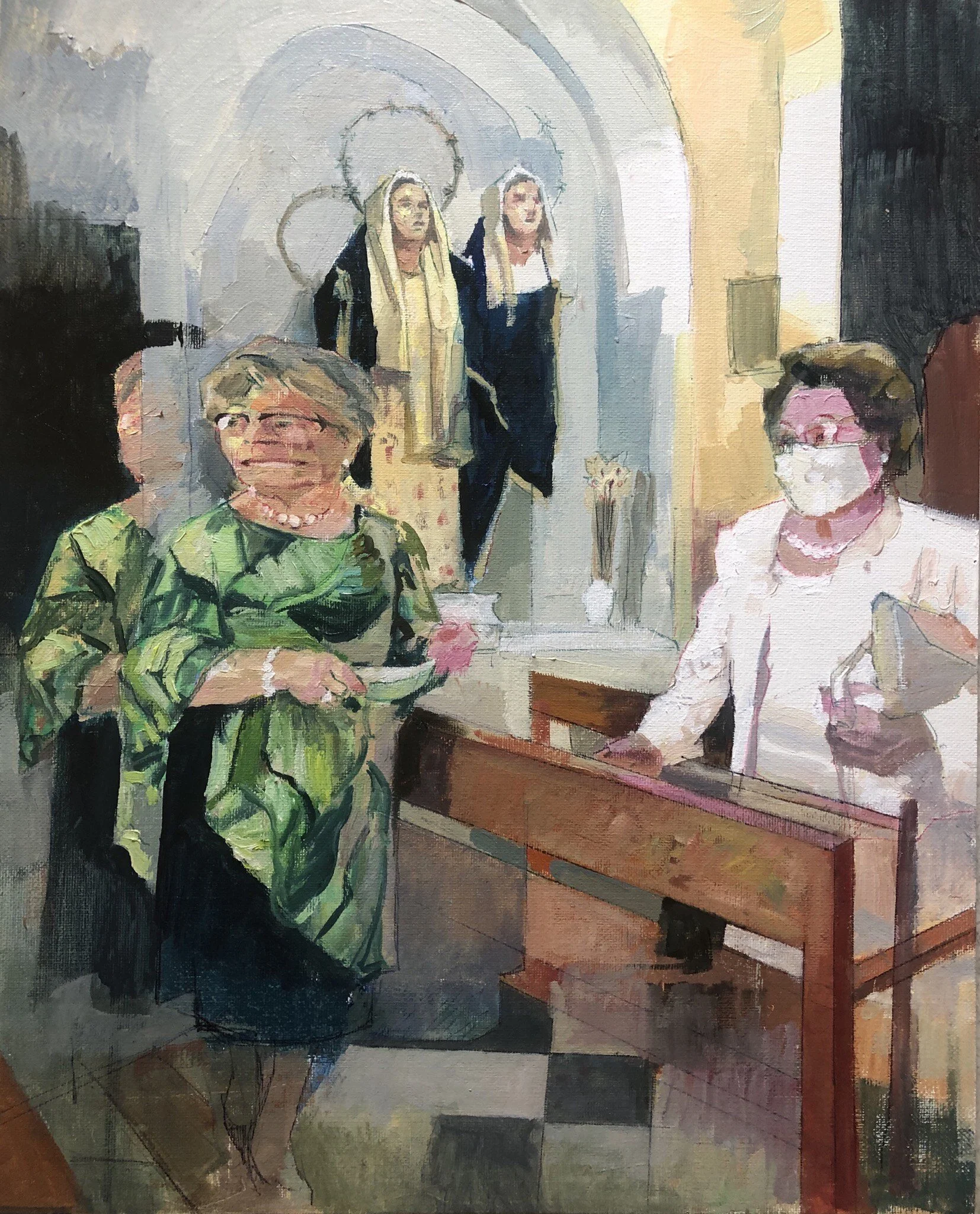
Alfonso del Moral was born in Murcia in 1992. After fifteen years of training at the Arles academy and a law degree, he moved to Valencia to study Fine Arts at the Polytechnic University of Valencia. He now teaches painting there as an associate professor and works between Valencia and Murcia, where he has his studio. His painting draws on the Spanish academic tradition and on queer theory in equal measure.
 Alfonso del Moral
Valencia · Studio portrait
Alfonso del Moral
Valencia · Studio portrait
He learned to paint at the Arles academy under Pablo Hernando and Ana Vazquez for fifteen years, before meeting Pedro Cano, who became his Maestro. He entered Fine Arts seven years later than his peers, having first completed a law degree, a master's in law, and the beginning of a doctoral thesis. This sequence gave him something few painters his age have: an interdisciplinary formation that places his work in direct conversation with philosophy, critical theory, and legal thought. He joined the Fine Arts faculty at UPV as an associate professor, and continues to show widely.
Alfonso del Moral We are not born isolated, nor can we be absolutely original. We artists join a choral conversation that has taken place for centuries, and all the previous tradition is a great path that has already been travelled. I do not deny that tradition, but I use it to be true to myself, or to the idea that I have of myself at all times. My Maestro Pedro Cano has been a great inspiration. I like painting, and about classical painting I especially love Fortuny, Sorolla and Freud. I suppose I am very influenced by the Spanish academic school. But inspiration comes from any field.
"Anything can be used to establish new connections that inspire me artistically, even a conversation with a friend or with an older person."
Alfonso del MoralAlfonso del Moral It depends on the type of work. When I have a commission, everything is more standardised. I use photos and the more the merrier. I make sketches and build the painting based on all the information I have. If it is a series or a project, things change. I also start from photos and make sketches, but the first results can take me to another phase. Ultimately, it is about experimenting, and I am never quite sure where painting will take me. After so many years, I have many internalised processes, so during the creative act I constantly let myself be carried away by intuition.
The process culminates with the exhibition of the work in front of the public, which produces feedback that determines some conclusions that generate new project ideas. So it really is a cyclical process, with no beginning and no end, like life itself.
Alfonso del Moral At first I felt very unmotivated, like a large part of the population. Soon after, I realised that I could use it to my own advantage. Never again would the opportunity to have so much time to dedicate to painting and nothing else be repeated. So I knew how to use what seemed like an impasse to be very productive and carry out various projects. The pandemic was a before and after for my work, thanks to social networks, which made me reach many more people and find ways to solve projects I had been most personally involved in.
Alfonso del Moral Samantha Hudson, a performer of the absurd from my country who ridicules the most unfortunate aspects of society and transforms them into humour art with a progressive-queer message. I entered Fine Arts seven years later than normal, after completing a law degree and a master's, which put me in contact with a significantly younger generation and gave me access to certain currents of millennial and centennial culture. That generational crossing has been essential for my work.
Alfonso del Moral Above all, it means going with the truth ahead. Being honest with others and, above all, with myself. Only then can I feel calm and at peace. Talk, express myself, that is wellbeing. Keeping quiet is the opposite.
Physical exercise helps me feel good. I particularly like to dance tango, which I have been doing for ten years, because I find a place where I forget my problems and only think about the present: my body, the other body, music, the dance floor and my emotions. It has also become my family and a safe space where I can explore different gender roles that help me deconstruct myself.
"I conceive art as a constant question, as a means to ask questions about myself and about the world, without looking for answers."
Alfonso del Moral