KALI TRIO PRESENTS LOOM
LOOM.
Three years in development. Six days to record. One underground vault. The debut is out now on Bandcamp.
"What is absolutely mind blowing about these instrumentalists is how each of them is able to push their instrument beyond its preset sonic aesthetics."
— FameMag UK
Tell us about the origins of the band.
Nicolas and I met at music school in Lucerne, at a program for jazz musicians. We shared a similar interest in rhythm and sound, so forming a band felt like a natural thing to do. As we were looking for a third player — someone willing to commit to a working band — the timing with Urs was just perfect. He was kind of fed up with all the pop sideman jobs he was doing at the time.
As a band, we figure things out together and work as a collective. That idea of collectivity was important to us from the very start. The sound of our debut reflected three distinct personalities with very particular tastes. On «LOOM» it evolved into something more homogenous — we were really working hard to find our flow and a sense of urgency with this material.
Describing our style is always hard because we draw from so many different places. It's minimal, it's rhythm-based, and we love detail. Our music is compositional at its core, but as instrumentalists we developed a high interactivity with each other on a very microscopic level.
Greatest inspirations or influences?
Apart from music, I draw a lot from hiking, nature and yoga. Musically, we're inspired by the likes of Beatrice Dillon and Kali Malone — both release records that work with a single mood across the entire duration. The sound of electronic music in general is a huge influence. We try to recreate that with acoustic instruments.
Living in Berlin for a year in 2018 had a huge impact on me. Before that I was completely ignorant of the clubbing scene and electronic music. That changed dramatically with my first night at Berghain — yes, total cliché, I know. But I found it fascinating how the music never stopped evolving yet stayed continuous for hours.
I realised jazz and electronic music are much more similar than I'd thought. Artists like Ricardo Villalobos and Max Loderbauer used modular systems to improvise. I've played gigs that were completely improvised on a club PA and people were dancing. The playing felt really free — you can draw a lot of analogies to improvised music.
"Music has the most impact when it serves a social function."
— Raphael Loher
What is the band's creative process like?
Our creative process has definitely evolved. In the beginning, especially Raphael would bring composed pieces and we'd work them out as a band. While working on «LOOM» we got rid of almost all the written melodic parts. Right now the focus is on much smaller fragments — a mood, a rhythm, a sound — which we work off of. These themes let us explore different settings that eventually evolve into tracks.
We take as much time with any idea as it needs, until everyone in the band really loves it. This can be tiring and it definitely leads to a lot of discussions — but through that process the initial idea becomes so much richer.
How has Covid impacted you on a creative level — and the industry in general?
Streaming and everything moving online has been dramatically accelerated — what might have happened in five years happened in one. I think a lot of people will question the old touring model. Hopefully it moves more towards residencies, bands staying longer in one city, other activities outside of just playing a gig. That would lead to better exchanges with local musicians, artists and communities. More sustainable — artistically too.
It gave us a lot of time to rehearse and really dig deep on «LOOM». We were able to think about the recording process much earlier and ask ourselves how it should really sound. Personally, I was also discovering far more music than before — spending hours on Bandcamp, finding new artists.
It also gave everyone a lot more time to reconnect with their instrument on a different level. A lot of musicians in my circle used this time to broaden their skill set — recording, video production, all of it.
Three years in development. Six days to record. One underground vault.
Antakly Projects / Ninu Nina
<
.
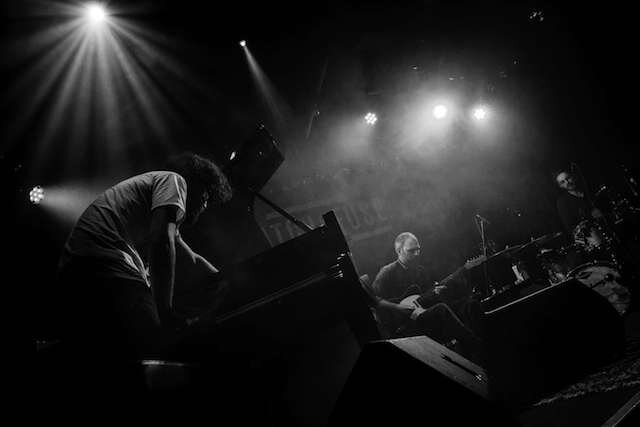
©Jean-Marc Guélat