Luma Shihab Eldin — Design as Strategy
Luma
Shihab
Eldin
I am constantly seeking new approaches by shifting the perspectives in which we see the world, exploring new opportunities to solve challenges in unconventional ways, and striving for unique insights that can be built into transformative ideas. It's an exercise in curiosity, discovery and intuition.
"There is a misconception that design is purely aesthetic. My career has always been strategic: challenging norms, exploring hidden opportunities, and designing transformative solutions. I've always been a BIG idea kind of person."
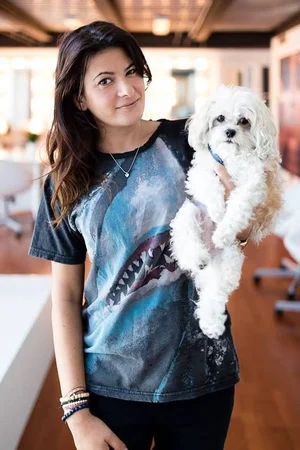
Most people who meet Luma Shihab Eldin for the first time ask about the NFC chip in her hand. That is understandable. She got chipped at a conference at the THNK School of Creative Leadership in Amsterdam, noticed that the volunteers were primarily male, and decided it was important to represent. She is also a strategic designer whose clients include Sony, American Express, the Qatar Museums Authority, and the World Government Summit. She founded MNDBAR. She works with a technology research institute building database digital platforms. The NFC chip is the least surprising thing about her.
Her father is a nuclear physicist who thrives on challenges. Her mother is, in her words, one of the most creative and imaginative people she knows. She grew up at the intersection of rigour and imagination, and her work has always operated in that same space: the place where systematic thinking meets the radical possibility that things could be done entirely differently.
How did you decide this was something you wanted to do?
There is a misconception that design is purely aesthetic. My career as a designer has always been strategic: challenging norms, exploring hidden opportunities, and designing transformative solutions. My strategic approach allowed me to leverage myself beyond a traditional approach of design as communications, where I would often offer clients more than what they came for, identifying new possibilities for their businesses and organisations. I've always been a BIG idea kind of person, searching for unique ways to do things differently and with more impact. I get excited by novelty and change. Which makes my transition into strategic consulting and technologies almost natural.
What are the challenges of what you do?
The main challenge is finding clients that appreciate and recognise the value of such a strategic approach. The world is changing rapidly and automation will soon replace most jobs that are dependent on expertise skill sets. With this said, 60% of CEOs value creativity, as a way of problem solving, not as an aesthetic, as the number one skill of the future.
Still, most people still fear this shift in professional dynamics and prefer to depend on what they know, what they are comfortable with, and ideas that are validated by precedence. It's been an interesting journey to explore this challenge using the process itself, educating potential clients to embrace uncertainty, take risk, explore the unknown, for more imaginative ideas and bigger impact.
"60% of CEOs value creativity, as a way of problem solving, not as an aesthetic, as the number one skill of the future."
Luma Shihab EldinYour greatest inspirations or influences?
My parents have had such a subconscious influence on me. My father is a nuclear physicist that thrives on challenges, and my mother is one of the most creative and imaginative people I know. That combination has defined my approach to design as well as my personality. Family time has always involved exploring nature and pushing our limits. Connecting the dots between their idiosyncrasies has really helped me understand where I get my unique perspective, even if it's often not understood by others. I still believe that ultimately it's my strength and what sets me apart.
I'm fascinated by human behaviour and psychology, which works out well for any strategic design approach, as it focuses on fulfilling human needs as a pillar of the process. I also try to surround myself by friends who challenge me to grow. I truly believe we are the five people that we spend the most time with, and I look for inspiration in those people.
What would be a dream project for you?
MNDBAR has been my dream project that is slowly and surely coming to fruition. I believe there's such an important gap that needs to be filled in our communities, that helps individuals reconnect to our human superpower: our imagination. We've lost that ability through our outdated educational systems and societal conditioning. Our successes as a species are a direct product of our imagining great things. We now carry an even larger responsibility to use it wisely and impactfully, as we've shifted the evolution of nature, where we dictate the fate of our surroundings, rather than the other way around.
You described SoleDXB as a cultural experiment in Dubai. Tell us more.
SoleDXB is an incredible example of Dubai's underlying social experiment. Whenever anyone asks me what draws me to Dubai, I always say because it is a city that exemplifies the design process: ideating and prototyping rapidly, learning from mistakes, and iterating. What's been particularly intriguing to me about this process is the byproduct of cultural integration that happens in pockets here and there, organically and sporadically, giving me hope in the faith of mankind. While far from perfect, this interactivity is so exciting to me it makes me giddy.
chip
She got chipped at a conference when she noticed the volunteers stepping forward were primarily male. It became important to represent. This is how she operates: she notices who is not in the room, and puts herself there.
The NFC chip is also a statement about the relationship between technology and the body. Not a fearful one. An exploratory one. She has been thinking about this relationship far longer than most people have had to: how to engage with technology consciously, how to build a healthy relationship with it, how to question its impact on you as an individual and renegotiate periodically how you interact with it.
"If people are worried about being tracked, they should stop carrying around their smartphone. That's far riskier than an NFC chip."
Luma puts her phone in the kitchen at 10pm and does not allow herself to look at it until 8am. This includes all TVs, iPads and the rest. This has opened at least an hour on each side of sleep for reading, writing, or spending time with family. The forgotten valuable experiences, as she puts it. The ones that happen when the screen is not on.
Even paper currency is a form of technology. Anything man-made is. What's most important about technology, and often left out of the conversation, is the importance of building a healthy relationship with it. Bringing a level of self-awareness to your engagement. Questioning its impact on you as an individual and renegotiating periodically how you interact with it. Otherwise it's easy to become overwhelmed and find yourself in a downward spiral.