How Wendy James of Transvision Vamp Paved the Way
Wendy James
Was the Blueprint
Before Amy Winehouse made defiance into art, before female rebellion became a carefully market-tested branding exercise, Wendy James was already kicking holes through every expectation placed on women in pop music.
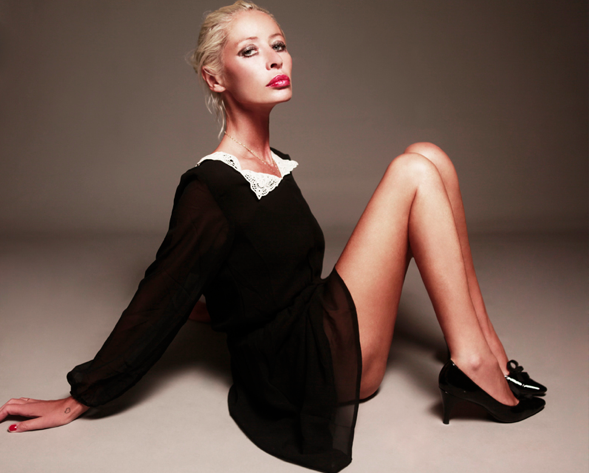
Long before the world met Amy Winehouse, a different kind of pop provocateur was tearing up the charts and redefining female audacity for a generation. Her name was Wendy James, the lead singer of the British band Transvision Vamp. For those of us who lived through the late 1980s, she was an electric shock to the system: a blast of Baby I Don't Care on the radio, a vision of bleached-blonde defiance on Top of the Pops. She was, as one fan recalls, "a mix of smart and moody, sexy and confounding, cool and unflappable," a description that perfectly captures the unique paradox of her star power. While her stateside fame was limited, in the UK, Wendy James was not just a singer. She was a cultural event.
Transvision Vamp's 1988 debut, Pop Art, was a statement of intent propelled to mainstream fame by anthems like I Want Your Love. They did not just break through; they exploded. The following year, Velveteen slammed straight to the top of the UK charts, cementing their status with the era-defining Baby I Don't Care. But the music was only half the story. The band's rocket-fuelled ascent was intrinsically linked to James's undeniable stage presence. She was not performing songs. She was embodying a new kind of attitude.
In an era of polished pop stars, Wendy James was gloriously unpolished. She was a rebel who embraced an aggressive, confident, sexually assertive style that deliberately challenged every traditional notion of what a female pop star should be. Her iconic look, platinum hair, heavy eyeliner, and a wardrobe that screamed downtown cool, was emulated by fans and viciously criticised by a baffled media. She famously appeared on magazine lists of "most hated" celebrities, a dubious honour that only solidified her status as someone powerful enough to threaten the status quo.
The background matters because it explains the fearlessness. Adopted at the age of one and raised in a middle-class family in Brighton, James began her musical education at age ten by buying the Sex Pistols' Never Mind the Bollocks. At fourteen she was at the Clash at the Brighton Centre. "I was up at the barrier," she recalls. "I remember the passion and the power. It felt like freedom." She left home on her sixteenth birthday with a hundred pounds and a toothbrush, "absolutely fearless, ready for all of it."
This is not incidental biography. It explains why she carried herself differently. She did not come from manufactured pop. She came from punk, where the refusal to be packaged was not a personality quirk but a philosophical position. She absorbed rebellion as philosophy, not as branding. When she arrived at the top of the charts, she brought all of it with her.
"It never occurred to me in my life, in my field, that I wasn't equal. I had absolute equal rights in the world with any man or any strata of society. I'm born and endowed with equal rights. It never even occurred to me that that could be a question or in doubt."
Wendy James · Women in PopThe British tabloids and male-dominated music press of the late 1980s and early 1990s did what they always did to women who refused to soften themselves for public consumption: they reduced her to caricature. Mocked for her image. Criticised for her confidence. Treated less like an artist than a provocation. The same qualities that would later be celebrated in artists like Gwen Stefani or Amy Winehouse were, in James's era, frequently framed as arrogance or artificiality. She was too outspoken, too sexual, too loud, too ambitious. In other words, she was ahead of her time.
The Elvis Costello episode is instructive. After moving to the United States to pursue a solo career, James approached Pete Thomas, drummer with Costello, at the bar of the Sunset Marquis hotel in Hollywood and asked if Costello might be interested in writing for her. Thomas suggested she write him a letter. She did. When she returned to England, there was a cassette through the mailbox: Now Ain't the Time for Your Tears, a whole album that Costello and his then partner Caitlin O'Riordan had written together for James in a single weekend. David Bailey shot the cover. Her record label thought they would "ride this baby straight to the bank."
It reached number 43. What went wrong? James's answer is unsparing. The album's opening track, Puppet Girl, begins: "Hey there little puppet girl, how'd you learn to talk that way?" Costello, she says, "definitely had a concept of me as this silly little blond thing that's trying to make it." She accuses him of writing "a male cliche of what idiots young female pop stars are. It was quite nasty: he was asking me to sing derogatory stuff about myself, or this concept of myself." Costello disputes this reading, saying the songs were written as satire, with the star "mocking tormentors by going to even greater extremes." The disagreement itself is revealing: the industry often wanted female artists to participate in their own diminishment, and when they refused the framing, the story got complicated.
After the commercial disappointment of the Costello album, James retreated from releasing music. When she was not having dinner with Bob Dylan and Van Morrison or spending time with Bono in Dublin ("He was very protective and encouraging during that Elvis period"), she was living in Ladbroke Grove with her then boyfriend, ex-Clash guitarist Mick Jones. She did not release music for a decade. "I like to think of them as my industrious years," she says. "I was learning how to write songs. Normally you would do that as a teenager in your bedroom and then make it, but I did it the other way round."
She returned in 2004 with the group Racine and then four solo albums, including 2016's The Price of the Ticket, for which her backing band included Glen Matlock of the Sex Pistols, two members of the Stooges, a Bad Seed, and Lenny Kaye of the Patti Smith Group. The album was not a chart event. It was something more durable: evidence of a career built on conviction rather than calculation.
After seventeen years in New York, she went to France to housesit for a friend and ended up staying. "It was totally random and not planned at all." Transvision Vamp have since reformed, with tour dates confirmed across multiple continents. She is not doing it for the money. "Whatever the size of venue, I am going to walk off stage feeling exhausted, exhilarated and knowing I gave it everything."
"There's a continuous path of spunky, independently minded, fearless young females that are warriors. I think Miley Cyrus has had a look. There's a line of us."
Wendy James · The GuardianConsider what connects Janis Joplin to Debbie Harry to Madonna to Wendy James to Gwen Stefani to Amy Winehouse to Miley Cyrus. It is not genre. It is not sound. It is the specific quality of refusing to apologise for existing on their own terms in a space that kept asking them to be smaller, quieter, more manageable. Each of them paid a version of the same price: critical hostility, reductive coverage, the persistent suggestion that their image was more important than their work.
James herself understands this clearly. "To get an accurate answer," she says, when asked about how female self-expression in music is treated, "you'd have to get me and a girl who is at the top today and ask how they're being seen by the music business, or the critics, or the audience. But I basically think it's the same fight because there is commonality between anything Janis Joplin went through to Debbie Harry, to Madonna, to me, and then on to Gwen Stefani or Miley Cyrus. We've been in bands with guys. So we travel with a gang, and that kind of gang mentality projects itself through the strength that we are armed with. You're not standing up there necessarily revealing your fragile vulnerability. You are out there going toe to toe with the boys, and I was always very competitive."
What is striking about this observation is how little has changed in the analysis, even as the cultural temperature around female artists has shifted considerably. The fight is the same fight. The targets move. The toll is recognisable.
Influence and fame
are not always the same thing.
Wendy James did not become Madonna-level famous. But for a generation of women watching from the sidelines, she represented another possibility entirely: that a woman could be aggressive and intelligent, sexual and self-possessed, glamorous and openly rebellious without apologising for any of it. She proved it could be done. She did not receive the institutional validation or the mythology that later generations got, in part because the culture was not yet ready to give it to her, and in part because she was too independent to spend much time asking for it.
Amy Winehouse, who did receive that mythology, in grief as much as in life, embodied many of the same qualities: the refusal to perform acceptable femininity, the brilliant talent coexisting with genuine difficulty, the critical hostility that arrived alongside the adulation. The difference between them is less about the music than about timing and tragedy. Both were too much for a culture that has always preferred its difficult women at a manageable distance.
Wendy James is still making music, still touring, still entirely herself. The pinnacle, she once said, was always to play Madison Square Garden. This time, who knows. The potential, she says, is massive. And whatever the size of venue, she is going to walk off stage knowing she gave it everything. She always has.
An independent platform dedicated to artists, musicians, photographers, designers, and thinkers at every stage. Every interview is selected for depth, not reach.
✦ Explore all our interviews →"The only difference not being famous has made is that I have to book my own flights and find my own way to the airport."
More music writing and cultural commentary from Leila Antakly on Substack.
Read on Substack ↗