YIM TAE KYU
Haunt and
Harmony
Korean contemporary art is not a trend. It is the product of a specific and irreducible national experience, Han, Gwangju, the DMZ, the speed of modernisation, that is now being recognised by the world's most important institutions at exactly the moment the global art market is hungry for it.
From Yim Tae Kyu's ink-and-hanji paintings of the Marginal Man to Mire Lee's visceral turbine hall commissions, from Park Chan-kyong's ghostly political cinema to the Gen Z artists building practices inside and outside the screen, this is the generation that arrived. The world caught up last. The artists were already there.
The Korean concept of Han, a deep collective sorrow and resentment born of centuries of occupation, division, and rapid, often brutal modernisation, is not simply an emotion. It is a structural condition that runs beneath Korean culture. Every significant Korean artist of this generation is in dialogue with it, whether they are painting cartoon characters on hanji paper, building kinetic machines that drip glycerin, or making films about the ghosts that Korea's economic prosperity cannot exorcise.
han
Deep sorrow
Collective anguish
Unresolved grief
Also: resilience
Yim Tae Kyu
임태규"The Marginal Man: the ordinary male navigating the impossible coordinates of modern life, somewhere between tradition and globalisation, between the collective and the self, between the comic and the tragic."
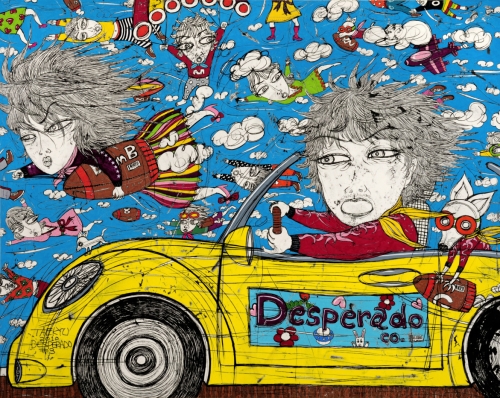
Yim Tae Kyu is a painter who works in traditional materials, Indian ink and oriental colours on hanji, the handmade Korean paper with a history spanning more than 1,000 years, and fills them with characters that could have emerged from a Saturday morning cartoon. The juxtaposition is not accidental and not ironic. It is the formal equivalent of his subject matter: a modernity that is simultaneously ancient and disposable, a self that is simultaneously heroic and absurd.
He layers hanji paper to produce unique, extraordinarily sharp pen-like lines. His characters are vibrant, dynamic, and deeply strange. His series Erewhon, named after Samuel Butler's satirical 1872 novel about a fictional nowhere that functions as a mirror to social reality, maps the landscape of contemporary Korean life through figures who are caught between systems they can neither accept nor escape.
"Yim Tae Kyu challenges the boundaries of traditional Korean painting while simultaneously satirising the world that produced it. The cartoon and the classical are not in conflict. They are the same image, seen from different distances."
What makes Yim Tae Kyu genuinely interesting to the international art world is the same quality that has made Korean popular culture internationally legible: the refusal to choose between tradition and modernity, and the willingness to make that refusal beautiful. His characters navigate a landscape that Korean viewers recognise immediately and that international viewers find simultaneously unfamiliar and deeply familiar. That dual legibility is the quality that the most attentive global collectors are beginning to pursue.
Mire Lee's works defy categorisation. Towels, chains, clay, silicone hoses, and steel structures coalesce into organisms that are haptic, primordial, and highly mechanised. Unsightly yet inexplicably sensational, her work challenges notions of selfhood, social acceptability, and cleanliness, obliterating aesthetic convention in the face of her transgressive, kinetic technologies. She is the only woman among the world's top Korean contemporary artists. She is also the fastest-rising.
Black Sun — New Museum, New York (2023) · Schinkel Pavillon, Berlin (2021–22)
59th Venice Biennale (2022) · 58th Carnegie International, Pittsburgh (2022)
Special Prize, Future Generation Art Prize (2021)
Rijksakademie residency, Amsterdam. Seoul Museum of Art. Cité internationale des arts, Paris. The institutional validation of Mire Lee's practice is now comprehensive. Collectors who came to her work before the Tate commission are sitting on significant appreciating positions. Those arriving now are still early by most standards, but the window of relative accessibility is closing.
Park Chan-kyong's practice is rooted in the discontinuous histories that haunt the image of a prosperous, modernised Korea. His three-channel film Citizen's Forest (2016) shows ghouls from Korea's past: students in uniform resembling those who died in the Sewol Ferry tragedy; men bearing skull-like helmets, presumably victims of the Gwangju massacre. Using the screen as a generational surface for memory, he addresses the lack of reparations for victims of history and proposes institutional critiques of social and political organisations.
His brother is Oldboy director Park Chan-wook, one of the artists blacklisted by the Park Geun-hye administration.
Kim Heecheon uses technology, video gaming, face swapping, virtual reality, to examine social issues in Korea. His work Sleigh Ride Chill (2016) intertwines a live-streaming video game session, a leaked sex tape, and an online suicide club into a portrait of contemporary Seoul. To Kim, loneliness, connectivity, and surveillance are intrinsically connected to the online world, temporal channels he describes as revealing the "cracks" or "gaps" in our reality.
DOOSAN Gallery, Seoul
Anthropomorphised animals feature often in Ji Hye Yeom's work. A dolphin narrates a strange folkloric tale in A Night with a Pink Dolphin (2015). In AI Octopus (2020), an artificial-intelligence octopus ruminates on its place within the human realm, gliding through European city streets. She engages our abject fear of the advancement of a hyper-sentient species and conveys radical evolutionary messages touching on environmental devastation.
Much of Chung's work springs from geopolitical tensions embedded in physical landscape. A four-month residency near the DMZ produced Ori Mountain (2016), a melting beeswax installation mimicking the geological ranges of that no-man's-land. Her sculpture Island for Fishermen (Delfina Foundation, London, 2019) utilises found buoys possibly used to mark oceanic territory claimed by both Korea and China.
The Erewhon series: a fictional, surreal landscape serving as a mirror to contemporary Korean social reality. The Marginal Man: the ordinary Korean male caught between tradition and globalisation, between collective expectation and individual desire. Vibrant, chaotic, satirical, and wickedly precise. Works have appeared at Christie's Hong Kong and are tracked on Artnet and Artsy.
Jeju Island-based painter whose works merge traditional Korean themes with modern pop aesthetics. His colourful compositions, featuring his recurring character Chunja, reflect a blend of folklore and contemporary animation. Where Yim Tae Kyu's Marginal Man navigates anxiety with dark humour, Shin's Chunja navigates the same landscape with warmth and folk memory. Two sides of the same generational experience.
Highly sought after by Gen Z collectors. Abstract paintings blending architectural photography with urban sensation. Sold out booths at Art Busan. The market is moving on him fast.
Web designer and artist creating interactive, immersive, chaotic web-based installations that challenge UX and digital norms. The internet as medium, not just distribution.
Known for her Post Truth series. Challenges perceptions of reality through multifaceted installations. Frequently featured at Frieze Seoul. Institutional validation accelerating.
Artist collective focusing on video and installation that critiques social issues, technology, and contemporary culture. The collective form itself as a statement against the individualism the market rewards.
Research into immigrant microbiomes, home-brewed lactic acid as anti-capitalist care, K-beauty products interrogating Western fetishisation. The biopolitical rendered intimate and consumable.
Political cinema and institutional critique. The ghosts of Gwangju and Sewol. Memory as the medium, the screen as the surface. Indispensable context for understanding everything else in this list.
Mire Lee at Tate Modern's Turbine Hall (2024) is the clearest signal. The Turbine Hall commission is one of the most visible platforms in contemporary art. Venice Biennale, Carnegie International, New Museum, Gwangju Biennale: Korean artists are present at every major international platform simultaneously. This density of institutional validation rarely happens by accident.
Since Frieze Seoul launched, Korean art has had a dedicated international market moment annually. Christie's Hong Kong, where Yim Tae Kyu's works appear, is the primary auction platform for Asian contemporary art. Sophisticated Western collectors are arriving early, as they did with Chinese contemporary art in the 2000s. The pattern is familiar to anyone who has watched a regional scene go global.
Korean contemporary art is internationally legible because Han, as a concept, is not exclusively Korean. The experience of unresolved collective grief, of rapid modernisation that leaves its population structurally disoriented, of social pressure that produces either conformity or explosion: these are experiences that resonate far beyond the peninsula. The artists in this collection speak Korean but they mean something global.
What makes this generation genuinely unmissable
There is a quality in the best Korean contemporary art that is very hard to manufacture and impossible to import: the specific pressure of a society that has moved, within living memory, from war and occupation to one of the world's most technologically advanced economies, while simultaneously carrying the weight of a cultural tradition that reaches back centuries and a political wound, the division of the peninsula, that has never healed.
Yim Tae Kyu paints this pressure onto hanji paper with Indian ink and cartoon figures. Mire Lee builds machines out of it. Park Chan-kyong films its ghosts. Kim Heecheon finds its cracks in the screen. None of them are making work about Korea as a subject. They are making work from inside Korea as a condition. That is the difference, and it is why what they produce cannot be replicated.
Antakly Projects has been watching these artists for years. The world is watching now. We are glad it finally caught up.
An independent platform dedicated to artists, musicians, photographers, designers, and thinkers at every stage, from emerging voices to established masters. Every interview is selected for depth, not reach.
✦ Explore all our interviews →"We need to support alternative films, art, any artistic form that challenges mainstream."
More personal essays and cultural commentary from Leila Antakly, on art, politics, wellness, and the complicated business of paying attention.
Read on Substack ↗