Zena Holloway- This Must Be Underwater Love
Hollow
ay
Born in Bahrain. Raised between London and everywhere else. First dive as a teenager. Egypt, then the Caribbean. PADI instructor. Commercial Diver. Then a camera. Nobody showed her the ropes. She taught herself.
"The magic for the viewer is in how she makes water look like our natural habitat, in capturing the perfect moment in an unlikely environment, to explore the possibilities and continue to challenge our usual expectations of underwater photography."
"Just being underwater makes us look into ourselves as sight, hearing, touch, and smell are all impaired. At the moment the photography is occurring it is somehow right that both model and photographer should be in their own space and silence."
She wanted to work underwater behind a camera from the age of 18. No one had shown her how. She became a SCUBA instructor, spent three years abroad as an underwater videographer, and returned to London in 1995 to carve out a profession that barely existed. The underwater photographer as fashion and commercial artist: technically demanding, physically punishing, and producing images that look effortless and otherworldly. She has been doing it for over 25 years. The technical vocabulary she built from scratch is now the standard for the field.
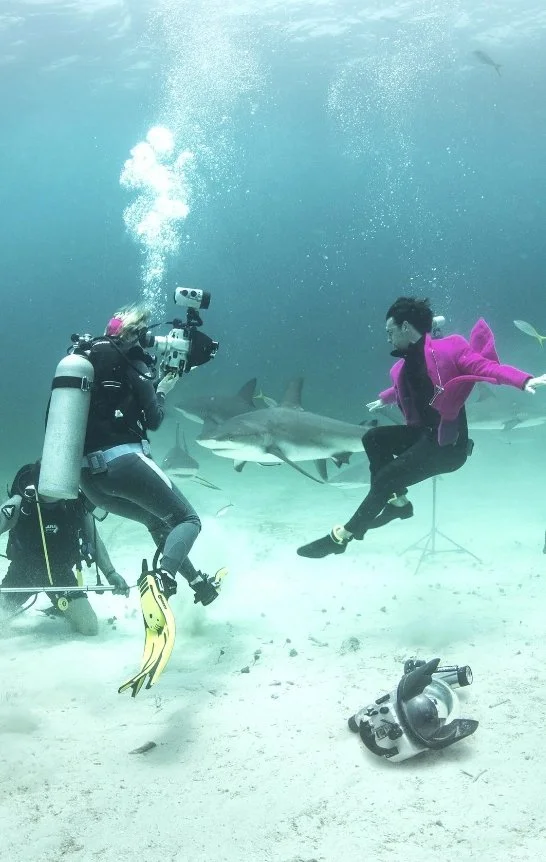
Most of her work is shot breath hold, which she finds more productive than using SCUBA kit. Four hundred to five hundred shots per shoot day: up to the surface, instruction, breath, down again. The silence is not a limitation. It is the medium. When both model and photographer are holding their breath and moving through water with no sound and no direction, something happens in the images that cannot be produced any other way.
What are the advantages of shooting underwater with digital cameras?
Shooting digital has revolutionised underwater photography completely. I used to shoot Polaroids, develop on site and have to surface after just 36 frames. Now I use a Canon 1DS MkIII coupled with a Seacam housing, which produces the best quality underwater imagery that I know of. Seacam housings are spectacular. Optically perfect and visually stunning.
Is underwater photography physically demanding?
Shooting underwater is certainly more demanding, both for the photographer and the artists. Most of my work is shot breath hold which I find more productive than using SCUBA kit. I average about 400 to 500 shots per shoot day, so that's a lot of up, down and breath holding.
How do you communicate with your models underwater?
I try to use the breath holding technique which means the models come to the surface to take instruction. When working in deeper water we use a series of underwater signals to communicate. Sometimes it's also possible to use underwater communication systems, although this is more effective if someone from the surface is giving instruction.
I've grown very used to working with the silence and I find it far more an advantage than a disadvantage. Just being underwater makes us look into ourselves as sight, hearing, touch, and smell are all impaired. At the moment the photography is occurring it is somehow right that both model and photographer should be in their own space and silence.
"Her images capture the deep, and often complex subconscious connections we have to oceans, rivers and lakes."
On Zena Holloway's practiceZena Holloway's career as an underwater photographer made her acutely aware of the depth of the plastic crisis in our oceans and rivers. The camera exposes pollution so visible, so devastating and so guilt-inducing that it led her to search for solutions in material science and biodesign.
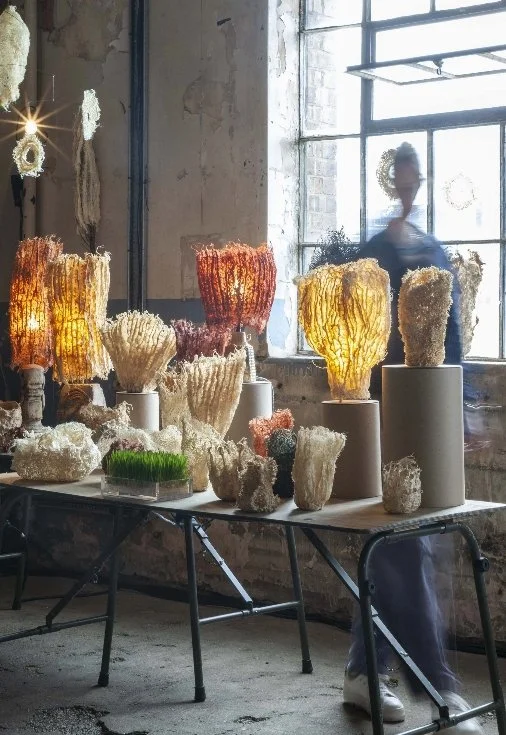
She grew mycelium in her basement for a year before encountering the tangled root system of a willow tree in her local river and asking: what if we could grow our clothes from seed? The idea took root. In 2023, she founded Rootfull, a creative studio that develops new generation root textile solutions for the circular economy.
The innovation pioneers a method of growing wheatgrass into templates carved from beeswax. Over 12 days, the shoots grow to 20cm while the root binds below to form a naturally woven structure. Ingredients are organic and locally sourced. Water is reused from runoff. Any leftover shoot or seed is eaten as animal fodder. The pieces show that the power of plants is infinitely renewable, and nature's amazing capabilities are simply waiting for us to tap into.
Working without SCUBA means working in pure silence. Models surface for instruction, then descend again. 400 to 500 frames per day. Up, down, hold, release. The physical discipline produces images no other method can.
Canon 1DS MkIII in a Seacam housing. Optically perfect, visually stunning, purpose-built for depth. From Polaroids and 36 frames per dive to hundreds of raw files per day. The technology changed what was possible.
Sight, hearing, touch and smell are all impaired underwater. Rather than resist this, Holloway works with it. The silence is not a limitation. It is where the images live. Both model and photographer inhabit their own space, and the camera records what happens there.
Grammy-nominated director on whale sharks, WildAid, and making images that change how people understand the ocean.
Underwater cinematographer Perrin James on what it means to work at the meeting point of film, water, and the human body.
An independent platform dedicated to artists, musicians, photographers, designers, and thinkers at every stage. Every interview is selected for depth, not reach.
✦ Explore all our interviews →"We need to support alternative films, art, any artistic form that challenges mainstream."
More personal essays and cultural commentary from Leila Antakly.
Read on Substack ↗