Between Body and Matter: A Conversation with Artist Li Ramet
Li
Ramet
Born in San Juan, Argentina · based in Ibiza · performance, installation, painting, sculpture
She works in the spaces between body and matter, gesture and stillness, the visible and the deeply felt. For Li, creation is an act of profound listening, where the materials themselves become collaborators.
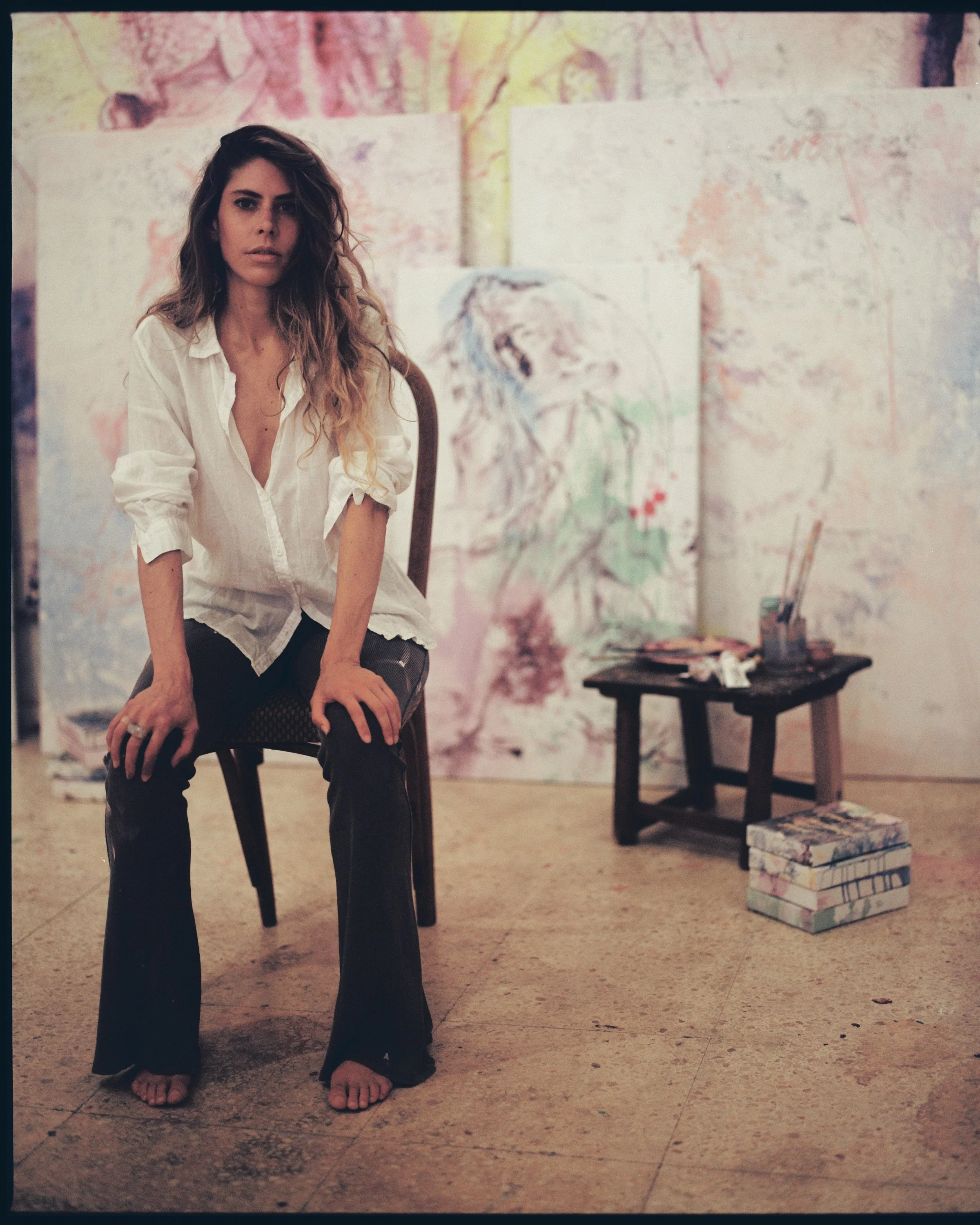
In Ibiza, Li Ramet has built a practice that exists in the spaces between body and matter, gesture and stillness, the visible and the deeply felt. Born in San Juan, Argentina, and trained across disciplines from fine arts to art therapy and photography, she approaches creation as an act of profound listening, allowing materials to become collaborators in an ongoing exploration of transformation and presence.
Moving fluidly between performance, installation, painting, sculpture, and photography, Li treats each medium not as a separate language but as a different register within a single conversation: one concerned with density and subtlety, with how the body negotiates space, and how energy moves through both physical and conceptual realms. As she prepares to release her first book this spring, a three-year collaborative project with curators, collectors, and thinkers, she stands at a compelling juncture.

How the conversation between body, matter, energy and space unfolds.
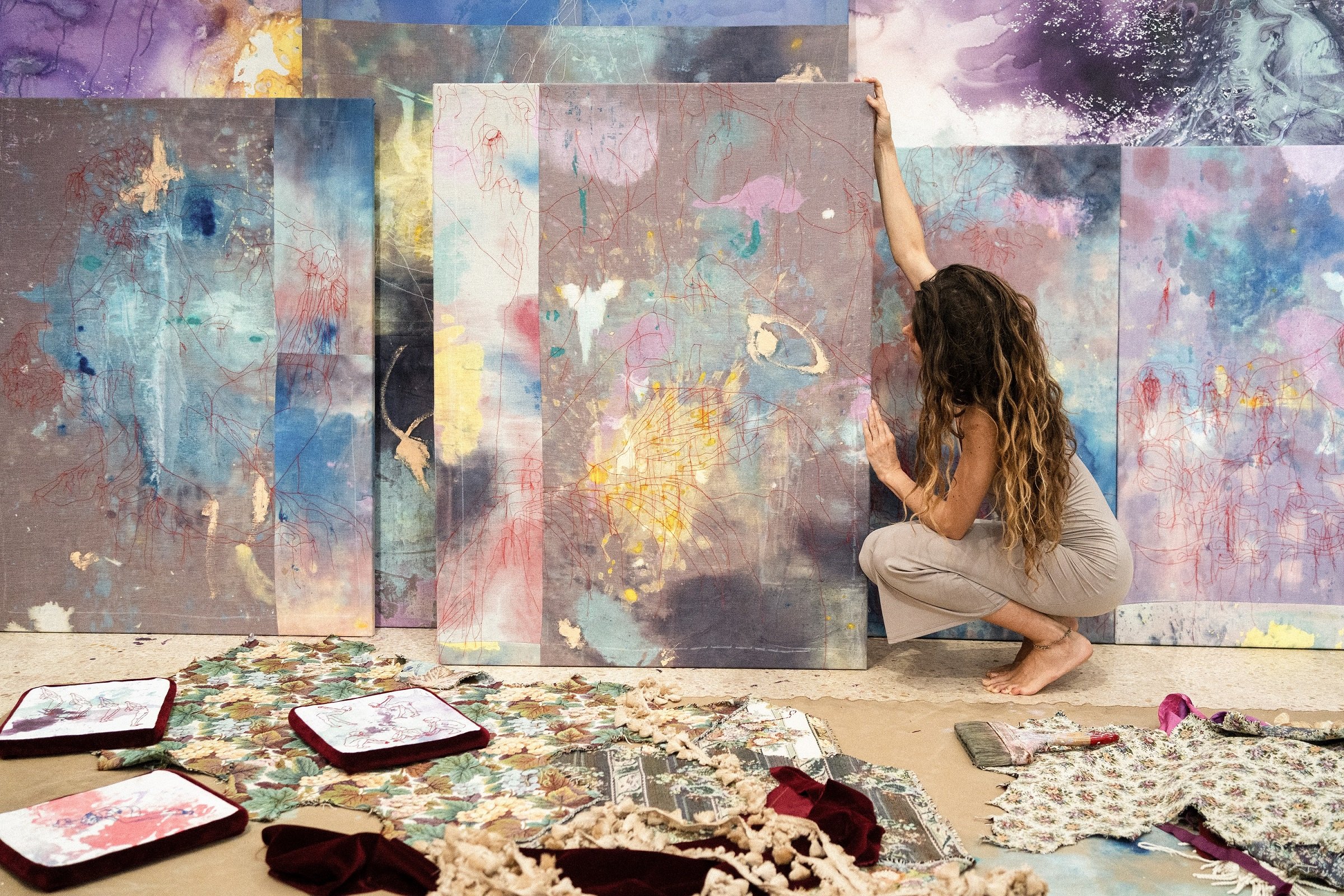
“In most cases, the process begins with the body. I experience a physical or energetic call that moves me into practice, an impulse that precedes thought. For me, creation is never a purely mental act. I often start by moving, preparing colors, arranging materials on the floor, or simply spending time in the space until something shifts.”
“At the same time, materials carry their own intelligence and memory. A certain fabric, pigment, or surface will insist on being used, guiding my gestures and decisions. Rather than imposing an idea onto the material, I try to remain in dialogue with it, allowing the work to emerge from the tension and harmony.”
“Creation is never a purely mental act. It begins in the body.”

On surrender, and letting the work find its form.
“There are moments, especially when I feel suspended or uncertain within a series, when I stop trying to decide and instead listen or observe. In those moments, a specific material seems to take over, offering a new direction that resolves the tension. Often, it is precisely through this surrender that the series finds its form and coherence.”
What draws you to objects that have already lived another life?
“I am deeply drawn to materials shaped by time. A piece of wood sculpted by water, wind, or sand already carries a history, and later maybe becomes part of a sculptural or installation ensemble. Other times it is something deeply personal, like a petticoat belonging to my grandmother, chosen for the story it holds or the texture of the fabric. These elements become intimate fragments within my tapestries, carrying memory forward in a quiet, tactile way.”
The artists, thinkers and traditions that shaped her.
Her references form a constellation rather than a linear lineage: artists like Louise Bourgeois, Hilma af Klint, Nancy Spero, Rebecca Horn, Graciela Iturbide and Camille Claudel; thinkers and poets from Marcus Aurelius and Julio Cortázar to Alejandro Jodorowsky, Carlos Castaneda and Taoism; the movement of Isadora Duncan, Valie Export and Ana Mendieta; and the cinema of Emir Kusturica, Agnès Varda and Stanley Kubrick.
A strong feminine and elemental energy.
“Ibiza influences my work in subtle and profound ways. The island carries a strong feminine and elemental energy that infuses my practice. Its light, landscapes, and natural rhythms shape how I work, while its multicultural, bohemian, and free-spirited community, marked by eccentricity and a certain glamour, creates an atmosphere of openness and possibility that continually feeds my imagination.”

Difficult emotions become the raw material.
“The past years have intensified my awareness of vulnerability, both personal and collective. These emotions are not external to my work, they form its raw material. Rather than offering answers, my practice has become a space for metabolizing these tensions. Through slowness, repetition, and attention, I allow difficult emotions to pass through the work and transform into something more porous and open. The act of creating becomes an alchemical process.”
“The work is not intended to create a bubble separate from reality. Instead, it seeks to open cracks within it, proposing other ways of sensing and feeling the world as it is, an invitation to sense that new worlds can be generated from within this one.”
“New worlds can be generated from within this one.”
Revealing the invisible dynamics when bodies gather.
“These shifts made me even more attentive to presence and shared space, while also sharpening my sense of responsibility toward all forms of life. My approach increasingly reflects a desire to rethink our relationship with nature, and to recognize the irregular, resilient intelligence of the world we inhabit.”
“I aim to reveal the invisible dynamics that arise when bodies gather, physically or energetically, and to question the blindness that often separates us from our deeper nature and our place within the living world.”
Antakly Projects, originally Ninu Nina, has been in conversation with the most inspiring voices in art, photography, design and culture since 2003. Interview by Leila Antakly. Li Ramet’s work maps the invisible architectures of human experience, and offers a moment of breathing within the conditions of contemporary life.
All works © Li Ramet. Photos by Clarissa Sofia, Ana G.Hernando, and Li Ramet. Thank you to Li for the conversation.
liramet.com → Instagram @li_ramet →
Explore the full Antakly archive →
And for the personal rants on life, opinions you didn’t ask for, and the occasional existential spiral: follow me on Substack. Follow us at @antakly.projects on Instagram.
Stay curious. ✦