Mayra vom Brocke: Forging Contemporary Painting from Childhood Surrealism and Artistic Rigor
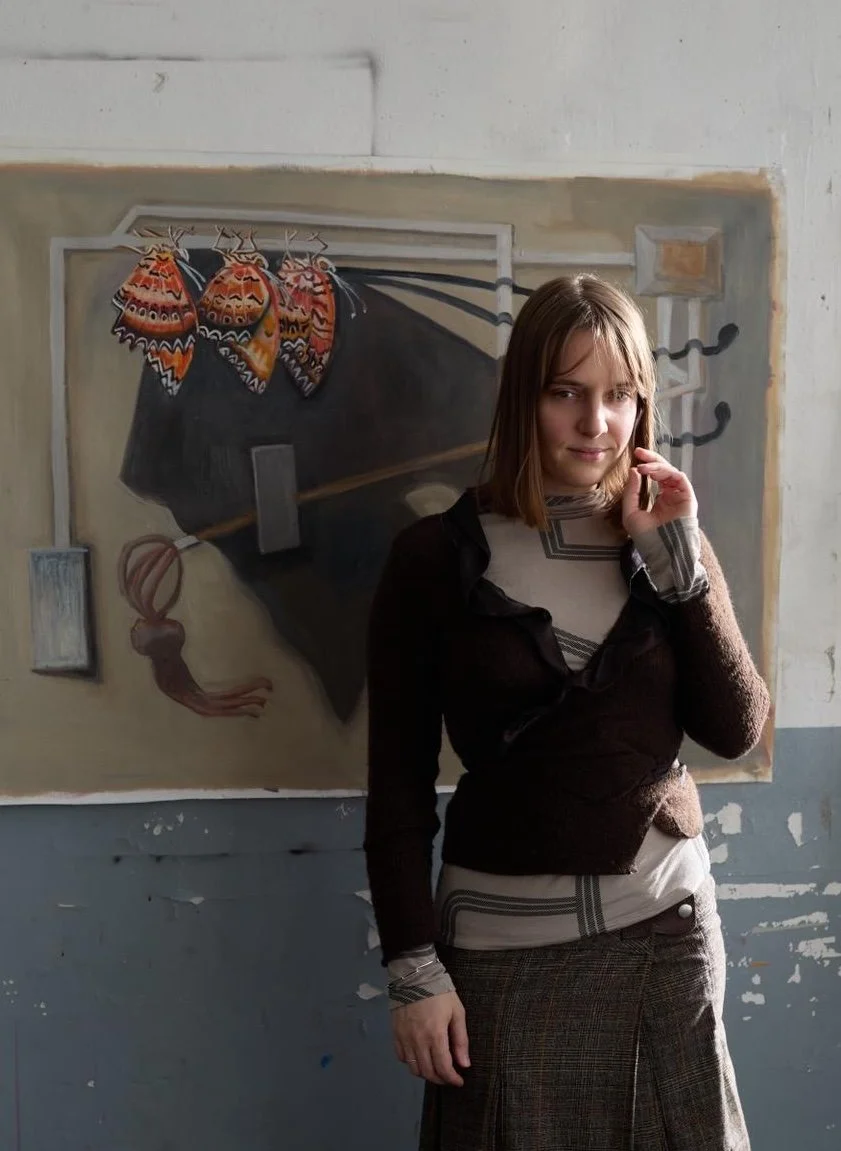
There's a particular kind of clarity that comes from harsh teaching. The sort that strips away pretense and forces an artist to confront their work without the cushion of subjective interpretation. For Mayra vom Brocke, this clarity arrived early, at fourteen, when her mother's legal work connected her with Alfredo Benavidez Bedoya, Argentina's preeminent printmaker and former director of the National Institute of the Arts. What began as an unconventional payment arrangement became a formative education in artistic rigor.
Mayra vom Brocke’s trajectory reads like a masterclass in artistic development: from those early sessions with Benavidez Bedoya, who taught her that authorship means accepting "the toughest of criticism, that being the critique of your own creation," through her mentorship with Pablo Siquier, who demystified the art market while refining her conceptual approach, to her studies at Universidad Torcuato DiTella's prestigious artist programme. But beneath this impressive institutional foundation lies something more visceral. An artistic sensibility shaped by her mother's bedtime readings of the Brothers Grimm and Maria Elena Walsh's subversive children's encyclopedias, where gender norms were quietly dismantled through hand-drawn illustrations and poetic definitions.
Drawing from the wells of Surrealism and Art Brut, Mayra's paintings possess a rawness that feels both deeply personal and universally resonant. Her three solo exhibitions to date reveal an artist unafraid of the vulnerability that comes with authorship, that inescapable responsibility her first teacher impressed upon her decades ago. Her work continues to explore the contemporary potential of painting, a medium she committed to after encountering Camille Henrot's Grosse Fatigue and Liv Schulman's Comercio Interior; two pieces she credits with transforming her understanding of art's possibilities in moments of creative doubt.
You've mentioned that Alfredo Benavidez Bedoya taught you that art isn't about subjective opinions—that there are concrete rules. How has that perspective shaped your practice, especially when working with Surrealism and Art Brut, movements often associated with breaking rules?
It's interesting because what he taught me wasn't about rigid formalism, but about understanding structure so deeply that you know exactly what you're doing when you break it. There's a difference between chaos that emerges from ignorance and chaos that's intentional. Surrealism and Art Brut aren't about abandoning craft—they're about channeling the subconscious through form. That foundation he gave me means I can trust my intuitions because I understand the language I'm working with.
You mentioned that Camille Henrot's Grosse Fatigue and Liv Schulman's Comercio Interior renewed your commitment to painting during moments of doubt. What about those works spoke to you?
They both deal with the overwhelming nature of information and existence in ways that feel deeply contemporary but also timeless. Grosse Fatigue especially this flood of creation myths and internet imagery colliding. It showed me that painting doesn't have to compete with new media; it has its own way of processing the chaos of contemporary life. Schulman's work operates in a similar space, questioning commerce and value in ways that feel urgent. They reminded me that painting can still do things that other mediums can't.
You've experienced both prizes and rejections throughout your career. How do you maintain resilience in the face of the latter?
Rejection is just part of the conversation. That sounds simple, but it took years to internalize. When you understand that your work is entering a dialogue, with history, with other artists, with viewers, then rejection becomes less personal and more contextual. Not every piece resonates with every moment or every audience, and that's okay. What matters is whether you're being honest in the work, whether you're pushing yourself. The resilience comes from knowing that the work needs to exist regardless of external validation.
Tell us about your creative process, from ideation to realizing a piece is finished.
My creative process is my search for sanity, though I don’t mean as art-therapy or a ‘wellness’ activity- it’s a non-optional treatment for obsession. I personally find obsessions can take hold quite easily, developing over almost anything, and it's through painting that I have a method to investigate these fixations. I don’t find it to be the theme that defines the depth of an artwork, but rather the approach to analysis. This notion, paired with the resistance reality excerpts on the creative process, is what I believe makes the process relevant. I see the object of appreciation as a device, a way of exploring and exhausting all of an idea’s semantic and ideological possibilities, it’s the politics that hides behind poetry. I’m sure that the mission of art is to demonstrate that ideas precede reality- it’s good to have ideas as a starting point, but for me ideas are proof that reality transcends imagination. To go beyond an idea and happen upon something that makes us say “wow, I couldn’t have imagined this”, that’s the magic of reality intercepting, and it shows reality isn’t necessarily something so black and white, so earnest.
I think when you see a work of art or hear about a concept that sounds too easy to understand, it’s probably ignoring the complexity of reality. Understanding the ‘particularity’ of a piece, the thing that makes it great on some level, demands going deep into a subject, drawing out the empirical and then assessing it from all possible perspectives. There are many ways of achieving the ‘particular’, I think mine is thinking of the worlds inside the paintings, and worlds inside those worlds- every centimetre of the painting is an opportunity to expand more on the narration of it.
Tell us about your upcoming solo show at NADA.
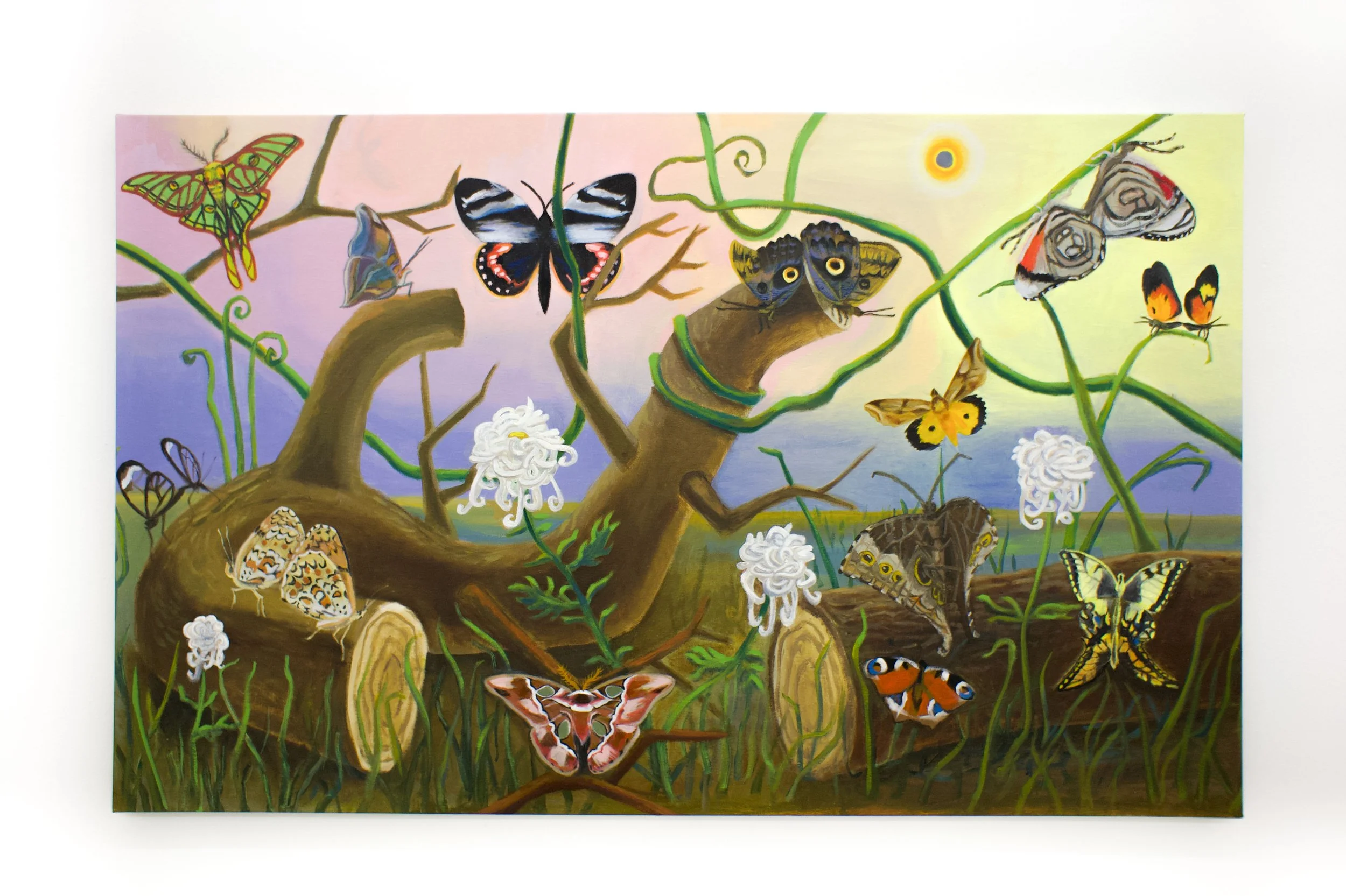
In my upcoming show at NADA, ‘No Tengo Ideas Mentales’, or ‘I Don't Have Mental Ideas’, my purpose is to synthesise and develop on from my recent show in Buenos Aires, “Somit or a fortunate life”. In this show I navigate the duality between two unrelated subjects within my life; butterflies and psychiatric medication.
My fixation on butterflies led to me getting in contact with entomologists and Lepidoptera collectors. Here I learned about the different forms of camouflages applied by butterflies and moths to deceive their predators; turning themselves into the glimmer of a leaf, the feather of a bird, the face of a poisonous animal or by letting the tail of their wings stay in the predator's mouth, similar to lizards. In this realm of what is and what is not, I began to understand myself as a channel for unlikely associations, between the altered perception created by my medication and the deceiving nature of the butterfly, revealing how easily our sense of discernment can shift, a core concern of the surrealists.
In this new series, I continue approaching the duplicity of the self, exploring the spectral elements that represent possible independent universes- in particular, the projection of the shadow. The light shed onto the butterflies passes over them; the capricious shape of the creatures, and the non-responsive shadow working as an independent entity, are my attempts to expose a small piece of unveiled reality, although you might have to look further than what you see on the surface to appreciate this. The veil of logic and morality is far less translucent than we imagine, in truth, it can be quietly deceiving.